What Is AI Transformation in Healthcare? Examples from Top Healthcare Companies, and How to Get Started
AI transformation in healthcare is the process of redesigning clinical and administrative workflows with AI at the core of how they operate, rather than adding AI tools on top of processes that already exist.
This is different from deploying individual AI tools, and different from the digital transformation health systems completed a decade ago.
Healthcare organizations that have completed AI transformation are seeing results across documentation, revenue cycle, and authorization workflows. In this guide, you'll learn what it means, what it covers, how leading health systems are doing it, and where programs commonly go wrong.
Quick answer: AI transformation in healthcare means rebuilding how workflows operate with AI at the center. AI adoption means adding AI tools to workflows that stay the same.
What Is AI Transformation in Healthcare?
AI transformation in healthcare is when a healthcare organization rebuilds its workflows around AI rather than inserting AI into workflows that already exist.
Here's how to see the difference. A hospital adds an AI scribe to its current documentation process. Physicians dictate, the AI transcribes, a staff member reviews, and the note gets filed. The workflow is the same with one step made faster. That's AI adoption.
Now consider a hospital that rebuilds documentation from the ground up. The AI listens to every encounter, generates a structured note in real time, files it to Epic pending a quick physician review, and surfaces billing codes automatically. The physician's role shifts from writing notes to reviewing them, charting time drops 40 to 45%, and notes become complete enough that coding accuracy improves and revenue capture shows gains within the first year.
That second version is AI transformation. The workflow itself has changed, and that change shows up in the financials.
How Is AI Transformation Different from Digital Transformation and AI Adoption?
These three terms get used interchangeably, but they describe meaningfully different stages of how healthcare organizations use technology.
| Digital Transformation | AI Adoption | AI Transformation | |
|---|---|---|---|
| What it means | Moving from paper and legacy systems to digital tools | Deploying AI applications on existing workflows | Rebuilding workflows with AI as the core operating layer |
| Example | EHR implementation, patient portals, telehealth | AI scribe, coding tool, scheduling chatbot | Agents running prior auth end-to-end; private clinical models handling documentation |
| Who drives it | IT department | IT and department heads | CIO, CMIO, and CFO aligned on shared outcomes |
| IP ownership | Vendor's | Vendor's | Your organization's |
| ROI timeline | 2 to 5 years | Variable, often none | 12 to 18 months for highest-ROI workflows |
Health systems today sit somewhere in AI adoption. They have an AI scribe, a coding assistant, maybe a patient scheduling chatbot, with each one purchased as a reasonable individual decision. The issue is that these tools sit in separate departments, on separate vendor platforms, without shared data infrastructure, so there's no compounding effect across the organization.
AI transformation asks a different question entirely: if we rebuilt this workflow from scratch with AI at the center, what would it look like?
What Does AI Transformation Cover in a Healthcare Organization?
AI transformation in healthcare spans three main areas. The workflows below are the highest-ROI starting points. Depending on your organization's vertical, data infrastructure, and operational priorities, the scope and sequencing will vary.
Clinical Operations
Clinical operations is where health systems typically begin, because the volume is high and the ROI is measurable within the first year.
The main workflows that AI is transforming in clinical operations are:
- Ambient documentation: AI listens to patient encounters, generates structured SOAP notes in real time, and files them to the EHR. Physicians review and confirm rather than draft from scratch, removing one of the primary drivers of clinician burnout.
- Clinical summarization: Before a specialist sees a patient with a complex history, AI synthesizes the full clinical record into a structured brief, saving 20 to 30 minutes of chart review per encounter.
- Coding and charge capture: AI reads completed clinical notes and suggests ICD-10 and CPT codes, with low-confidence suggestions flagged for human review. Errors get caught before claims go out rather than after a denial comes back.
- Clinical decision support: AI converts complex clinical guideline documents into structured decision logic and surfaces ranked treatment recommendations at the point of care. For example, HxAI built this for a large public health system in South Florida, where an agentic system converts MOFFIT oncology guideline PDFs into deterministic pathway logic and returns explainable treatment recommendations based on pathology and biomarker inputs.
- Care gap closure: AI identifies patients overdue for specific interventions, generates personalized outreach, and logs every touchpoint in the EHR. For health systems in value-based care contracts, this directly affects quality metrics and reimbursement.
Revenue Cycle and Administrative Operations
AI is transforming healthcare revenue cycle operations faster than nearly any other area. The reason is straightforward: the workflows are well-defined, the outcome metrics already exist, and the ROI lands within 12 months.
The core workflows are:
- Prior authorization: An AI agent detects the prior auth requirement at the moment an order is placed, reads the clinical documentation, checks the payer's current policy requirements, assembles the submission packet, and submits via FHIR API. Staff handle only the exceptions the agent cannot resolve.
- Denial management: AI monitors denied claims in real time, identifies the reason code, pulls supporting documentation from the EHR, drafts the appeal letter, and routes it to a specialist for final review. The specialist handles judgment calls while the agent handles the research and drafting.
- Eligibility verification: AI runs insurance checks before appointments automatically, flags coverage issues before they become denials, and surfaces specific benefit details so staff can have accurate conversations with patients upfront.
- HCC and RAF accuracy: For Medicare Advantage plans, AI reads through encounter notes, problem lists, and lab results to surface chronic conditions that meet HCC criteria but haven't been coded. It maps the evidence to specific ICD-10 codes and presents suggestions to coders for review.
- Collections and billing: AI works collections queues across payer portals and patient accounts, prioritizing by recovery likelihood and escalating complex cases to human staff.
See Agent Hero in action for RCM workflows
HxAI builds prior authorization and denial management agents on Agent Hero, a HIPAA-compliant agentic infrastructure platform. 21 of the top 30 US post-acute providers run their operations on it.
Thanks - we'll be in touch soon
Our team usually responds within one business day.
Technology and Data Infrastructure
AI transformation doesn't only sit on top of your existing technology. It requires rebuilding parts of the foundation that clinical and financial workflows depend on.
The three main areas are:
- FHIR interoperability: For AI agents to read clinical notes, check payer policy, and submit prior auth packets via API autonomously, the data layer must support real-time read and write access across the EHR, payer systems, and data warehouse. Without it, agents can't operate without manual steps at every handoff.
- Legacy modernization: A lot of healthcare software was built before AI agents were a realistic operating assumption. AI-native architecture means building systems where agents function as first-class users alongside humans from day one, rather than retrofitting three years later. HxAI builds this on Anticlock AI, an agentic software delivery platform.
- Private AI infrastructure: For organizations where PHI data sovereignty is a firm requirement, a private language model deployed inside your own environment means protected health information never reaches an external API. SLM in a Box is HxAI's private clinical language model, deploying in 6 to 8 weeks with full ownership transferring to your organization.
HxAI has run this across health systems, payers, pharma companies, and HealthTech vendors spanning 17 verticals. We know which workflows produce results fastest and what the data foundation needs to look like to support them. If you want that applied to your organization, a strategy call is where it starts.
How Are Health Systems Approaching AI Transformation Right Now?
Some of the best-documented examples in the US show a consistent pattern: start with one workflow, build the shared infrastructure underneath it, then use that foundation to expand.
Mass General Brigham
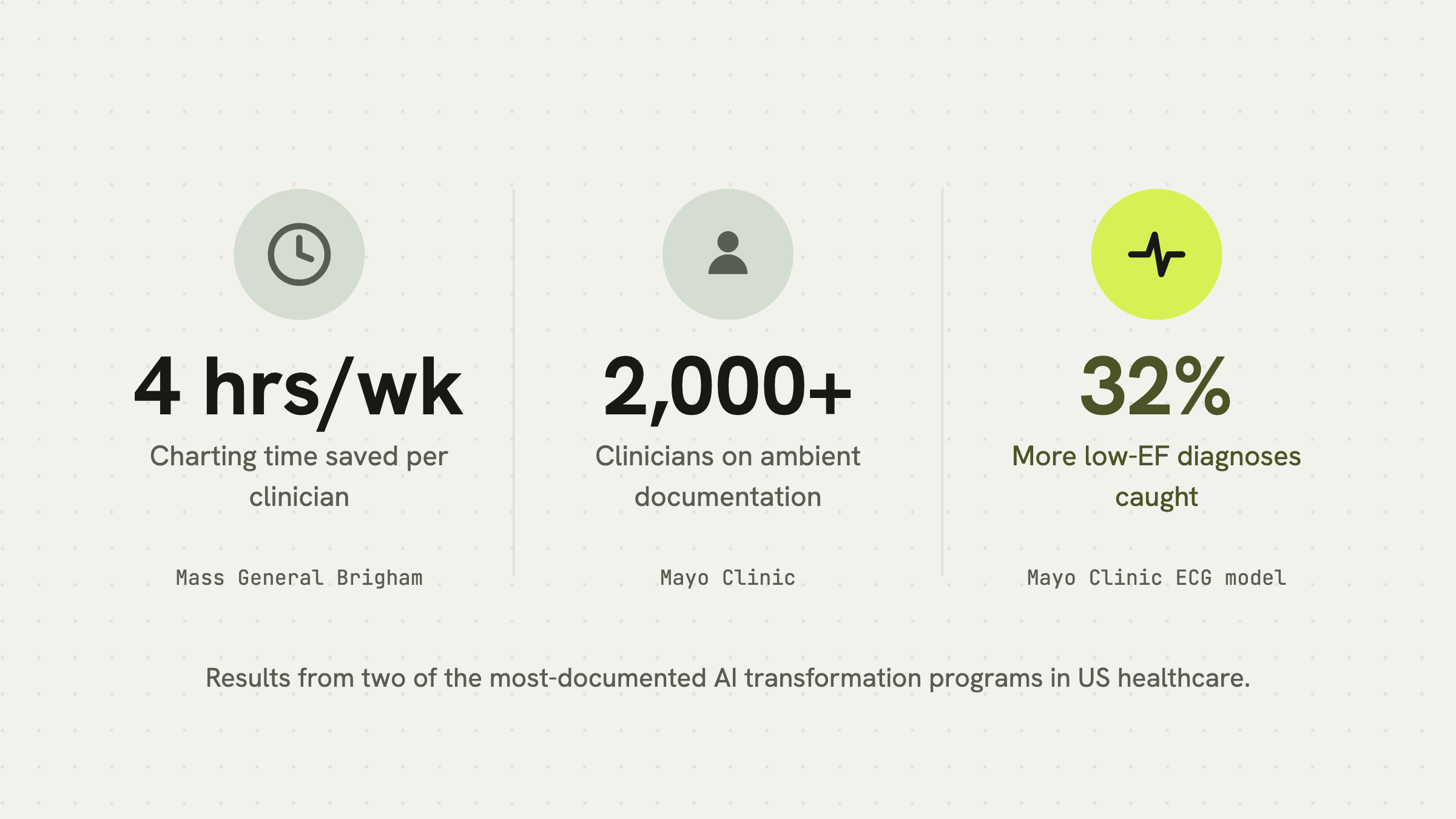
MGB started with clinical documentation. They deployed ambient AI scribes and measured the outcome carefully. According to a Mass General Brigham study, scribes saved approximately 4 hours per clinician per week in charting time. For a system with hundreds of physicians, that translates to tens of thousands of hours of clinical capacity recovered annually.
What they did next is what made it AI transformation rather than AI adoption. Instead of treating documentation as a standalone tool, MGB used it as the foundation for broader AI infrastructure: governance frameworks, data architecture, and compliance structures that could support the next workflow. That compounding effect, where each deployment builds on the infrastructure already in place, is the defining characteristic of AI transformation.
Mayo Clinic
Mayo Clinic started with two discrete AI applications. First, an FDA-cleared ECG model that increased new low ejection fraction diagnoses by 32% by embedding it into routine primary care. Second, an enterprise rollout of ambient documentation to more than 2,000 clinicians since January 2025.
What they're building now goes further. According to a 2026 report on hospitals using AI, Mayo is deploying Google Vertex AI Search to query their entire EHR and imaging system in natural language, so a physician can ask a question and get an answer synthesized from the full clinical record. That's no longer separate tools on separate workflows. It's a connected AI operating layer across the organization.
Element5 (built by HxAI)
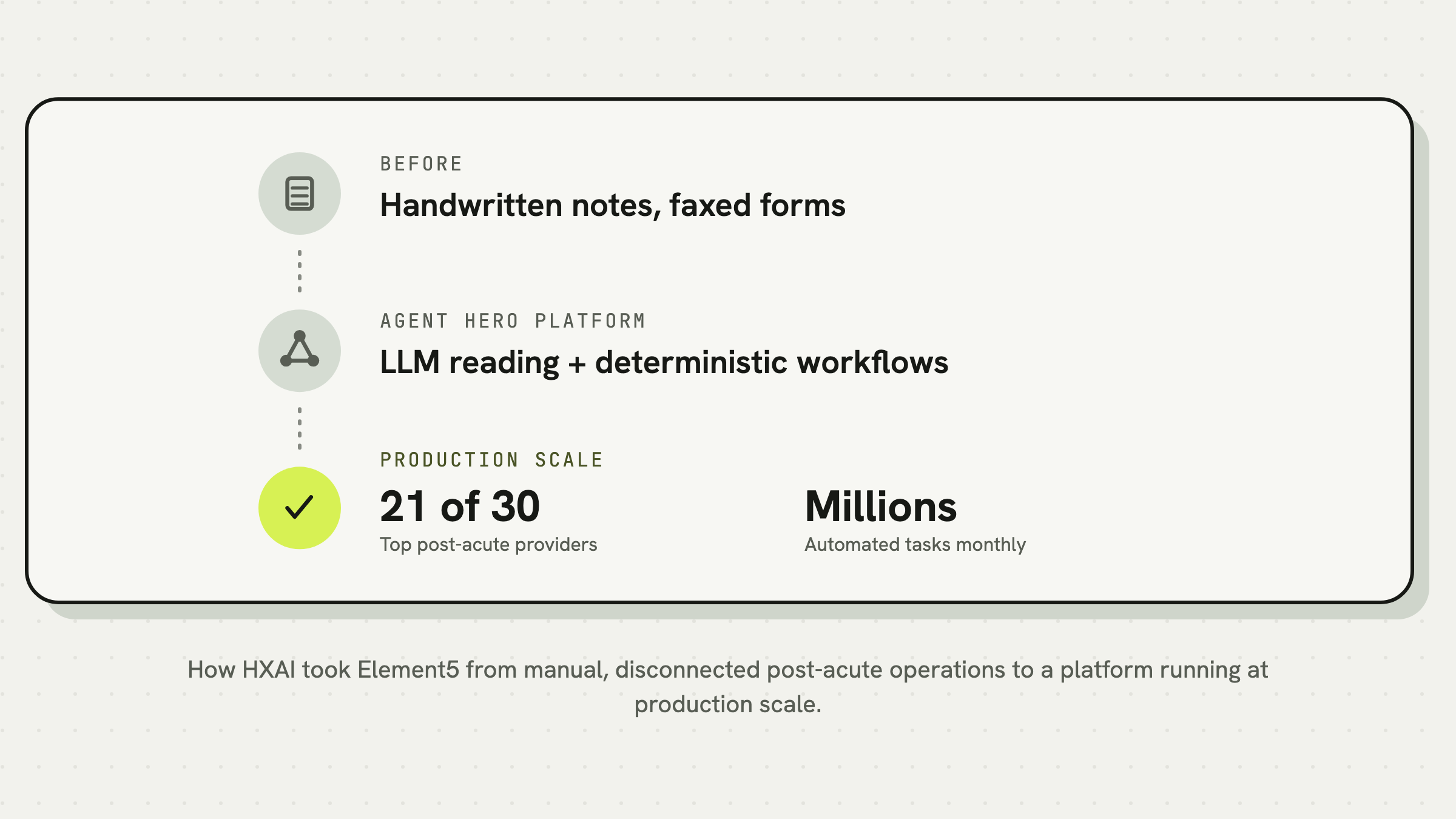
Element5 came to HxAI with post-acute healthcare operations running on manual, disconnected processes across eligibility, authorization, and revenue cycle. Handwritten physician notes, faxed prior auth requests, and scanned eligibility forms defeated every rule-based system they had tried.
HxAI built their automation platform end-to-end on Agent Hero. The platform included LLM-powered document comprehension for unstructured clinical records, a pre-built RCM workflow library, and a deterministic control architecture so agents operated reliably at production volume. Today, 21 of the top 30 post-acute providers in the US run their operations on that platform, processing millions of automated tasks monthly.
What Results Are Healthcare Organizations Actually Seeing?
Based on documented production deployments and published industry research, here are the numbers health systems are reporting across the core AI transformation workflows.
| Workflow | Metric | Reported Outcome | Source |
|---|---|---|---|
| Clinical documentation | Charting time reduction | 40 to 45% | Mass General Brigham |
| Clinical documentation | Time saved per clinician, per week | ~4 hours | Mass General Brigham |
| Clinical documentation | Year-one revenue capture improvement | 10 to 15% | Bessemer Venture Partners |
| Clinical documentation | US health systems piloting AI scribes | 92% | Industry data, 2025 |
| Prior authorization | Staff hours saved annually | 2,841 hours | HFMA |
| Prior authorization | Direct cost savings | $644,000 | HFMA |
| Prior authorization | Clean submission rate achieved | 83% | HFMA |
| Prior authorization | Authorization turnaround time reduction | 80% | HFMA |
| Prior authorization | Annual staff cost recovery (5,000 auths/month) | $1.5M to $2M | Taction |
| Prior authorization | Additional revenue from approval rate gains | $2M to $8M | Taction |
| Denial management | Claim denials that are avoidable | 86 to 90% | Industry research |
| Denial management | Denial rate reduction in mature deployments | 30 to 40% | Industry research |
| HCC / RAF accuracy | Added capitation per 0.5pt RAF, 50K-member MA plan | $5M to $10M/year | Industry benchmarks |
Why Is Healthcare AI Transformation Harder Than It Looks?
Transforming healthcare with AI takes more than deploying the right model. These are the four problems that trip programs up.
1. Legacy data is messier than expected
Healthcare data is not clean, structured tables. It's handwritten notes, faxed forms, scanned documents, and lab results in multiple formats. Before AI agents can work reliably at production volume, the data layer has to handle all of it. Organizations that underestimate this phase reliably experience it as a major delay during the build.
2. HIPAA compliance is architecture, not paperwork
A signed BAA is necessary but not sufficient. HIPAA-compliant AI means the system was designed from the start for PHI to be handled correctly at every component, including:
- Data encrypted in transit and at rest
- Role-based access controls limiting what each system can read and write
- Immutable audit logs capturing every agent action with full provenance
- BAAs with every vendor in the stack that processes PHI
- For high-sensitivity use cases, PHI never reaching an external API
Getting this wrong in production is expensive and often requires rebuilding from the infrastructure level.
3. Pilots don't predict production
A prior auth pilot on 200 cases a month behaves differently from a production system handling 5,000. Edge cases multiply rapidly at scale. Payer-specific policy variations that never appeared in the pilot begin showing up constantly. The monitoring and exception-handling infrastructure that wasn't needed at pilot volume becomes critical. Organizations that design pilots without a clear path to production scale frequently rebuild.
4. Domain knowledge is non-negotiable
A general-purpose AI company doesn't know that a specific commercial payer's prior auth policy for specialty drugs changed last month, that a particular ICD-10 combination triggers an HCC flag, or that denial reason code CO-4 requires a different appeal strategy than CO-5. At production scale, healthcare-native domain knowledge is the difference between an 83% clean submission rate and something much lower.
What Does an AI-Native Healthcare Organization Actually Look Like?
The changes that define an AI-native healthcare organization run across how teams operate, what the cost structure looks like, how decisions get made, and where competitive positioning lands over time.
AI runs across teams simultaneously, not just in one department
- Clinical, financial, and operational functions draw on the same underlying infrastructure rather than running disconnected point solutions with separate data, separate governance, and separate vendor relationships.
- A single workflow improvement in one function produces downstream benefits across others. Better clinical documentation improves coding accuracy, which improves claim submission quality, which reduces denial rates, without each team running a separate AI initiative to get there.
- Governance, compliance, and change management happen once at the infrastructure level rather than being rebuilt for every new deployment across every team.
- Leadership gets a unified view of AI performance across the organization, rather than managing a fragmented portfolio of tools that each report their own metrics in their own formats.
The cost structure of clinical and administrative operations shifts permanently
- The marginal cost of processing an additional unit of work, whether an authorization, a claim, a clinical note, or a member inquiry, falls significantly once AI is handling the volume.
- Fixed costs that previously scaled with headcount, including recruitment, training, supervision, and attrition, reduce as a proportion of operational spend.
- Infrastructure costs are owned rather than rented. The organization is not paying per seat, per transaction, or per API call to a vendor whose pricing it does not control.
- Technology spend consolidates around a shared platform rather than accumulating across an expanding portfolio of single-purpose tools.
Decisions get made on the organization's complete data, processed in real time
- Clinical, financial, and operational decisions draw on the full dataset continuously, rather than on the subset available through periodic manual reporting.
- The lag between what the organization knows and what it acts on closes, because AI surfaces signals in real time rather than on reporting cycles.
- Risk is identified earlier across clinical quality, financial exposure, and regulatory compliance because the systems monitoring for it never stop running.
The organization becomes structurally harder to compete with over time
- Every workflow that runs in production adds to the organization's institutional intelligence, which compounds rather than resetting.
- Entering new service lines, markets, or care arrangements requires less operational buildup each time because the infrastructure, the compliance architecture, and the integration layer carry forward.
- Expertise encoded in systems persists through team changes, restructuring, and growth, rather than walking out with the individuals who built it.
- The gap between an AI-native organization and one still assembling point solutions widens with each passing quarter, because the AI-native organization is compounding while the other is still catching up.
How Do You Actually Start with AI Transformation in Healthcare?
Data readiness: Your data foundation determines what AI can reliably do inside your organization. Clinical records, claims data, operational systems, and payer feeds each need to be mapped for accessibility, completeness, and format before any program is scoped. Organizations that skip this step build on unstable ground.
Leadership alignment: AI transformation touches clinical, financial, and technology functions at the same time. Getting the right leaders committed to the same problem statement and the same outcome metrics before anything is built is what separates programs that scale from ones that stall the moment they cross an organizational boundary.
Workflow selection: Starting narrow is what makes transformation compound. The right first workflow is where the pain is already quantified, the stakeholders are ready to move, and the data can support a production build without prerequisite projects running in parallel.
Integration landscape: The platforms AI needs to connect to shape every architecture decision that follows. Understanding your EHR environment, payer connectivity, and data infrastructure early prevents the surprises that consistently push timelines and budgets.
Governance: PHI handling, clinical workflow approvals, and exception escalation paths need to be built into the architecture from the start. Every organization that has tried to retrofit governance after deployment has found it significantly harder and more expensive than building it in upfront.
Talent: AI transformation requires people who understand the domain deeply enough to know when the system is wrong. Building internal capability alongside the technology program determines whether the organization can own, operate, and improve what gets built after the engagement ends.
Ownership: Infrastructure control, data rights, and model ownership are decisions that need to be made at the start of any engagement. The organizations that build compounding AI capability own what they build outright, with no licensing dependencies and no lock-in to a vendor's platform.
Measurement: Setting outcome metrics before selecting a partner or platform changes the quality of every decision that follows. It holds every party accountable to results rather than deliverables and gives leadership a clear basis for deciding whether to scale.
HxAI runs a structured assessment across all eight dimensions in the first four weeks of every engagement, producing a 90-day blueprint and a board-ready business case before any build begins. Book a free strategy call →
Get your 90-day blueprint started
Tell us the workflow you're accountable for. We run the eight-dimension assessment in the first four weeks and come back with a board-ready business case before any build begins.
Thanks - we'll be in touch soon
Our team usually responds within one business day.
Frequently asked questions
RPA follows fixed rules and breaks on unstructured inputs like faxed forms or handwritten notes. Agentic AI handles those naturally, adapts when payer policies change, and takes multi-step actions across systems without human reprogramming.
Smaller health systems often move faster because they have fewer legacy systems and shorter decision cycles. The ROI percentages and payback timelines are similar regardless of size.
Set your outcome metrics before the build starts. Here are the key ones by workflow:
- Prior authorization: Turnaround time, clean submission rate, denial rate, and staff hours per authorization
- Clinical documentation: Charting time per clinician, after-shift documentation time, and downstream coding accuracy
- Denial management: Denial rate, appeal win rate, and days in accounts receivable
- HCC coding: RAF score accuracy, conditions surfaced per chart review, and coder review time per suggestion
Five questions worth asking:
- Can you share references from health systems with production deployments and measurable results?
- How does your system handle a specific payer edge case for one of our service lines?
- Who owns the infrastructure, models, and data at the end of the engagement?
- Walk me through your HIPAA architecture at the component level.
- Are your milestones tied to business outcomes or project deliverables?
When PHI cannot leave your environment under any circumstances, whether for regulatory, board-level, or contractual reasons. HXAI's SLM in a Box deploys inside your infrastructure in 6 to 8 weeks with full IP ownership transferring to your organization.
- Mass General Brigham ambient AI scribe outcomes study: massgeneralbrigham.org
- HFMA prior authorization AI deployment data: hfma.org
- Bessemer Venture Partners healthcare AI revenue capture research: bvp.com
- Taction prior authorization ROI benchmarks: taction.ai
- Top hospitals using AI in 2026, including Mayo Clinic programs: getprosper.ai
