AI Value Creation in Healthcare Private Equity: The Ultimate Playbook for Operating Partners
Healthcare PE is under more pressure to generate operational value than it has been in years. Multiple expansion is narrowing, hold periods are stretching, and LP expectations around AI have risen sharply.
According to Bain's 2025 research, 80% of PE-backed portfolio companies have not operationalized AI use cases delivering measurable returns. McKinsey's 2026 data shows that 70% of GPs expect AI to deliver high impact within three to five years, while only 6% report seeing it today. The gap between expectation and execution is the core problem this playbook addresses.
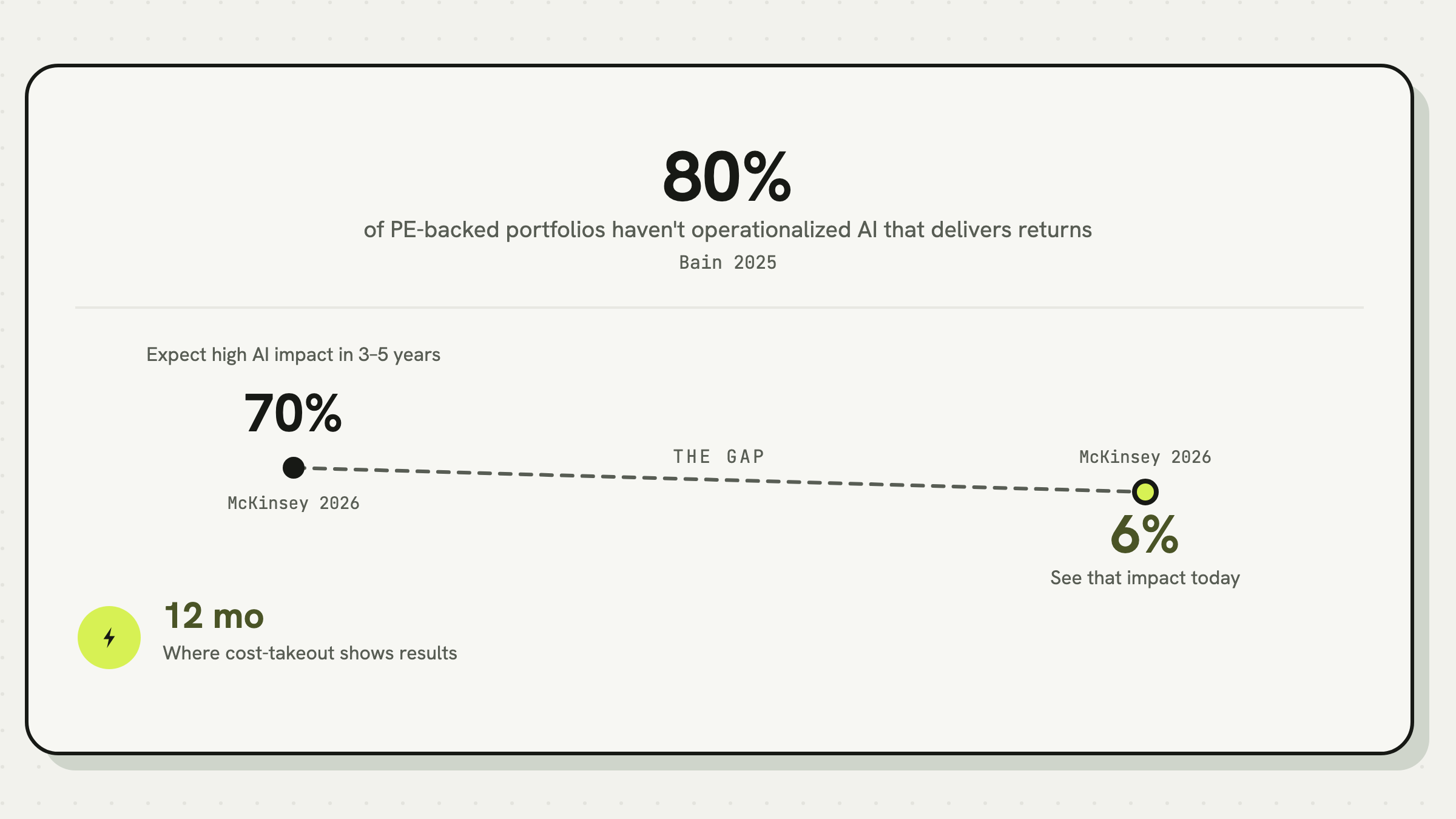
This guide covers what AI value creation in healthcare PE means, what options exist, what operating partners and portfolio companies should each do, and how to get a fundable use case in front of the board within 90 days.
Quick answer: AI value creation in healthcare private equity is the process of building EBITDA and exit multiples through systematic AI deployment across healthcare portfolio companies. It covers three levels: cost reduction through workflow automation (shows up in 12 months), operational transformation through AI-native process redesign (shows up in 18 to 30 months), and proprietary data assets (shows up in exit multiples). The funds generating real returns are running all three simultaneously, not sequentially.
What Is AI Value Creation in Healthcare Private Equity?
AI value creation in healthcare private equity refers to the specific mechanisms through which PE funds use AI to grow EBITDA and build exit value in their healthcare portfolio companies.
It is different from general AI adoption. The goal is not to deploy AI tools or run pilots. The goal is to generate measurable financial outcomes: reduced operational costs, improved revenue capture, higher quality scores, and defensible data assets that the next buyer pays a premium for.
In healthcare specifically, AI value creation happens across three areas:
- Fund operations: Using AI to improve how the fund itself runs: LP reporting, portfolio monitoring, deal sourcing, and diligence. This is where the fastest ROI lives and the most consistently underinvested area in PE AI programs.
- Portfolio company operations: Deploying AI agents into the clinical and administrative workflows of healthcare portfolio companies to reduce cost and improve revenue capture.
- Portfolio company capabilities: Building owned AI infrastructure and proprietary clinical data assets that create defensible competitive advantage and command a premium at exit.
The distinction between value creation and tool deployment matters because the vast majority of AI spend in PE portfolios is going into the third category of generic tools: productivity copilots, document summarizers, meeting assistants. According to BCG's 2025 Global Study of 1,250 companies, approximately 60% of organizations have yet to realize measurable EBITDA impact from AI. That is because generic tools produce generic productivity, which the next buyer will price as baseline.
The funds producing real returns are investing in AI that is specific to their portco's workflows, that the portco owns outright, and that builds data assets that compound over the hold period.
Why Healthcare PE Needs a Different Approach to AI
PE AI programs built for industrial or services portfolios do not transfer cleanly to healthcare. Three structural differences change how everything works.
Healthcare compliance changes the architecture
- Every AI system touching clinical workflows or billing records operates inside a compliance environment that does not exist in other sectors
- This shapes the technical design from day one and determines which vendors can operate at production scale in healthcare
- Horizontal AI firms consistently underperform in healthcare portco deployments because they build the software first and discover the compliance requirements later
Domain knowledge determines production performance
- The gap between an AI demo and production performance in healthcare is almost always a domain knowledge gap
- Healthcare-native programs, where teams understand payer criteria, documentation standards, and coding logic, consistently outperform generic AI deployed in healthcare settings
- This knowledge takes years to build and cannot be learned mid-engagement at a client
Regulatory timelines create urgency windows
- CMS rule cycles, Medicare Advantage risk model transitions, and prior authorization mandate timelines are predictable
- Funds that plan around them build advantage; those that react to them absorb cost
- This is structurally different from other PE sectors, where regulatory calendars are slower-moving and less directly tied to revenue
What Types of AI Value Can Healthcare PE Funds Create?
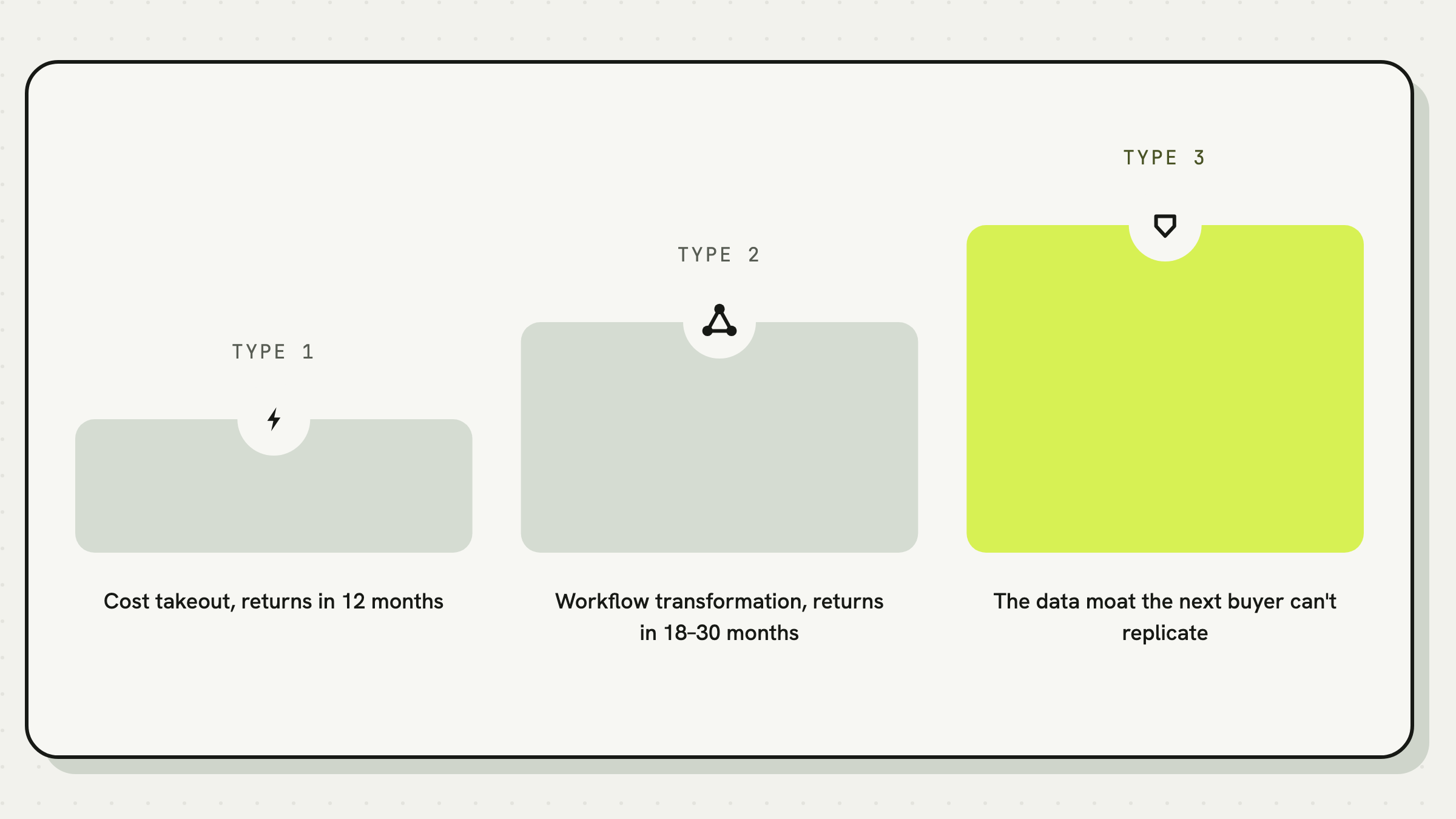
There are three types of AI value available in a healthcare portfolio, each with a different return profile and time horizon.
Type 1: Cost takeout (returns in 12 months)
The fastest path to EBITDA runs through high-volume, rules-based administrative workflows. In healthcare portfolio companies, this means prior authorization processing, clinical documentation, denial management, and coding. These workflows have high headcount, measurable cost per transaction, and well-defined inputs and outputs that make them strong candidates for agentic automation.
Expected financial outcomes:
- Prior authorization: 80% reduction in turnaround time, $1.5M to $2M annual staff cost recovery for a portco running 5,000 authorizations per month (Taction 2026)
- Clinical documentation: 40 to 45% reduction in physician charting time, 10 to 15% revenue capture improvement in year one (Bessemer VP 2026)
- Denial management: 30 to 40% denial rate reduction in mature deployments (HFMA 2026)
- HCC coding under V28: $5M to $10M additional capitation per 0.5-point RAF improvement for a 50,000-member Medicare Advantage plan
Type 2: Workflow transformation (returns in 18 to 30 months)
Type 2 goes deeper than automating existing workflows. It redesigns the workflow itself around AI. Revenue cycle operations that previously required large teams now run with smaller teams focused on exceptions. Prior authorization becomes an automated process rather than a queue. The portco's operational cost structure changes permanently.
This is where switching costs and defensibility get built. A portco running its revenue cycle on AI infrastructure it owns is structurally harder to displace than one using three point-solution vendors. General partners focused on asset operations achieve IRR 2 to 3 percentage points higher than peers who depend on multiple expansion, according to McKinsey's PE value creation analysis.
Type 3: Proprietary data assets (shows up at exit)
The highest-durability AI value comes from building data assets that the next buyer cannot replicate by deploying a vendor tool. A portco that has been accumulating proprietary clinical data for three years, with AI systems trained on that data, has a moat. A portco running off-the-shelf AI tools has table stakes.
This investment starts at the beginning of the hold, not after Types 1 and 2 are complete. The funds that stall typically invest heavily in cost takeout, partially in workflow transformation, and almost not at all in data asset accumulation. The result: margin expansion without multiple expansion.
What AI Options Are Available to Healthcare PE Funds and Their Portfolio Companies?
Four categories of AI partner exist for PE-backed healthcare portcos. These four options are not interchangeable. Each delivers a different type of value at a different cost, timeline, and IP model.
| Option | What it delivers | Where it falls short | Best for |
|---|---|---|---|
| Horizontal AI tools (ChatGPT Enterprise, Copilot, Glean) | Generic productivity across individual tasks: drafting, searching, summarizing | No measurable P&L impact; table stakes at exit | All portcos as baseline deployment |
| Clinical point solutions (Abridge, Cohere Health, SmarterDx) | Specific workflow automation with fast Horizon 1 results | No IP transfer; portco licenses the vendor's platform, not its own capability | Fast cost takeout returns where FHIR architecture already exists |
| Full-stack AI transformation partners (HxAI) | Owned agentic infrastructure, IP transfers at completion, Layer 2-3 value creation | Requires structured upfront assessment | workflow transformation and data asset value: the work that shows up at exit |
| Strategy consultants (BCG, McKinsey, Bain) | AI strategy frameworks, market benchmarks, investment thesis framing | Strategy without implementation; roadmap delivered, execution gap remains | IC-level framing and competitive positioning |
A note on selecting the right option per portco: The right partner depends on where the portco sits in the value creation plan. Portcos targeting fast cost takeout can use clinical point solutions if the compliance architecture is already sound. Portcos building toward workflow transformation and data asset accumulation need a full-stack partner who builds infrastructure they own. Funds that create the highest-durability returns typically use a combination: horizontal tools for baseline AI fluency across all portcos, point solutions for specific fast wins, and a full-stack partner for the portcos where workflow transformation and exit multiple expansion is the goal.
See how full IP ownership works for your portfolio
HxAI is a full-stack healthcare AI transformation partner covering all 17 US healthcare sub-sectors. Every engagement is outcome-based, with full IP ownership transferring to the portco at completion.
Thanks - we'll be in touch soon
Our team usually responds within one business day.
How Should Operating Partners Build the Portfolio AI Program?
The operating partner's job in a healthcare PE AI program is not tool selection. It is sequencing, governance, and accountability for outcomes across the portfolio.
Prioritize which portcos to start with
Not every portco is ready for an AI deployment on day one. Before scoping anything, rank your portfolio companies against five criteria:
- Data infrastructure maturity: Which portcos have the cleanest, most accessible operational and clinical data? A portco with structured EHR data in an API-accessible format can deploy in 90 days. One with scanned PDFs and manual workflows needs data infrastructure work first.
- Hold period timeline: Portcos with more runway have room for Horizon 2 and Horizon 3 investment. Portcos approaching exit need Horizon 1 ROI that is already showing in the financials.
- Workflow volume and revenue at stake: High-volume administrative workflows (prior auth, denial management, documentation, HCC coding) have the largest EBITDA at stake and the clearest build pattern. Start where the numbers are biggest.
- Leadership alignment: The portco CEO, CFO, and relevant clinical leader need to be committed to the AI program before any build starts. Portcos where leadership is ambivalent stall at the change management stage regardless of how good the technology is.
- Return potential vs. complexity: Start with the portcos where EBITDA impact is high and technical complexity is low. These fund the program and build the internal credibility to tackle harder deployments later. These fund the program and build the internal credibility to tackle harder deployments.
The first two portcos you deploy in also build the shared infrastructure: FHIR integrations, HIPAA architecture, and agent monitoring stack. Every subsequent deployment runs on this foundation. Choose them carefully.
At the fund level:
- Conduct AI readiness assessments for all portcos within 90 days of acquisition: understand what each company's data infrastructure can support before scoping anything
- Build shared infrastructure once (FHIR integrations, HIPAA architecture, agent monitoring stack) and deploy across portcos rather than rebuilding at each company
- Deploy fund-level AI operations: LP reporting automation, real-time portfolio KPI monitoring, and deal intelligence agents
- Embed AI outcome metrics into 100-day plans and quarterly board reporting alongside operational KPIs
- Negotiate portfolio-wide AI vendor agreements to use portfolio-wide pricing agreements
At the portfolio company level:
- Align clinical and operational leadership on any workflow AI touches before the build starts
- Define outcome metrics before selecting any vendor: prior auth turnaround time, denial rate, RAF accuracy, charting time per clinician
- Ensure portco executives own the AI program, not the IT department
- Track AI outcomes in the same management report as all other operational KPIs
- Run staged rollouts with defined exception handling paths before going to full production volume
The firms creating measurable EBITDA impact are closing the execution gap before hold-period value begins to erode. The strategy exists and the use cases exist. What is missing is the engineering execution layer that converts a value creation plan into a sprint backlog before the hold period closes.
What Should Each Portfolio Company Type Do?
The AI program looks different depending on the portfolio company's sub-sector. Here is what each type should prioritize.
Providers and Post-Acute Portfolio Companies
High-volume administrative workflows make providers and post-acute operators the clearest starting point in a healthcare portfolio.
Build first:
- Prior authorization agents: Connect to payer systems via FHIR API, check payer-specific criteria, and submit authorizations automatically. 80% turnaround reduction, 83% clean submission rate in production deployments.
- Denial management agents: Read denied claims, identify reason codes, assemble documentation, draft appeals, route to reviewer. 30 to 40% denial rate reduction in mature deployments.
- Ambient clinical documentation: Capture spoken encounters and generate structured SOAP notes. 40 to 45% charting time reduction, 4 hours per clinician per week (Mass General Brigham).
- Coding and charge capture: Read completed notes, suggest ICD-10 and CPT codes with confidence scoring. 10 to 15% revenue capture improvement in year one.
Build toward: A revenue cycle infrastructure the portco owns outright, processing prior auth, managing denials, handling coding, and monitoring payer policy changes continuously. This is what distinguishes the exit story.
For example, HxAI built the agentic RCM platform behind a PE-backed post-acute technology company that came in with manual workflows, handwritten notes, and faxed prior auth requests. The company now processes millions of automated tasks monthly and runs operations for 21 of the top 30 US post-acute providers.
Payer and Health Plan Portfolio Companies
Payer portcos have two parallel revenue-critical programs: risk adjustment accuracy and quality performance.
Build first:
- HCC identification under V28: Surface conditions that meet V28 criteria but are not yet submitted. $5M to $10M in additional capitation per 0.5-point RAF improvement for a 50,000-member Medicare Advantage plan.
- HEDIS care gap outreach: Identify open measures, generate personalized member outreach, track responses. Up to $17M quality bonus for a 100,000-member plan.
- PA compliance (CMS-0057-F): Receive and process PA requests via FHIR API within the CMS-mandated 7-day standard and 72-hour urgent timelines.
Build toward: A continuously running risk adjustment and quality program that replaces batch retrospective work with real-time prospective identification. The payer portco that reaches this has a data asset, years of member-level clinical intelligence: that the next buyer values at a premium.
HealthTech and SaaS Portfolio Companies
HealthTech portcos face a different question. The priority is adding AI capabilities to the product itself, not automating internal operations.
Build first: An agentic product layer that gives enterprise customers the workflows they are now asking for in every RFP: prior auth automation, denial management, care gap closure, or documentation, depending on the product category.
Build toward: A product where the AI layer is proprietary infrastructure, not a third-party integration. The HealthTech company that owns its AI capability wins enterprise deals that the company licensing a vendor's API loses.
A PE-backed healthcare software company running over 35% of US healthcare enterprises came to HxAI with a 32-year-old platform, 290 single-tenant deployments, and no AI capabilities. In 7 months: platform rewritten to cloud-native multi-tenant SaaS, onboarding dropped from 3 weeks to under a day, infrastructure costs fell 65%, and 32 years of clinical data became the foundation for a 15+ use case AI product roadmap. The data asset is now what the next buyer will pay a premium for.
Behavioral Health Portfolio Companies
Behavioral health portcos have extreme documentation burden and a unique compliance environment for substance use disorder data.
Build first:
- Ambient documentation with regulatory compliance: Therapists spend 30 to 40% of their time on paperwork. AI documentation that handles the specific regulatory requirements for substance use disorder records cuts this significantly.
- Prior authorization agents: Adapted for behavioral health payer criteria and mental health parity requirements.
- Outcomes measurement automation: PHQ-9, GAD-7, and PCL-5 administration and tracking automated and fed directly into value-based care reporting.
How Do You Measure AI Value Creation in a Healthcare Portfolio?
The 36% of PE firms with an AI strategy that have defined no specific KPIs for measuring AI impact on value creation are managing a program they cannot defend at exit (FTI Consulting PE AI Radar 2026).
Here are the metrics that matter, by portfolio company type:
Provider and Post-Acute Portcos
| Workflow | Metric | Benchmark |
|---|---|---|
| Prior authorization | Turnaround time (days) | Target: under 24 hours |
| Prior authorization | Clean submission rate | Target: 80%+ |
| Prior authorization | Staff hours per authorization | Baseline vs. post-deployment |
| Denial management | Denial rate | Target: 30-40% reduction |
| Clinical documentation | Charting time per clinician (hours/week) | Benchmark: 4 hours saved (MGB) |
| Coding | Revenue capture improvement | Target: 10-15% year one |
Payer and Health Plan Portcos
| Workflow | Metric | Benchmark |
|---|---|---|
| HCC coding | RAF score accuracy | Target: measurable improvement vs. prior year |
| HCC coding | Conditions surfaced per chart review | Baseline vs. post-deployment |
| HEDIS | Care gap closure rate | Target: improvement vs. prior year |
| Star Ratings | Star score movement | Track across measurement years |
| PA compliance | Decision turnaround time | CMS standard: 7 days, urgent: 72 hours |
HealthTech Portcos
| Metric | What It Measures |
|---|---|
| Enterprise contract win rate | Whether AI features are closing deals competitors are not |
| Customer churn rate | Whether AI capabilities are improving retention |
| Time to onboard new customers | Whether AI-native infrastructure is reducing implementation cost |
| ARR per customer | Whether AI is expanding share of wallet |
How Do You Get Started?
The fastest path to a fundable AI use case is mapping your portco's workflows against what its data infrastructure can support today given its current state. That means understanding which processes have the volume and structure to support an AI deployment in 90 days, which need data infrastructure work first, and what a board-ready business case looks like for the top opportunity.
Healthcare PE portco AI programs stall at exactly this step: not because the use cases do not exist, but because nobody does the structured work of mapping them to the portco's actual data readiness, delivery capacity, and hold period timeline.
HxAI built a specific session for this. In two hours, you walk out with a ranked map of your highest EBITDA opportunities, one prioritized use case with a clear build path, and a board-ready business case delivered within 2 to 3 days. of your highest EBITDA opportunities, Here is what the session produces:
| Phase | What happens | Output |
|---|---|---|
| Map | Identify EBITDA opportunity points across your portco's revenue workflows, cost centers, data systems, and business workflows | Ranked opportunity list scored by EBITDA impact and feasibility |
| Prioritize | Pressure-test top candidates against data readiness, stack compatibility, delivery risk, and time to first result | One use case with a clear path to a visible win |
| Build the case | Draft the board narrative, recommended stack, and high-level architecture | Board-ready deliverable within 2 to 3 days |
The session is private, costs nothing, and requires no commitment. It is designed for portco leadership teams and operating partners where AI is on the board agenda but there is no fundable use case yet, or where the hold period timeline requires AI in EBITDA before it ends.
Map your portfolio's EBITDA opportunity
Send us one portco and one revenue workflow. We'll map the opportunity, prioritize it against data readiness and delivery risk, and hand you a board-ready case in two to three days.
Thanks - we'll be in touch soon
Our team usually responds within one business day.
Frequently asked questions
AI value creation in healthcare PE is the process of using AI to grow EBITDA and build exit multiples in healthcare portfolio companies. It works at three levels: cost reduction through workflow automation, operational transformation through AI-native process redesign, and proprietary data asset accumulation. The combination of all three, run simultaneously across the hold period, is what produces both EBITDA improvement and multiple expansion at exit.
Two reasons. First, 80% of AI investment in PE portfolios goes into generic productivity tools that produce Layer 1 efficiency: the kind the next buyer will price as baseline. Second, the execution gap: strategy firms produce roadmaps, but the engineering work of connecting AI to specific portco workflows, data systems, and compliance requirements does not happen without a team that can build it.
cost takeout workflows (prior auth, denial management, clinical documentation) typically show measurable financial results within 12 months. Workflow transformation shows up in 18 to 30 months. Proprietary data assets show up at exit. Running all three simultaneously from Day 1 is what produces the full return profile.
A clinical point solution automates one workflow. The portco licenses access to the vendor's platform with no IP transfer at the end. A full-stack partner builds the infrastructure the portco owns: the data layer, the agent architecture, the compliance design, and the domain-specific models. The portco exits the engagement with owned infrastructure, zero licensing dependencies, and a data asset that compounds.
Define outcome metrics before the build, not after. For providers: prior auth turnaround time, denial rate, charting time, revenue capture. For payers: RAF accuracy, HEDIS closure rate, Star score movement. For HealthTech: enterprise win rate, churn, onboarding time, ARR per customer. Track these in standard management reporting alongside operational KPIs, not in a separate AI dashboard.
- Bain & Company, Global Private Equity Report 2026
- BCG, Build for the Future: Global Study 2025
- BCG, AI for Healthcare Payers: How to Become AI-First, June 2026
- Deloitte, PE AI Readiness in Portfolio Companies, 2026
- FTI Consulting, PE AI Radar 2026
- HFMA, Prior Authorization AI Deployment Outcomes, 2026
- McKinsey, PE Value Creation and Operational Alpha Analysis, 2026
- Taction, Prior Authorization ROI Research, 2026
- Bessemer Venture Partners, State of Health AI 2026
- Mass General Brigham Ambient Scribe Study
.png)