Sovereign AI in US Healthcare: Why Health Systems and Payers Are Building AI They Own in 2026
On June 2, 2026, Mayo Clinic and Microsoft announced a frontier AI model built specifically for healthcare. The part that got attention was the ownership structure: the model belongs to Mayo Clinic, not Microsoft.
That announcement is the clearest signal yet of where US healthcare AI is heading. The largest health systems in the country are making a new kind of AI decision: whether to rent it or own it. The ones with the clearest strategic picture are choosing to own it.
This is what sovereign AI in healthcare means: an organizational decision about who controls the model, the data it was trained on, the infrastructure it runs on, and the governance around how it behaves.
Quick answer: Sovereign AI in healthcare means a health system or health plan owns its AI infrastructure outright: the model weights, the training data, the compute environment, and the governance framework, with no dependency on a vendor's platform, pricing decisions, or roadmap. It differs from HIPAA-compliant AI (which governs vendor behavior) and private AI (which keeps PHI inside a perimeter). Sovereign AI means the organization controls the full stack, permanently.
In this guide, you'll learn:
- What sovereign AI in healthcare means, and what it is not
- How it differs from private AI and HIPAA-compliant AI
- Why US health systems and payers are moving toward it in 2026
- What sovereign AI looks like in production at US organizations
- The three dimensions every sovereign AI program needs to address
- How to build sovereign AI infrastructure without starting from scratch
What Is Sovereign AI in Healthcare?
Sovereign AI is the organizational decision to own your AI stack rather than rent it.
When a health system or health plan deploys AI through a cloud API, a vendor platform, or a SaaS product, it is renting capability. The model runs on the vendor's infrastructure. The vendor's pricing decisions, roadmap changes, and terms of service govern what the health system can do with it. When the vendor deprecates a model or changes the pricing structure, the health system absorbs the impact.
Sovereign AI flips that relationship. The health system owns the model weights, the training data, the compute environment, and the governance framework. The AI runs inside infrastructure the organization controls. No vendor can change the pricing, deprecate the model, or alter how it behaves without the health system's explicit decision to allow it.
In US healthcare specifically, sovereign AI has three dimensions:
- Data sovereignty: PHI and clinical data never leave the organization's controlled environment at any stage: training, inference, or audit
- Model sovereignty: The organization owns the model weights and training methodology outright, not under a license that can be revoked
- Infrastructure sovereignty: AI compute runs on hardware and cloud infrastructure the organization controls, with administrative access held internally
All three need to be true simultaneously. A health system with data sovereignty but no model ownership is still dependent on a vendor's model roadmap. A health system with model ownership running on a vendor's shared cloud is still exposed to their infrastructure decisions.
How Sovereign AI Differs from Private AI and HIPAA-Compliant AI
These three terms are used interchangeably across healthcare AI discussions, but they describe meaningfully different levels of organizational control.
| Approach | What It Guarantees | What It Does Not Guarantee |
|---|---|---|
| HIPAA-compliant AI | The vendor has signed a BAA and follows HIPAA data handling requirements | PHI does not transit vendor infrastructure; model or infrastructure ownership |
| Private AI | PHI stays inside a controlled perimeter during inference | Model ownership; governance independence from vendor roadmap |
| Sovereign AI | Data, model, infrastructure, and governance are all controlled by the organization | Lower upfront cost; vendor manages infrastructure complexity |
The practical consequence of this distinction: a vendor can be fully HIPAA-compliant while still processing your clinical data on shared infrastructure you cannot directly audit. A private AI deployment keeps PHI inside your perimeter, but the model may still be licensed from a vendor whose roadmap you cannot influence. Sovereign AI addresses all three points together.
For US health systems and payers operating under NIST AI RMF requirements, Joint Commission RUAIH guidance, and the updated HIPAA Security Rule, the governance documentation and audit trail requirements increasingly favor sovereign architectures. Owned infrastructure produces the evidence logs, model cards, and change control records that compliance reviews require. Rented infrastructure requires significant additional instrumentation to reach the same standard.
Ready to evaluate what sovereign AI requires for your health system or payer?
HXAI works with US health systems and payers to assess sovereign AI readiness, define the right architecture, and deploy infrastructure they own outright.
Thanks - we'll be in touch soon
Our team usually responds within one business day.
Why US Health Systems and Payers Are Moving Toward Sovereign AI in 2026
Four forces are driving this shift simultaneously in the US healthcare market.
The Accountability Gap in Rented AI
When clinical staff use AI through browser-based tools or third-party APIs, healthcare organizations face a question they often cannot answer: where did that PHI go, who saw it, and how do you prove it six months later? The accountability gap between how AI is used day-to-day and what compliance reviews require is widening.
Owned infrastructure answers this question structurally. Every inference call produces an immutable audit log, every model update is version-controlled, and every access event is tied to a role-based identity. The audit trail is built in from the start.
Vendor Dependency Creates Compounding Risk
Cloud AI APIs are operational expenses that scale with usage. As health systems and payers deploy AI into high-volume workflows: prior authorization, clinical documentation, HCC coding, the per-token cost of rented inference compounds quickly. At clinical volume, organizations running millions of AI transactions monthly reach the point where owned infrastructure has a lower total cost than continued API dependency.
Beyond cost, vendor dependency creates strategic risk. Model deprecations, pricing changes, and terms of service updates have forced healthcare organizations to rebuild integrations, retrain staff, and absorb unexpected costs. Owned AI infrastructure eliminates these external variables.
Regulatory Requirements Are Moving Toward Ownership
The January 2025 HIPAA Security Rule update, the first major revision in over two decades, removes the distinction between required and addressable safeguards, making all security controls mandatory. AI systems are specifically addressed within it. NIST AI RMF, now referenced by CMS and the Joint Commission, requires governance documentation that rented infrastructure does not produce automatically.
State-level AI legislation is adding further pressure. Texas, California, Colorado, and more than a dozen other states have passed or introduced AI-specific legislation affecting healthcare. Organizations that build sovereign infrastructure now are ahead of requirements rather than reacting to them.
Owned AI Is a Strategic Asset; Rented AI Is an Expense
The health systems making the highest-stakes AI bets in 2026 are treating AI infrastructure the way they treat clinical research assets: something they own, develop, and benefit from over time. A clinical AI model trained on five years of a health system's own patient population data, running inside infrastructure the health system controls, is a strategic asset. A SaaS subscription to the same capability is a line item.
This distinction matters for health plan portcos, for academic medical centers seeking licensing revenue, and for health systems that want to retain the value created by their own clinical workflows, rather than contributing that value to a vendor's model improvement.
What Sovereign AI Looks Like in Production: US Healthcare Examples
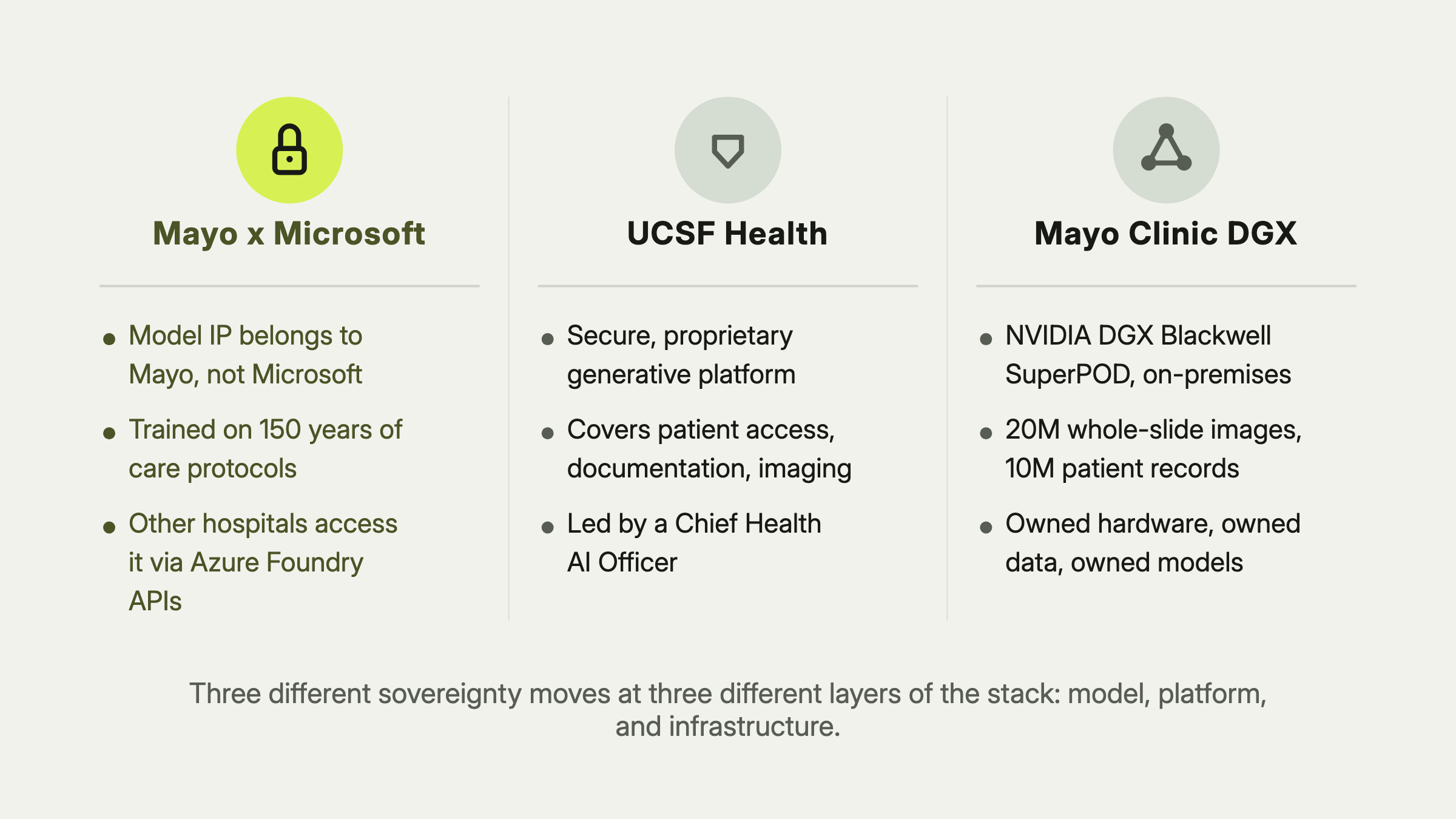
Three organizations show what sovereign AI looks like once it is actually running, at three different layers of the stack.
Mayo Clinic and Microsoft announced a collaboration at Microsoft Build 2026 to develop a frontier AI model specifically for healthcare. The ownership structure: the model belongs to Mayo Clinic, with Microsoft as co-developer. Other hospitals access it through Azure Foundry APIs, but the underlying model is Mayo's intellectual property, built on its de-identified clinical data, longitudinal patient insights, and 150 years of care protocols.
UCSF Health's AI strategy, led by a Chief Health AI Officer, is built around a secure, proprietary generative platform: their own infrastructure, not a vendor's. The system covers patient access, clinical documentation, and advanced imaging, giving UCSF full control over how clinical data is used and how the AI behaves across workflows.
Mayo Clinic also deployed NVIDIA's DGX Blackwell SuperPOD on-premises, separate from the Microsoft partnership, for its digital pathology platform. The system runs on 20 million whole-slide images linked to 10 million patient records, all inside Mayo's own infrastructure: owned hardware, owned data, owned models, owned outputs.
Two paths to sovereign AI
Build on Agent Hero directly, or build with HXAI, a healthcare engineering team that has already done the infrastructure work across 17 US healthcare sub-verticals.
Thanks - we'll be in touch soon
Our team usually responds within one business day.
The Three Dimensions of a Sovereign AI Program
Building sovereign AI requires decisions across three distinct areas. Organizations that address one or two but not all three remain partially dependent on external actors.
Dimension 1: Data Sovereignty
Clinical training data, inference inputs, and model outputs must all remain inside the organization's controlled environment. This means:
- PHI never transits external systems at any stage of the AI lifecycle
- Training pipelines run inside your infrastructure with PII/PHI redaction handled internally
- Inference logs are retained and auditable under your own access controls
Dimension 2: Model Sovereignty
The organization owns the model weights, the training methodology, and the evaluation framework. This means:
- Model artifacts are held by the organization permanently, not under a revocable license
- The organization controls update cadence, version rollback, and retraining decisions
- Third-party model providers are used as foundations for fine-tuning, not as dependencies the organization is locked into
Dimension 3: Infrastructure Sovereignty
AI compute runs on infrastructure under the organization's operational control. This means:
- On-premises GPU infrastructure, a customer-managed VPC, or a dedicated single-tenant environment, depending on the workload and compliance requirements
- Administrative access held by the organization's own security team
- Monitoring, logging, and incident response handled under the organization's own security program
How to Build Sovereign AI: The Agent Hero Path
The infrastructure assembly problem is what holds back sovereign AI deployment for US health systems and payers.
Building the foundation required for a production agentic AI system: orchestration, LLM gateway and routing, memory, guardrails, human-in-the-loop review, observability, takes an average team 12 or more weeks before any clinical product work begins. That is the quarter spent building what the AI runs on, not the AI itself.
HXAI starts with assessment, not deployment. Every sovereign AI engagement begins with a structured assessment: what does sovereign AI require for your specific infrastructure, compliance posture, and clinical workflows? That assessment produces the architecture recommendation and the use case prioritization before any code is written.
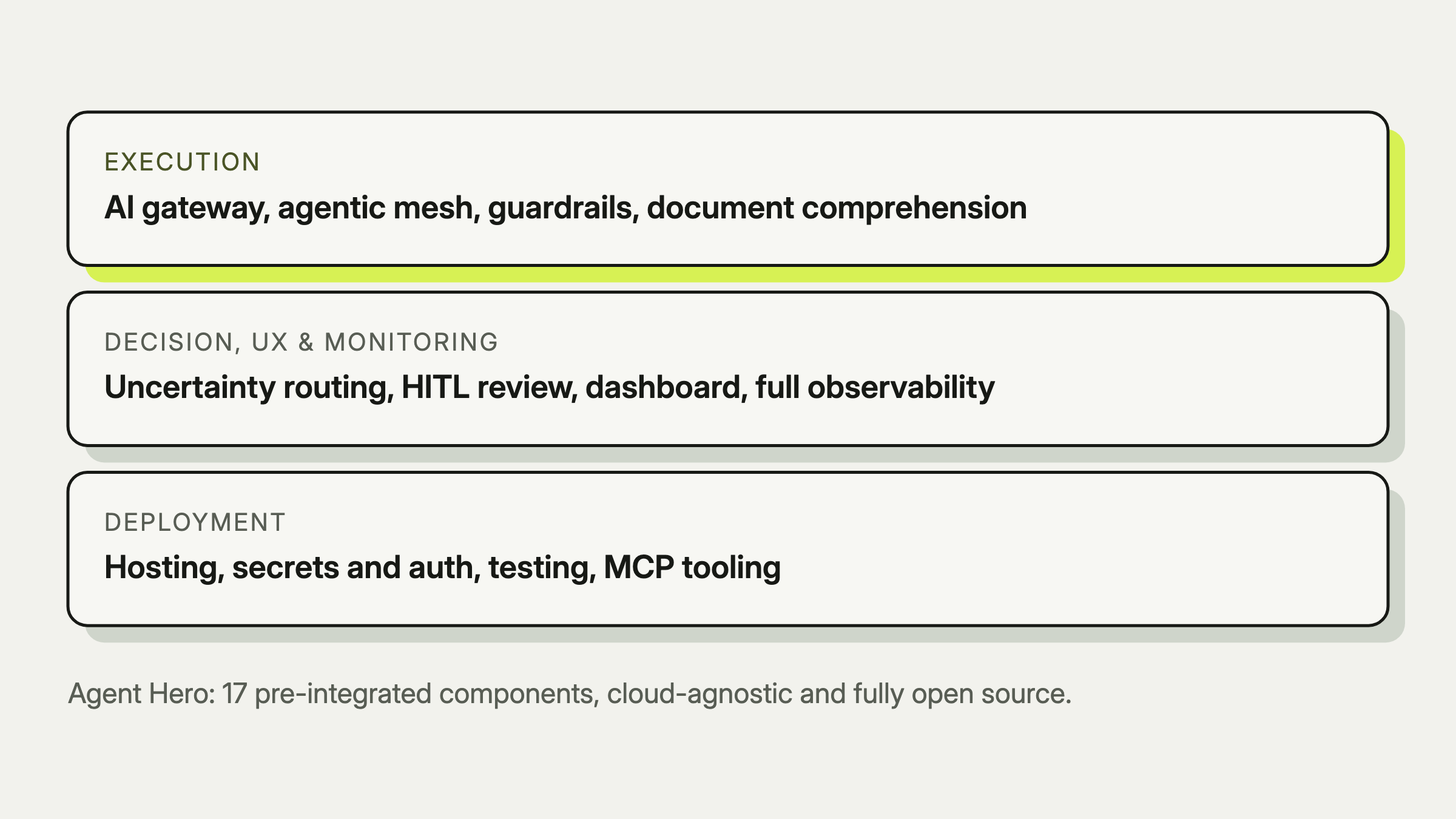
The deployment layer is Agent Hero, the open-source agentic infrastructure that collapses the 12-week assembly problem to day one. Seventeen pre-integrated components across five layers: execution, decision, UX, monitoring, and deployment, wired together and ready to build on. Cloud-agnostic: runs on any LLM, any cloud, any framework. No vendor lock-in.
What Agent Hero provides out of the box:
- Execution layer: AI gateway, agentic mesh, guardrails, document comprehension
- Decision layer: Uncertainty quantification, human-in-the-loop routing
- UX layer: Chat interface, operator dashboard, frontend
- Monitoring layer: Tracing, evaluation, explainability, drift detection, cost controls
- Deployment layer: Hosting, secrets and auth, testing, MCP tooling
Because Agent Hero is fully open source, health systems and payers own everything built on top of it. When HXAI builds a clinical AI program on Agent Hero, the infrastructure, the agents, and the clinical workflows are yours at the end of the engagement. No ongoing license, no platform dependency. Sovereign by design.
Two paths to starting: your team can build on Agent Hero directly, since the full codebase is open and extensible. Or you can build with HXAI, a healthcare engineering team that has already done the infrastructure work, deployed across 17 US healthcare sub-verticals, and knows the clinical domain well enough to build the product layer without a learning curve.
Frequently asked questions
- Mayo Clinic and Microsoft: Building a Frontier AI Model for Healthcare, Microsoft Build 2026
- Healthcare AI Data Sovereignty in 2026: What Breaks and How to Architect Around It, Arc Compute
- On-Premises AI and Sovereign AI in Healthcare, Nelson Advisors
- What is Sovereign AI, Cloudera
- Sovereign AI Infrastructure: Why On-Prem Is Coming Back in 2026, Intellabel
- HHS Office for Civil Rights, HIPAA Security Rule Update, January 2025
- NIST AI Risk Management Framework
