Healthcare claims processing sits among the highest-volume administrative operations in any health system or payer organization. A mid-size hospital might process 5,000 to 15,000 claims per month. Each one requires eligibility verification, coding review, payer-specific rule checks, fraud screening, adjudication, and payment reconciliation.
For a large share of organizations, a significant portion of that work still runs on manual review, rules engines, and disconnected systems. I've spent 25 years on both sides of this: at NTT DATA running healthcare IT programs for payers and providers, and at Cognizant leading healthcare solution development across the Southeast and Midwest US. The operational reality hasn't changed as fast as the headlines suggest. But AI is genuinely changing the architecture now, and the organizations that understand what it does and doesn't do are the ones getting solid results.
This post covers what AI in healthcare claims processing means, where the industry sits right now, how the technology works step by step, and what it takes to deploy it in a way that produces measurable financial results.
Quick answer: AI in healthcare claims processing uses machine learning, natural language processing, and agentic AI to automate and optimize the full claims lifecycle from intake through adjudication and payment. It reduces processing cost per claim, improves accuracy, accelerates resolution time, and detects fraud patterns that rule-based systems miss. The biggest shift in 2026 is the move from AI-assisted workflows to agentic AI that orchestrates the entire claims journey with human oversight only at genuine exception points.
What Is AI Claims Processing in Healthcare?
AI claims processing is the application of machine learning, natural language processing, and agentic AI to automate and optimize the healthcare claims lifecycle, all the way from claim submission through eligibility verification, coding, fraud detection, adjudication, and payment.
It differs from traditional rules-based automation in a fundamental way. Rules engines handle defined scenarios, decision trees built on if-then logic. When a claim arrives with unstructured clinical notes, a non-standard procedure code, or a payer policy that changed last month, the rules engine fails and a human steps in.
AI handles the unstructured, the ambiguous, and the edge cases that rules cannot. It reads clinical documentation, interprets free-text fields, learns from historical denial patterns, and adapts when payer policies change. That distinction is the difference between a system that automates 20% of your claims and one that automates 80%.
How Healthcare Organizations Are Processing Claims Today
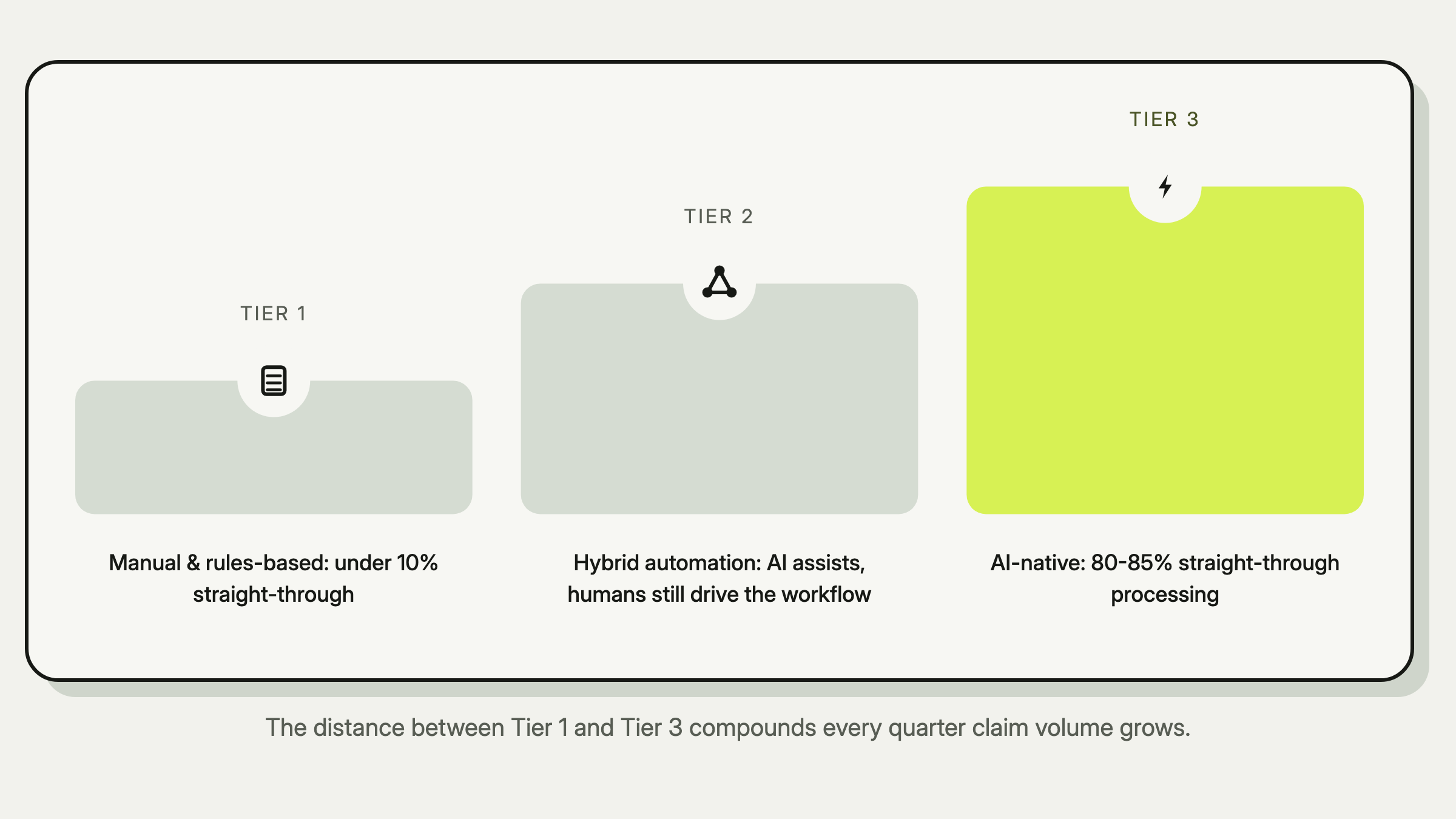
The industry is spread across three operational tiers, and the distance between them is growing every quarter.
Tier 1: Manual and Rules-Based Operations
These organizations are still running claims through combinations of manual review, legacy automation, and disconnected point solutions. Staff enter data manually, verify eligibility through phone calls or payer portals, and track submissions on spreadsheets or basic databases. Each manual error requires 15 to 25 minutes of staff time to identify, correct, and resubmit. Nearly 30% of medical insurance claims contain errors that delay payment, and manual processing inefficiencies cost the average mid-size practice over $180,000 annually in lost revenue and operational overhead.
The teams working in this environment are working within an architecture that has a scale ceiling, and they hit it predictably as volume grows.
Tier 2: Hybrid Automation
These organizations have deployed a combination of electronic claim submission, clearinghouse edits, and AI-assisted coding or denial management. Routine claims move through automatically while complex cases land with billing specialists. This is where a significant portion of the industry sits today, including many organizations that consider themselves technologically advanced.
The limitation in Tier 2 is that the AI layer and the operational layer are still separate systems. AI surfaces an insight and a human processes it. The value exists, but the throughput ceiling remains.
Tier 3: AI-Native Claims Operations
The leading payer and provider organizations have AI embedded into the claims workflow itself, not layered on top. In these organizations, 80 to 85% of health insurance claims process automatically, with AI handling standard cases end to end and humans reviewing only genuine exceptions.
The gap between Tier 1 and Tier 3 compounds. AI-native organizations get faster, cheaper, and more accurate every month as their models learn from production data. Organizations in Tier 1 get more expensive as claim volume grows and staffing costs rise.
One organization HXAI worked with illustrates what this transition looks like in practice. A US Medicaid-funded care franchise was running billing and care operations across 17 disconnected tools: separate systems for authorizations, utilization tracking, billing, and compliance. We consolidated the entire operation into a single multi-tenant SaaS platform with automated Medicaid billing built in from the ground up. The inter-system handoffs that were generating errors and delays at every stage of the claims cycle were eliminated. What had been a manual coordination problem became an architectural one that the platform solved.
How AI Processes a Healthcare Claim from Submission to Payment
For all the variation in how AI is deployed, the claims lifecycle follows a consistent structure. Here is where AI applies at each stage.
Step 1: Intake and Data Extraction
A claim arrives via HIPAA X12 837 transaction, paper form, or portal submission. AI performs intelligent document capture, extracting relevant data from structured and unstructured formats including clinical notes, operative reports, and faxed forms. NLP reads free-text fields that rules-based systems cannot process.
Step 2: Eligibility and Coverage Verification
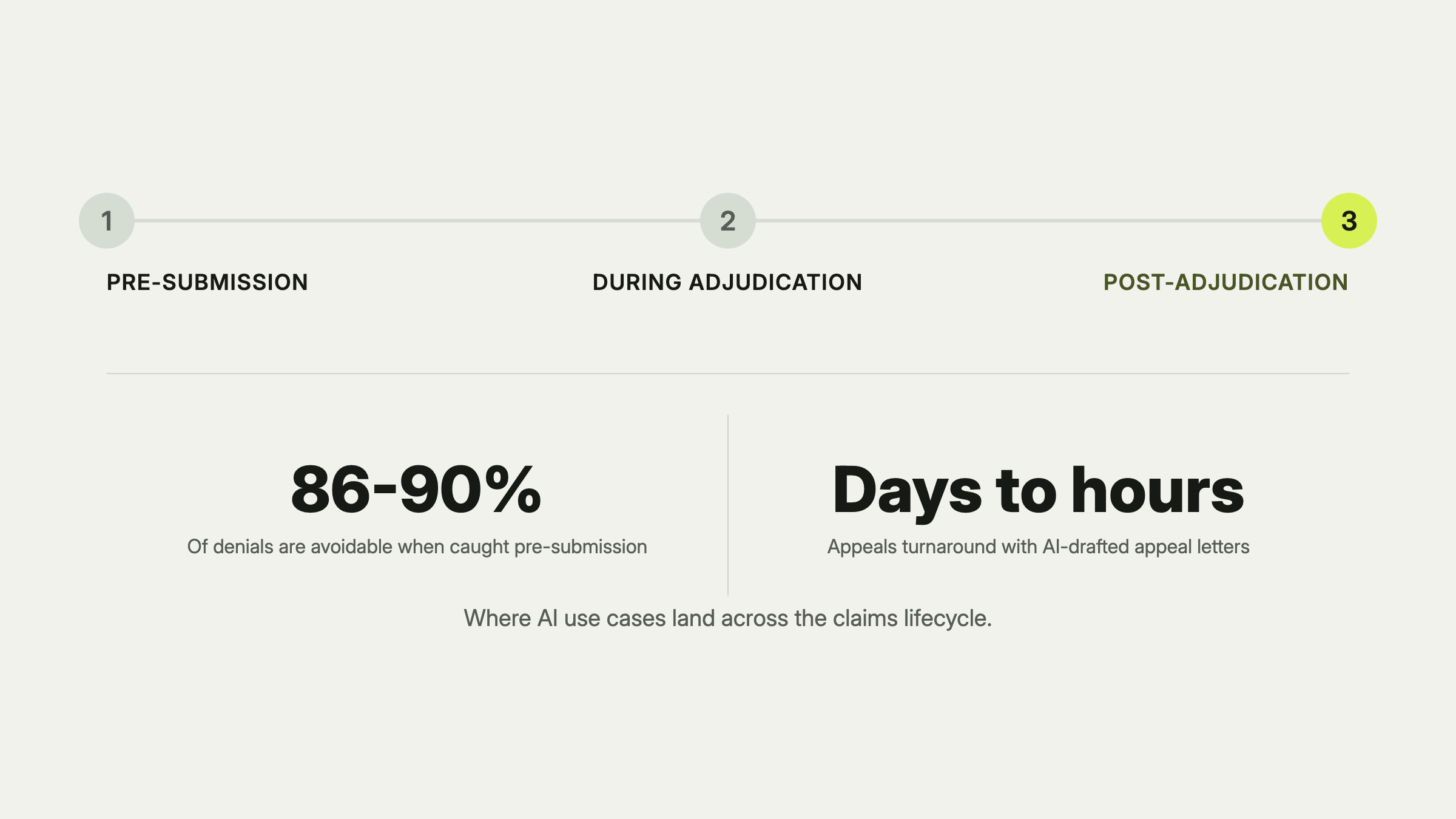
AI checks patient eligibility against payer data in real time, verifies coverage for the specific procedure or service, and surfaces coordination of benefits issues before the claim moves forward. Catching a coverage problem here costs nothing. Catching it after a denial costs rework time, and 86 to 90% of denials are avoidable.
Step 3: Coding and Charge Capture
AI reads completed clinical documentation, suggests appropriate ICD-10 and CPT codes, flags undercoding or upcoding risk, and checks against payer-specific code sets before submission. This is where AI is replacing significant coder capacity without replacing coders: the coder confirms what AI surfaces rather than reading from scratch.
Step 4: Fraud Detection and Risk Scoring
Before the claim moves to adjudication, AI runs it against fraud, waste, and abuse detection models. Billing pattern anomalies, duplicate submission indicators, and statistical outliers across provider networks are flagged automatically.
Step 5: Adjudication
The claim is evaluated against coverage rules, medical policies, and contractual obligations. AI adjudicates straightforward claims automatically and routes borderline cases to clinical reviewers with AI-generated context: the relevant policy sections, historical precedents for similar claims, and a recommended determination.
Step 6: Payment and Reconciliation
Payment is issued and the AI system reconciles actual reimbursement against contracted rates. Underpayments are flagged automatically for appeal rather than passing unnoticed through the revenue cycle. AI can increase reimbursement accuracy by up to 25% and reduce the average number of days in accounts receivable by 15 to 30% when implemented strategically, according to University of Colorado Denver HARC research.
Your first claims agent is on us
Denial prediction, underpayment detection, or appeals drafting: we'll build it and run it in your environment against real claims data, no cost.
Thanks - we'll be in touch soon
Our team usually responds within one business day.
What AI Healthcare Claims Processing Delivers
The benchmarks from production deployments are consistent enough to be useful reference points.
| Metric | Legacy / Manual Baseline | With AI | Improvement |
|---|---|---|---|
| Claim resolution time | 7-14 days | 1-3 days | 60-80% reduction |
| Processing cost per claim | $15-$25 | $3-$8 | 50-70% reduction |
| Clean claim submission rate | 65-75% | 85-95% | 15-20pt improvement |
| Denial rate | 10-15% | 4-7% | 50-60% reduction |
| Straight-through processing rate | Under 10% (industry avg) | 35-60% | 3-6x improvement |
| Days in accounts receivable | 45-60 days | 30-40 days | 15-30% reduction |
| Manual data entry errors | 25-30% of submissions | Under 5% | 80%+ reduction |
For example, a mid-size health system processing 10,000 claims per month at $20 average cost per claim is spending $200,000 per month on claims operations. Deploying AI to 60% straight-through processing at $5 per claim on those cases reduces monthly spend by $90,000, $1.08M annually before factoring in denial rate improvement or underpayment recovery.
A healthcare provider we worked with deployed a GenAI document comprehension engine for clinical notes, discharge summaries, and diagnosis reports. By combining PHI redaction, query routing, and a clinical language model, the solution cut information retrieval time for the RCM team by 50%, with measurably fewer coding errors in downstream submissions. That single improvement compounded across the full claims cycle.
The Key AI Use Cases Across the Healthcare Claims Lifecycle
These are the use cases generating sizable returns across the industry. Organized by claims stage, because the sequencing matters.
Pre-Submission
- Denial prediction: AI scores each claim for denial probability before submission and flags high-risk claims for correction. Our Claims Denial Prediction Agent catches the patterns that generate denials, missing modifiers, documentation gaps, payer-specific code exclusions, before the claim leaves the system.
- Coding accuracy: AI suggests ICD-10 and CPT codes from clinical documentation and flags undercoding. Coders review and confirm rather than build from scratch.
- Eligibility verification: Automated checks at point of registration, surfacing coverage gaps before service is rendered.
During Adjudication
- Automated adjudication: Straight-through processing of standard claims without manual touchpoints, with clear audit trails for compliance review.
- Prior authorization support: AI assembles supporting documentation for authorization requests and tracks payer response timelines against CMS-0057-F requirements.
Post-Adjudication
- Underpayment detection: AI compares contracted rates against actual reimbursement and flags underpayments for appeal. Our Underpayment Detection Agent surfaces systematic underpayment patterns that most RCM teams are not catching at the claim level.
- Appeals drafting: AI generates payer appeal letters using clinical documentation and payer-specific denial reason codes, reducing time from denial to appeal submission from days to hours.
- Payment reconciliation: Automated matching of expected vs. actual payments, with exception routing for manual review.
Ready to see what your first free agent looks like?
Tell us your claims volume and where things are slowest. We'll build your first agent and run it against real data, on us.
Thanks - we'll be in touch soon
Our team usually responds within one business day.
How AI Detects Healthcare Claims Fraud
Healthcare fraud costs the US healthcare system an estimated $100 billion annually. Rule-based fraud detection systems generate false positive rates of 30 to 50%, meaning fraud teams spend the majority of their time chasing legitimate claims while genuinely fraudulent patterns pass through undetected.
AI fraud detection works differently. Rather than checking claims against a fixed set of known-bad patterns, AI models identify statistical anomalies across the full claims dataset: billing patterns that deviate from peer norms, duplicate submissions with minor variations, and network-level coordination across providers that suggests organized fraud.
The specific patterns AI catches that rules miss:
- Upcoding and unbundling: AI compares the coding distribution for a provider against peer groups with similar patient populations and flags outliers for SIU review
- Duplicate submissions with variation: Claims for the same service across slightly different dates, facilities, or provider identifiers that fall outside standard matching logic
- Phantom billing: Services billed for patients documented in other care settings on the same date
- Network-level fraud: Coordinated billing patterns across a group of providers that individually appear normal but statistically cluster together
Our Fraud, Waste & Abuse Detection Agent flags anomalous billing patterns across providers and routes them to payer SIU teams with the specific evidence threads that support investigation, not just a flag, but the documentation that makes the case.
What Agentic AI Means for Healthcare Claims
The transition from AI-assisted to agentic claims processing is the biggest architectural shift in this space in a decade. I want to be clear about what this means operationally, because the term is used loosely.
AI-assisted claims processing means AI provides a recommendation at a specific step, and a human still drives the workflow from step to step. AI is a tool within the process.
Agentic claims processing means an AI agent orchestrates the entire claim journey. It reads the intake, runs the eligibility check, flags coding issues, routes to fraud detection, generates the adjudication recommendation, and only hands off to a human at a genuine exception that requires clinical or contractual judgment. The human governs the system rather than operating within it.
The operational difference is substantial. An AI-assisted operation achieves 30 to 40% straight-through processing on simple claims. An agentic operation targets 60 to 80% STP across the full claims portfolio.
Healthcare organizations that build agentic claims infrastructure on a foundation they own can extend it. A denial prediction agent that runs well becomes the foundation for an underpayment detection agent, which shares the same payer connection layer and HIPAA architecture. Each new agent takes weeks, not months, because the hard infrastructure is already there.
Organizations that license a series of point solutions rebuild from scratch every time they want to add something. Different vendors, different integrations, different compliance reviews. The total cost of that coordination usually exceeds the cost of building the foundation once.
HIPAA Compliance and Governance in AI Claims Processing
Every AI system that touches claims data is operating on protected health information. The compliance architecture is not optional, and it shapes every technology decision.
What HIPAA requires for AI claims systems:
- Business Associate Agreements: Every vendor in the AI stack handling PHI needs a signed BAA: the model provider, the data pipeline vendor, and any cloud infrastructure touching claim data
- Minimum necessary standard: AI systems should only access the PHI required for the specific claims function
- Audit logging: Every AI action on a claim requires an immutable audit log, required for CMS compliance reviews and payer contract audits
- PHI isolation: Claims data should not pass through general-purpose LLM APIs without specific contractual data handling guarantees
The CMS transparency requirement effective March 2026 changes the governance picture for health plans. Plans are now required to publicly disclose approval and denial metrics across Medicare Advantage, Medicaid managed care, CHIP, and ACA plans. An AI system generating or supporting denial decisions needs to produce defensible, auditable outputs.
The governance model that should be set up: clinical or compliance leadership approves any AI workflow touching claims decisions, exception handling paths are defined and tested before go-live, and AI outcomes appear in the same operational reporting as all other claims metrics, not on a separate technology dashboard.
How to Get Started
Start with an honest picture of where your claims operation sits today, and which workflows have the volume, data quality, and organizational readiness to support an AI deployment in the next 90 days.
Three questions that will help you figure out the starting point:
- What is your current clean claim submission rate and denial rate? If these numbers aren't readily accessible from a single report, that tells you something about your data infrastructure before you scope anything.
- Where are your claims spending the longest time? The answer is almost always eligibility-related denials or documentation gaps in complex claim types. These are the highest-ROI starting points.
- Who owns the outcome? AI claims deployments treated as IT projects stall. The ones that succeed have a VP of Revenue Cycle or VP of Claims Operations holding the outcome metrics.
Over the last few years, I've seen a lot of claims automation promises. What actually moves the needle is simpler than vendors make it sound: clean agents that connect to the systems you already run, handle PHI the right way, and produce results you can measure in the next billing cycle.
That's what we build at HXAI. If you want to see what it looks like on your claims data, your first agent is on us. Get your first claims agent free →
Frequently asked questions
- University of Colorado Denver HARC Research Brief: AI in Revenue Cycle Management and Medical Claims Processing, Fall 2025
- ArtsylTech: Healthcare Claims Management Complete Guide 2026
- ArtsylTech: Claims Processing Workflow Steps and Best Practices 2026
- MedVision: Payer's Guide to Healthcare Claims Processing Software 2026
- Dash Technologies: Automation in Claims Processing, May 2026
- CMS, Prior Authorization and Transparency Rule 2026