The prior authorization process exists to ensure clinical appropriateness. In practice, I have spent 25 years watching it become one of the highest-cost administrative workflows in healthcare, consuming significant physician and staff time on the provider side while generating review backlogs on the payer side that delay necessary care.
AI prior authorization eliminates the manual handling from both sides of the transaction simultaneously. And in 2026, CMS-0057-F has made acting on that urgency a compliance requirement as much as an operational one.
This guide covers how it works on both the provider and payer sides, what it delivers in production, and how to build it.
What Is AI Prior Authorization in Healthcare?
Prior authorization is the process by which a provider obtains payer approval before delivering a specific service, medication, or procedure. Every PA request is a two-sided transaction: a provider submitting clinical documentation and a payer reviewing it against medical necessity criteria.
AI prior authorization brings machine learning and agentic AI into both sides of that transaction simultaneously. On the provider side, AI reads the clinical order, identifies whether authorization is required, assembles the supporting documentation, and submits the request. On the payer side, AI reads the incoming request, validates clinical evidence against current criteria, and determines approvable cases without routing them to a human reviewer.
The goal on both sides is the same: remove manual handling from requests where the answer is already clear.
A service that clearly meets medical necessity criteria shouldn't require three hours of biller time to document and submit. A request that clearly meets the payer's coverage rules shouldn't sit in a reviewer's queue for five days. AI solves the same problem from both ends of the transaction.
Why Prior Authorization Automation Has Become Urgent in 2026
The administrative burden of prior authorization has been a recognized problem for years. Two things changed in 2026 that turned it from a chronic operational challenge into an urgent business and compliance issue.
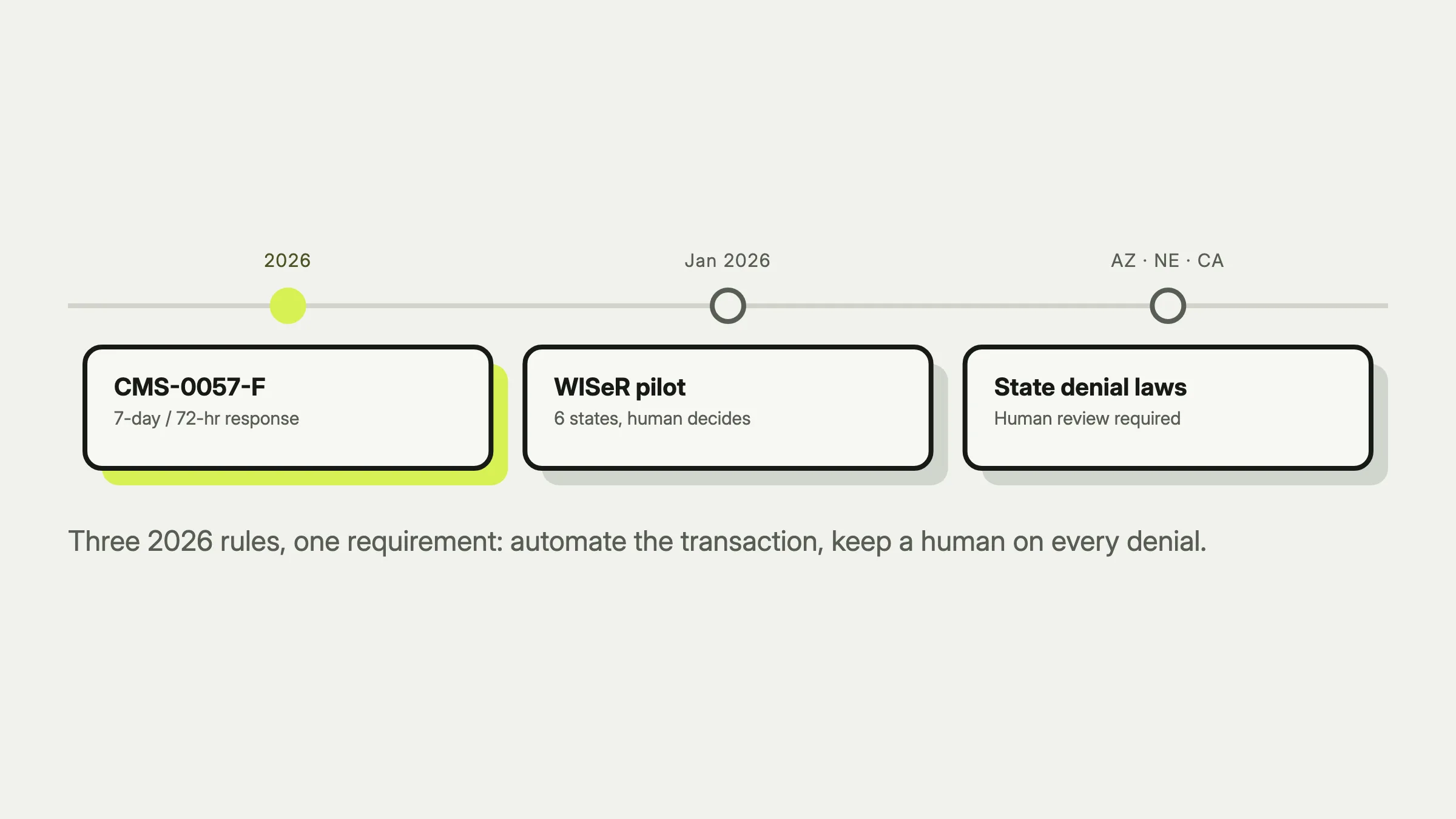
CMS-0057-F is now in effect: The Interoperability and Prior Authorization Final Rule requires health plans to respond to standard prior authorization requests within seven days and urgent requests within 72 hours. Plans that relied on manual review queues to process PA volume are now running a compliance risk alongside an operational one.
Both sides of the transaction are under simultaneous pressure: Payers accelerating PA review timelines to meet CMS requirements need AI to maintain throughput without proportional headcount growth. Providers dealing with faster payer decisions still face the upstream burden of assembling complete, accurate submissions that won't be returned for additional documentation. The operational problem has compounded from both directions.
I've watched organizations try to solve this with incremental staffing and rules-based automation for years. The rules engines handle the simple cases and fall apart on anything non-standard. AI handles the non-standard inputs that rules-based systems cannot: unstructured clinical notes, faxed forms, handwritten documentation.
How AI Automates Prior Authorization on the Provider Side
On the provider side, prior authorization involves multiple manual steps before a request ever reaches the payer. AI addresses each step in sequence.
Step 1: Detecting the Authorization Requirement
At the point of order entry, AI checks whether the ordered service requires prior authorization for the specific patient's insurance plan. Payer PA requirements vary by plan, service, and coverage year. AI reads the patient's current benefit information and flags the requirement automatically, so staff aren't discovering the authorization gap after the service has been delivered.
Step 2: Reading the Clinical Documentation
AI reads the clinical notes, diagnostic results, and treatment history relevant to the authorization request. It handles structured and unstructured documentation formats: typed notes, scanned documents, faxed forms, and handwritten records. This is where rule-based systems fail and AI delivers its highest operational impact.
Step 3: Checking Payer-Specific Criteria in Real Time
AI references current payer medical necessity criteria for the specific service, procedure, and diagnosis combination. Payer criteria change quarterly or more frequently. AI connected to current payer policy documentation always applies the latest criteria, updated in real time as policies change.
Step 4: Assembling and Submitting the Authorization Packet
AI assembles the complete authorization packet (clinical documentation, prior treatment history, supporting evidence) formatted for the specific payer's requirements and submits via FHIR API where payer connectivity exists, or through the payer portal where it doesn't.
Step 5: Monitoring and Following Up
After submission, AI monitors response timelines against CMS-0057-F requirements, flags submissions approaching the response window without a determination, and escalates authorization failures for human follow-up.
How AI Processes Prior Authorization Requests on the Payer Side
On the payer side, CMS-0057-F has fundamentally changed what manual PA review capacity can sustain. AI is the operational response.
Step 1: Receiving Requests via FHIR API
CMS-0057-F requires that payers accept PA requests electronically. AI receives incoming requests via FHIR API, normalizes them regardless of the EHR or clearinghouse they originated from, and immediately begins the review process.
Step 2: Extracting and Validating Clinical Documentation
AI reads the clinical documentation submitted with the request: physician notes, diagnostic results, treatment history. It identifies whether the submitted evidence addresses the specific medical necessity criteria for the requested service. This includes reading unstructured documentation that clinical reviewers would otherwise read manually.
Step 3: Applying Current Coverage Criteria
AI checks the request against current medical necessity criteria and coverage rules. For straightforward requests where clinical documentation clearly supports the requested service, AI routes the case for auto-determination. For borderline requests, it surfaces the specific criteria at issue and the relevant documentation to a clinical reviewer, so the reviewer is confirming rather than researching.
Step 4: Generating the Determination With Audit Trail
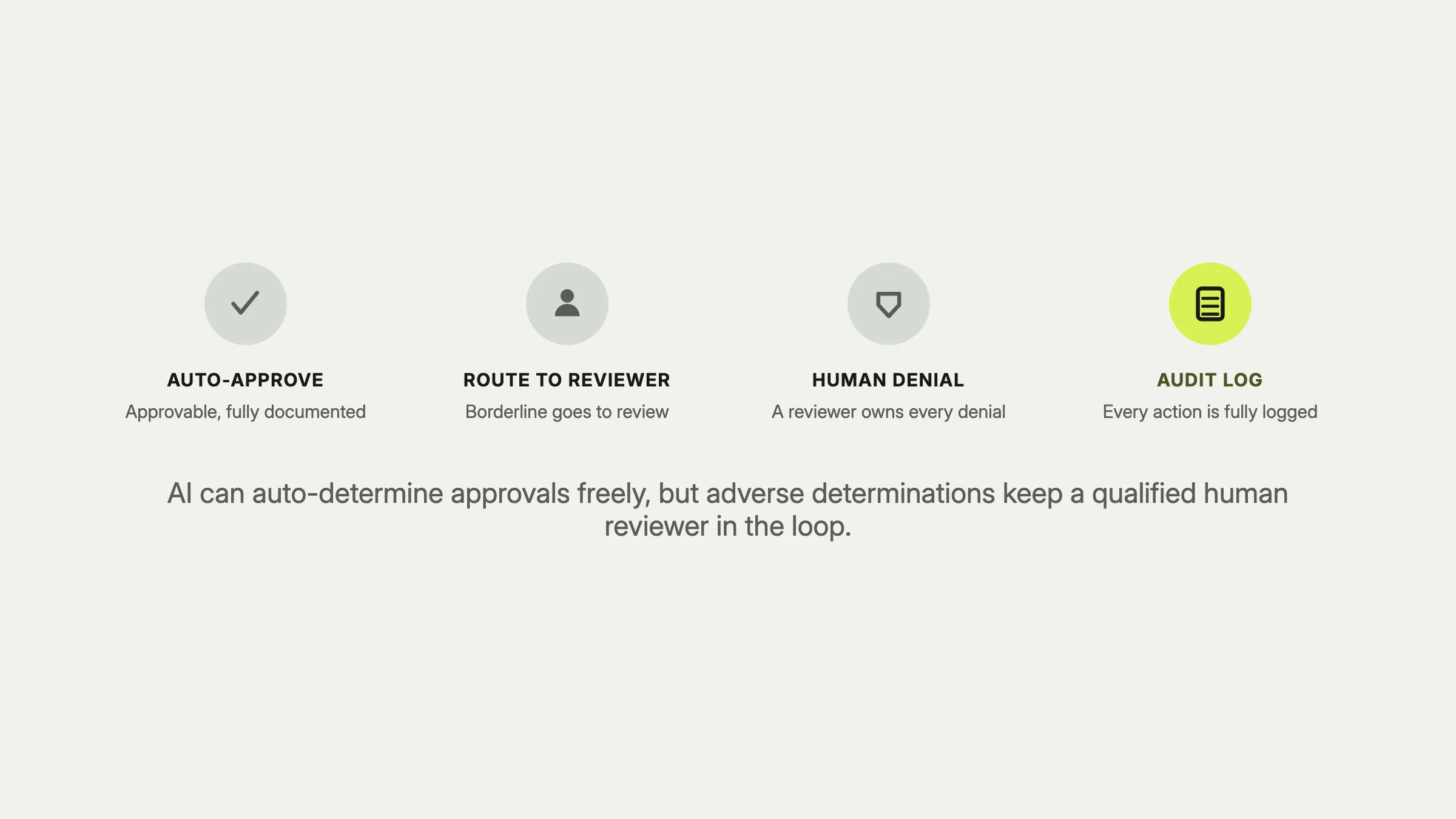
For auto-determined approvals, AI generates the authorization with a complete, auditable record of the clinical evidence reviewed and the criteria applied. For cases routed to human review, AI records the reviewer's determination with the same audit trail. CMS transparency requirements and state AI disclosure laws require this documentation.
Step 5: Communicating the Determination
AI communicates the determination back to the provider via FHIR API within CMS-0057-F timelines, automatically triggering the next step in the provider's PA follow-up workflow.
Want to see what AI prior authorization looks like against your actual PA volume and payer mix?
HxAI will deploy your first prior authorization agent at no cost, inside your environment, against your real authorization data.
Thanks - we'll be in touch soon
Our team usually responds within one business day.
AI Prior Authorization and Adverse Determinations: What the Compliance Architecture Requires
Arizona, Nebraska, and California have enacted legislation prohibiting AI from being the sole basis for a prior authorization denial. The operational implication is specific: AI can auto-determine approvals freely, but adverse determinations require a qualified human reviewer in the decision loop, with that review documented.
The architecture that works:
For Medicare Advantage plans, CMS adds a layer: plans must apply clinical criteria at the same standard as original Medicare, and AI tools must be applied consistently without discriminatory effect. Plans using AI in MA prior authorization need to validate that their models produce consistent outcomes across clinical presentations and demographic groups.
Building this compliance architecture into the system from day one rather than adding it after production deployment is the difference between a program that scales and one that faces regulatory remediation after the first audit.
What AI Prior Authorization Delivers in Production
The outcomes vary by organization depending on starting state and deployment depth. These are the ranges we see consistently across production deployments.
| Metric | Manual Baseline | With AI |
|---|---|---|
| PA turnaround time | 5-10 days | Under 24 hours |
| First-pass approval rate | 75-80% | 95%+ |
| Staff hours per authorization | 15-20 minutes | Under 2 minutes |
| Authorization-related denial rate | 8-12% | 3-5% |
| CMS-0057-F compliance | At risk | Structurally compliant |
For Medicare Advantage health plans, PA accuracy has a direct Star Ratings connection. Plans with high appeal overturn rates on PA decisions face CMS scrutiny and risk to their quality bonus. Getting PA decisions right the first time matters financially beyond the operational cost reduction.
The compounding benefit is the data. An AI PA system that has processed thousands of requests for a specific payer builds a pattern database of that payer's approval behavior: which clinical documentation elements correlate with approval, which combinations trigger additional review requests, which procedure-diagnosis pairs the payer scrutinizes. That institutional knowledge makes each subsequent authorization cycle more accurate than the last.
What HxAI Has Built in Prior Authorization
HxAI is a healthcare AI transformation partner headquartered in Dallas, Texas, with 400+ healthcare engineers and production deployments across all 17 US healthcare sub-verticals. We hold SOC 2 Type II certification and ISO 27001 compliance, across both provider-facing submission automation and payer-facing processing and compliance infrastructure.
Post-Acute RCM Platform: Solving PA at Enterprise Scale
A post-acute care technology company operating across some of the largest post-acute networks in the US came to us with a PA process built around fax machines, manual eligibility checks, and staff physically reading handwritten forms. The company had tried multiple rule-based automation systems, each of which failed when it encountered non-standard inputs.
We built an agentic prior authorization infrastructure on Agent Hero, our open-source HIPAA-compliant agentic platform, that reads unstructured inputs directly: handwritten notes, faxed documentation, scanned forms. The system processes authorizations automatically and routes only genuine exceptions to human reviewers. It now handles millions of automated PA transactions monthly for a significant share of the top US post-acute providers.
Clinical Documentation for RCM: Faster PA Assembly
For a healthcare provider RCM team, we built a GenAI document comprehension engine that reads clinical notes, discharge summaries, and diagnostic reports with PHI redaction and structured retrieval. The system cut information retrieval time for the billing and authorization team by 50%, directly reducing the time staff spent assembling prior authorization documentation and appeals packets.
Both programs run inside the client's own environment, on infrastructure they own at completion, with no platform fees and no vendor dependency.
Get your first PA agent free
We've built AI prior authorization infrastructure processing millions of transactions monthly for some of the largest post-acute networks in the US. We'll build your first agent at no cost, inside your environment, against your real authorization data.
Thanks - we'll be in touch soon
Our team usually responds within one business day.
How HxAI Builds AI Prior Authorization Programs
HxAI is a healthcare AI transformation partner headquartered in Dallas, Texas, with a team of 400+ healthcare engineers and production deployments across all 17 US healthcare sub-verticals. We hold SOC 2 Type II certification and ISO 27001 compliance, which means the data handling, audit trail, and access control requirements of a healthcare AI deployment are already built into how we operate.
Prior authorization is one of the highest-frequency AI programs we build. We work on both sides of the transaction, covering both provider-facing PA submission automation and payer-facing PA processing and CMS-0057-F compliance infrastructure.
Every prior authorization program we build runs on Agent Hero, our open-source HIPAA-compliant agentic infrastructure. Agent Hero provides the orchestration, human-in-the-loop routing, immutable audit trail, and FHIR connectivity out of the box. This is the infrastructure that takes healthcare engineering teams 12 or more weeks to build from scratch.
How we engage:
We start with your PA data: your current turnaround times, your authorization-related denial rates by payer, and where your staff time is going. That assessment tells us which payer and service line combination to start with: highest volume, clearest ROI, cleanest data to support a 90-day production deployment.
We build inside your environment. You own the infrastructure at the end of the engagement with no platform fees and no vendor dependency. The first prior authorization agent is free. We build it, run it against your real authorization data, and show you the results before you commit to a full program.
How to Start Your AI Prior Authorization Program
The right starting point depends on which side of the transaction your organization is on and where the largest volume gap is.
For provider organizations: Pull three numbers from your PA workflow: your current average turnaround time by payer, your authorization-related denial rate by service line, and the staff hours your team spends per authorization. The payer with the highest volume and the longest turnaround is the right starting point for a FHIR-connected PA agent.
For health plans and payers: Identify your current PA response time against CMS-0057-F requirements by request type. The service lines where your review queue is creating the greatest CMS compliance risk, combined with your highest request volume, are the right starting point for payer-side PA automation.
For both: The FHIR readiness question determines the deployment timeline more than anything else. Organizations with FHIR R4-compliant EHR infrastructure move significantly faster than those building the FHIR layer during the deployment.
Frequently asked questions
- CMS. Interoperability and Prior Authorization Final Rule (CMS-0057-F).
- AMA. 2025 AMA Prior Authorization Physician Survey.
- HFMA. Prior Authorization AI Deployment Outcomes 2026.
- KFF. Regulation of AI in Prior Authorization and Claims Review 2026.
- LiveCompliance. AI Healthcare Regulations 2026: Federal, State and HIPAA.
- Rock Health. Digital Health Funding Report 2025.
- McKinsey. Healthcare Revenue Cycle Management at a Strategic Turning Point, April 2026.