A small language model (SLM) is a language model in the 100M to 10B parameter range, fine-tuned to do one specific clinical task well. SLMs run inside your infrastructure, keep PHI fully contained, and outperform general-purpose LLMs on the workflows they are built for.
This guide covers what SLMs are, where they outperform general models in clinical settings, what a production deployment requires, and how to tell whether one is the right architecture for your use case.
Quick answer: A small language model in healthcare is a domain-trained language model in the 100M to 10B parameter range, deployed on-premise or in a private cloud for a specific clinical workflow. SLMs keep PHI inside your infrastructure, run at sub-40ms latency, and outperform general-purpose LLMs on the tasks they are built for. Common healthcare SLM use cases include clinical note summarization, prior authorization drafting, medical coding support, and care coordination routing.
What Is a Small Language Model?
An SLM is a language model designed to be a specialist. General-purpose LLMs are built to handle anything. An SLM is built to do one thing well: extract codes from clinical notes, draft prior auth requests, or summarize discharge summaries. When the task is narrow and the output space is bounded, a specialist model trained specifically on that task outperforms a larger general model zero-shot.
The parameter range is 100 million to 10 billion. That is small relative to LLMs, which run in the hundreds of billions. A 3B parameter SLM trained on your clinical data outperforms a 70B general model zero-shot on the tasks it was built for. Parameter count is not the performance measure. Task accuracy, latency, and deployment constraints are.
How SLMs Are Built
Production clinical SLMs are built by adapting a pretrained base using PEFT (Parameter-Efficient Fine-Tuning), specifically LoRA or QLoRA. This delivers faster iteration, lower memory requirements, and smaller model artifacts per use case variant. The three common techniques used to reduce model size while preserving task performance are:
- Distillation: Training a smaller model to replicate a larger model's behavior on a specific task
- Pruning: Removing parameters that contribute minimally to task performance
- Quantization: Reducing numerical precision to cut memory and inference cost
Why Healthcare Is Moving to SLMs Now
The first wave of clinical AI ran on public LLM APIs and hit three walls at production scale. PHI could not transit an external API without compliance risk. Inference costs at clinical volume were unsustainable. General models produced clinical errors teams could not accept. SLMs address all three simultaneously, which is why healthcare AI teams are moving to them now.
How SLMs Compare to General-Purpose LLMs in Clinical Settings
In healthcare, every dimension of this comparison carries a specific operational consequence.
| Dimension | Large Language Model | Small Language Model |
|---|---|---|
| Task fit | Broad generative tasks | Focused domain workflows |
| Latency | Higher, network-dependent | Sub-40ms achievable on-prem |
| Operating cost | Per-token, scales with volume | Fixed infrastructure cost |
| Deployment | Typically hosted | On-prem, private cloud, edge |
| Data sovereignty | Data transits external API | Full control, no data transit |
| Governance | No standard audit deliverables | Audit trails, model cards by design |
| Domain accuracy | Degrades without prompt engineering | Outperforms LLM zero-shot on trained domain |
| Breadth | Best for open-ended tasks | Bounded to trained domain |
Two dimensions drive production decisions in healthcare.
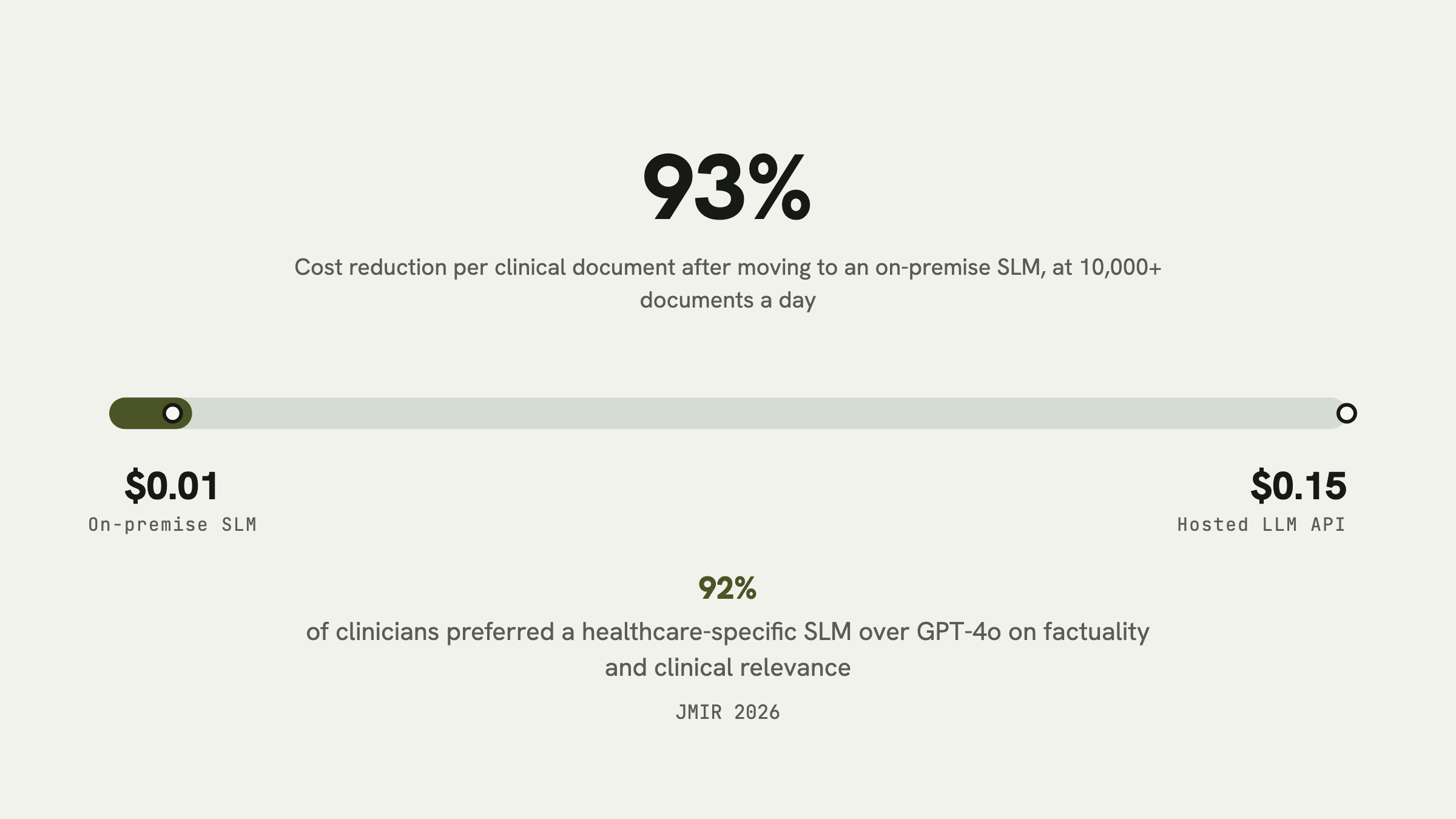
Cost at volume: At 10,000+ clinical documents per day, per-token API pricing becomes a budget problem. One healthcare organization reduced cost per document from $0.15 to $0.01 after moving to an on-premise SLM, a reduction of over 93% on a workflow running 10,000 records daily.
Domain accuracy: Research published in JMIR found that medical professionals preferred a healthcare-specific SLM over GPT-4o from 45% to 92% more often on factuality, clinical relevance, and conciseness. A well-tuned 3 billion parameter SLM consistently outperforms a 70B general model zero-shot on narrow clinical tasks. The accuracy gap surfaces when clinical teams review real outputs at scale, rarely during the proof of concept.
Why Public LLMs Create Compliance Problems for Certain Clinical Workflows
There are four specific compliance and governance reasons healthcare organizations cannot run PHI-bearing workflows on hosted public LLM APIs.
HIPAA and BAA Limitations
Major LLM providers offer Business Associate Agreements. The BAA covers the vendor's data handling practices. It does not govern what happens to data used for model improvement or data transiting vendor infrastructure during inference. For workflows where clinical notes, member records, or claims data are in the prompt, the compliance exposure is real and difficult to audit after the fact.
Audit Trail Requirements
The Joint Commission's RUAIH guidance and NIST AI RMF both require auditable logs: inputs, outputs, model versions, and change history. Hosted API providers do not produce these in a format compliance teams can review. A private clinical SLM produces them by design as a standard deployment output.
Hallucination Risk in Clinical Contexts
A general LLM producing a confident incorrect output in a consumer product is a quality issue. In a prior authorization decision, treatment recommendation, or discharge summary, it is a liability issue. A fine-tuned SLM with a bounded output space and a custom evaluation harness can be tested against clinical acceptance criteria before any live workflow runs on it.
Change Control
Hosted API models update on the vendor's schedule without notice. A private clinical SLM has version control, reproducible checkpoints, and a change control process your compliance team can document and sign off on.
Where Fine-Tuned SLMs Win in Healthcare
Fine-tuned SLMs win when the task is bounded, the output is measurable, and the data is sensitive. The following workflows meet all three conditions.
| Workflow | Why SLM Wins | Reported Outcome |
|---|---|---|
| Clinical note summarization | Bounded format; PHI stays inside | $0.15 → $0.01 per document |
| Prior authorization drafting | Narrow extraction; PHI-heavy; high volume | 80% turnaround reduction (HFMA) |
| Medical coding support | Bounded classification; no external API | 2,841 staff hours saved annually (HFMA) |
| Physician documentation | Ambient capture; bounded structured output | 40–45% charting time reduction (MGB) |
| Discharge summary generation | Consistent format; bounded clinical output | Reduced physician review time |
At Mayo Clinic, AI-assisted documentation has reached over 2,000 clinicians. At Mass General Brigham, physician charting time dropped by 40 to 45%. Both deployments run on private infrastructure, not public API endpoints.
What makes a workflow right for an SLM: The highest-confidence fits are workflows that run at high volume, involve PHI that cannot leave your environment, and have a bounded output space you can define acceptance criteria against. Prior auth, coding, and note summarization meet all three. Open-ended differential diagnosis reasoning does not.
Not sure if your workflow fits this profile?
SLM in a Box starts every engagement with a structured workflow fit assessment, at no commitment. Comparing options? See 6 Companies That Deploy Private Language Models for Healthcare in 2026.
Thanks - we'll be in touch soon
Our team usually responds within one business day.
The Six Stages of a Clinical SLM Deployment
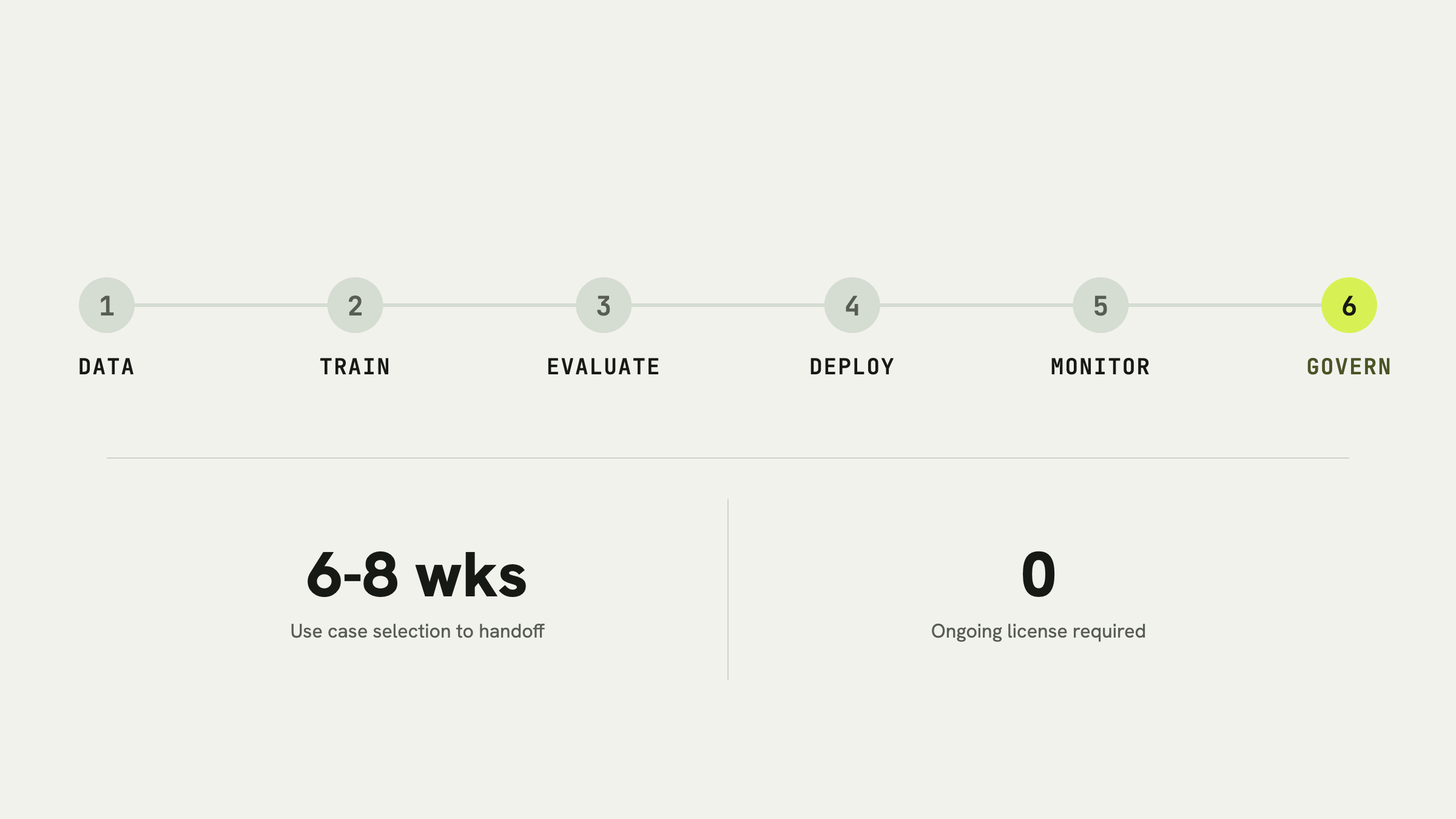
A clinical SLM deployment covers six stages that all have to be operationalized before any clinical workflow runs on the model. Organizations that approach deployment as a model selection exercise consistently hit the same failures: data quality surfaces in week five, compliance review stalls in week eight, and operational ownership is unclear at handoff.
Stage 1: Data
Collect, clean, label, and redact PII from training data. Establish source-to-training lineage. Confirm the legal basis for using the data. This stage consistently takes four to eight FTE-weeks done correctly and is the stage organizations underestimate by the widest margin. What can be used, how it is retained, and who can access it must all be resolved before a single training run begins.
Stage 2: Train and Fine-Tune
Production deployments use PEFT, specifically LoRA or QLoRA: faster iteration, lower memory requirements, smaller model artifacts per use case. Supervised fine-tuning (SFT) is added when labeled examples of the target clinical task are available and task behavior needs to be explicitly shaped.
Stage 3: Evaluate
Build a custom regression test suite against your specific acceptance criteria. Safety tests, accuracy thresholds, hallucination checks, edge case coverage specific to the clinical task. Build this for your use case and run it every time the model updates.
Stage 4: Deploy
Private endpoint, access controls, authentication, and observability stack. Deploy means the model runs inside your infrastructure, inputs and outputs are logged, and access is controlled at the role level.
Stage 5: Monitor
Track latency, accuracy drift, feedback signals, and retraining triggers. Models degrade in production when data distributions shift: payer criteria change, formularies update, documentation standards evolve. Monitoring catches degradation before it affects clinical outcomes.
Stage 6: Govern
Policies, access management, audit trails, model cards, incident response, and change control. NIST AI RMF organizes governance across Govern, Map, Measure, and Manage functions. In a compliant clinical SLM deployment, governance operates as a set of lifecycle stage gates built into the delivery process.
On-Prem, Private Cloud, or Edge: Matching Deployment to Your Workflow
The right deployment pattern depends on workflow sensitivity and existing infrastructure.
On-Premise
PHI never leaves your network perimeter. This suits the highest-sensitivity workflows: claims processing, prior authorization, any scenario where your CISO needs to certify data movement is impossible rather than unlikely. Requires GPU infrastructure on-premise. Higher upfront cost, lowest ongoing data risk.
Private Cloud
The model runs in a Virtual Private Cloud on AWS, Azure, or GCP, with no data transiting a shared public endpoint. For health systems that have already moved clinical workloads to cloud infrastructure, this is the natural home for a clinical SLM. Data residency is controlled, infrastructure scales with demand, and compliance posture is auditable.
Edge
The model runs at the point of care: a clinical device, a field workstation, or equipment in a bandwidth-constrained environment. Edge suits ambient documentation tools that need sub-second response times and care coordination copilots that operate without reliable connectivity. Typical model size: 1B to 3B parameters with quantization applied to reduce inference compute.
For a detailed guide on infrastructure requirements for each pattern, see How to Deploy Private AI in Healthcare: On-Premise, Private Cloud, and Air-Gapped.
How HxAI Deploys Clinical SLMs: SLM in a Box
SLM in a Box is HxAI's managed clinical SLM delivery program for healthcare organizations that need a production-ready private language model without building the MLOps infrastructure and specialist team from scratch.
What the Engagement Covers
SLM in a Box runs the full six-stage lifecycle under a single engagement: use case definition, data readiness and PII redaction, fine-tuning inside your infrastructure, custom evaluation harness build, private deployment, and a NIST AI RMF-aligned governance documentation package.
The HxAI delivery team works inside your environment under your access controls throughout. PHI does not transit HxAI's infrastructure at any point.
What You Receive at Handoff
At the end of the engagement, your team receives:
- Model artifacts: The fine-tuned model files, fully owned by your organization
- Evaluation harness: A custom regression test suite built for your specific workflow and acceptance criteria
- Deployment runbooks: Step-by-step operational documentation for your infrastructure team
- Governance package: Model cards, audit trails, access logs, and incident response procedures aligned to NIST AI RMF
- Retraining guidance: Documentation covering when and how to retrain as your data distribution evolves
No ongoing license is required to run the model after handoff. The model lives on your infrastructure permanently, with zero dependency on HxAI continuing to be involved.
Deployment Patterns Supported
SLM in a Box supports on-premise, private cloud (AWS, Azure, GCP VPC), and air-gapped deployment. The delivery team works within whichever pattern your compliance requirements call for.
Timeline
A first production deployment on a single, well-scoped clinical workflow takes six to eight weeks from use case selection to handoff. Common first workflows include prior authorization drafting, clinical note summarization, and medical coding support.
HxAI has delivered SLM deployments across health systems, payers, pharma companies, and HealthTech vendors spanning 17 US healthcare verticals.
Is a Private Clinical SLM Right for Your Workflow?
The fit comes down to two axes: task focus and privacy constraints.
Task Focus: Is the output space bounded with measurable acceptance criteria? Prior auth drafting, medical coding, and note summarization qualify. Open-ended differential diagnosis reasoning and research summarization do not.
Privacy Constraints: Does PHI enter the workflow in a way that cannot transit an external API under your compliance posture? If yes and the task is also bounded, a private SLM is the correct architecture.
| Architecture | Privacy | Task Focus | When to Use |
|---|---|---|---|
| Hosted LLM API | Low | Low | Fast start, broad tasks, no compliance constraints |
| Private LLM or Hybrid | High | Low | Sensitive data, wide task surface |
| Classic ML and Rules | Low | High | Narrow deterministic tasks, no generative requirement |
| SLM Sweet Spot | High | High | Focused workflows, private deployment, high volume |
A practical test: if the workflow runs 1,000 times per day, PHI is in the prompt, and the correct output can be defined and measured, a private clinical SLM is the right starting point.
If you want to walk through a specific use case, book a 45-minute pilot discovery call with the HxAI team. We run a workflow fit assessment in the session and return a deployment recommendation before the call ends.
Get a deployment recommendation for your workflow
Send us one clinical workflow. We run the workflow fit assessment live and return a deployment recommendation before the call ends.
Thanks - we'll be in touch soon
Our team usually responds within one business day.
Frequently asked questions
The highest-confidence use cases are clinical note summarization, prior authorization drafting, medical coding support, discharge summary generation, and care coordination routing. Each is bounded, high-volume, and privacy-sensitive: the three conditions where SLMs consistently outperform general models on accuracy, latency, and cost simultaneously.
An SLM starts smaller, typically 100M to 10B parameters, and is designed to run on constrained infrastructure including on-premise hardware and edge devices. A fine-tuned LLM adapts a large model, typically 70B or more parameters, on domain data. Both improve clinical accuracy, but they differ significantly on infrastructure requirements, inference cost at volume, and deployment flexibility. SLMs are the right choice when hardware constraints, latency requirements, or data sovereignty rules out large model deployment.
In a properly architected private SLM deployment, PHI does not leave your infrastructure at any point. Training runs inside your environment. Inference runs on a private endpoint. The delivery team works under your access controls. Every data access decision is logged. SLM in a Box by HxAI is built on this architecture: the model, training, and governance documentation all live inside your infrastructure.
A fine-tuned SLM with a bounded output space has a structurally lower hallucination surface than a general model used zero-shot. The evaluation harness tests against your specific acceptance criteria, including accuracy thresholds, safety checks, and edge cases, before any clinical workflow runs on the model. Monitoring tracks accuracy drift in production and triggers retraining when performance degrades.
A first production deployment following PEFT or SFT on a single, well-scoped clinical workflow typically takes six to eight weeks. The timeline extends when data readiness is lower than expected, compliance review surfaces access questions not scoped in week one, or acceptance criteria are defined too loosely at the start of the engagement.
Yes. A common production architecture pairs an SLM for classification and extraction with a RAG layer for workflows requiring access to frequently changing reference information: formularies, guidelines, payer policies. The SLM handles the bounded high-volume task. The RAG layer handles lookups against documents that update faster than a model can be retrained.
Your team receives model artifacts, an evaluation harness, operational runbooks, and governance documentation at handoff. The model runs on your infrastructure permanently with no dependency on HxAI continuing to be involved. No ongoing license required. SLM in a Box is structured this way explicitly: model artifact ownership transfers permanently at handoff.
- John Snow Labs. Medical Small Language Models: Benchmarking JSL-MedS vs GPT-4o. John Snow Labs Healthcare NLP, 2025.
- Belcak P, Heinrich G, Diao S, et al. Small Language Models are the Future of Agentic AI. NVIDIA / arXiv:2506.02153, September 2025.
- HFMA. Health systems start to fight back against AI-powered robots driving denial rates higher. Healthcare Financial Management Association, December 2025.
- Mass General Brigham. Hybrid Ambient Documentation Decreases After-Hours Work, Note Delays for Physicians. Mass General Brigham Newsroom, November 2025.
- Mass General Brigham. How Shiv Rao's Abridge Is Freeing Clinicians from Administrative Burdens. Mass General Brigham Newsroom, 2025.
- Springer Nature. Adaptive, Privacy-Preserving Small Language Models for Multi-Task Clinical Assistance. Journal of Imaging Informatics in Medicine, March 2026.
- NIST. Artificial Intelligence Risk Management Framework (AI RMF 1.0). National Institute of Standards and Technology, 2023.
- HFMA. Prior Authorization Is Draining Revenue: Why Automation Has Become a Strategic Imperative. Healthcare Financial Management Association, May 2026.
.png)