How to Deploy Private AI in Healthcare: On-Premise, Private Cloud, and Air-Gapped
Private AI in healthcare means running AI models entirely inside your own infrastructure: on-premise hardware, a Virtual Private Cloud, or an air-gapped environment, with PHI never transiting external systems. Training data, inference inputs, and model outputs all stay inside the environment your security team controls.
This guide covers what private AI deployment requires in healthcare, how it differs from simply being HIPAA-compliant, the infrastructure components every deployment needs, and what CISO sign-off looks like in practice.
Quick answer: Private AI in healthcare means the model trains and runs inference inside your infrastructure, with PHI never transiting external systems. It requires GPU compute, network isolation, IAM, and an observability stack. Data governance must be resolved before training begins. First deployment: six to eight weeks.
What Is Private AI in Healthcare?
Private AI in healthcare is any AI system that runs entirely inside your infrastructure, with no data transiting external systems at any stage of the model lifecycle. Three deployment modes qualify.
| Deployment Mode | Definition | Best Fit |
|---|---|---|
| On-Premise | Model runs on hardware inside your data center | Highest-sensitivity workflows: claims, prior auth, any workflow where the CISO needs to certify data movement is impossible |
| Private Cloud | Model runs in a VPC (AWS, Azure, GCP) with no shared public endpoints | Organizations with existing cloud infrastructure and scalable workload volume |
| Air-Gapped | Model runs on isolated hardware with no external network connectivity | Maximum-security environments: federal health systems, certain payer compliance environments |
"Sovereign AI" is the term gaining traction for this category: a health system running its own AI platform on its own infrastructure so PHI never leaves its perimeter under any condition. Whatever the label, the technical requirement is the same: the model runs where your data lives.
Read What Is a Small Language Model in Healthcare?, the architecture at the center of private AI deployments in healthcare.
Still working out which model architecture to deploy privately? Read SLM vs RAG vs Fine-Tuned LLM: Choosing the Right Clinical AI Architecture.
Why Healthcare Is Moving to Private AI in 2026: The Regulatory Picture
The pressure to bring AI inside the infrastructure boundary is coming from four directions simultaneously, and the regulatory environment is tightening faster than organizations anticipated.
The New HIPAA Security Rule: First Major Update in 20 Years
In January 2025, HHS Office for Civil Rights proposed the first major update to the HIPAA Security Rule since 2003. The proposal removes the distinction between "required" and "addressable" safeguards, making all security controls mandatory, and introduces stricter requirements for AI systems specifically. For organizations running clinical AI on hosted APIs, this update changes the compliance calculus significantly.
BAA Limitations in AI Workflows
Major LLM API providers offer Business Associate Agreements. The BAA covers the vendor's data handling practices: it does not govern what happens to data used for model improvement or data transiting vendor infrastructure during inference. The covered entity remains liable for PHI even when a vendor integrates AI into its workflow. Private AI eliminates this liability exposure entirely.
NIST AI RMF: Governance Documentation Requirements
NIST AI RMF 1.0, now referenced by CMS, Joint Commission, and state-level AI legislation, requires AI governance documentation for systems used in clinical or operational healthcare settings: audit logs, model cards, change history, and incident response procedures. Hosted API deployments do not produce these in a format a compliance team can review. Private deployments produce them by design.
Joint Commission RUAIH
The Joint Commission's Requirements for Using AI in Healthcare, effective for accredited organizations, require that health systems demonstrate oversight, monitoring, and governance of clinical AI tools. Private deployments with version control and auditable logs satisfy these requirements structurally. Hosted API deployments require significant additional instrumentation to reach the same standard.
State-level AI legislation is adding a fifth pressure point. Colorado, California, Texas, and at least twelve other states have passed or introduced AI-specific legislation affecting healthcare. Organizations that move to private infrastructure now are ahead of requirements rather than reacting to them.
Private AI vs HIPAA-Compliant AI: What the Difference Means for Your Compliance Team
This distinction matters and is widely misunderstood. They are not the same thing, and treating them as equivalent creates real compliance risk.
HIPAA-compliant AI means the vendor has signed a BAA and follows HIPAA data handling requirements. The vendor's infrastructure is audited and its practices are governed in contract. PHI may still transit the vendor's infrastructure during inference, stored on shared servers your team cannot directly audit.
Private AI means the model runs inside your infrastructure. PHI does not transit any external system at any point. To see how HXAI compares to other private clinical LLM deployment companies, see 6 Companies That Deploy Private Language Models for Healthcare in 2026. Training, inference, and monitoring all happen on hardware your compliance team can audit directly.
A vendor can be fully HIPAA-compliant while still processing your clinical data on shared external infrastructure. That distinction is what matters to a CISO reviewing AI deployments for a NIST AI RMF audit, and it is what private AI resolves.
The practical question for your compliance team: for a given clinical workflow, can PHI legally and safely transit the vendor's infrastructure? If the answer is no, private AI is the requirement. A BAA is not a substitute.
The Four Infrastructure Requirements for On-Premise AI Deployment in Healthcare
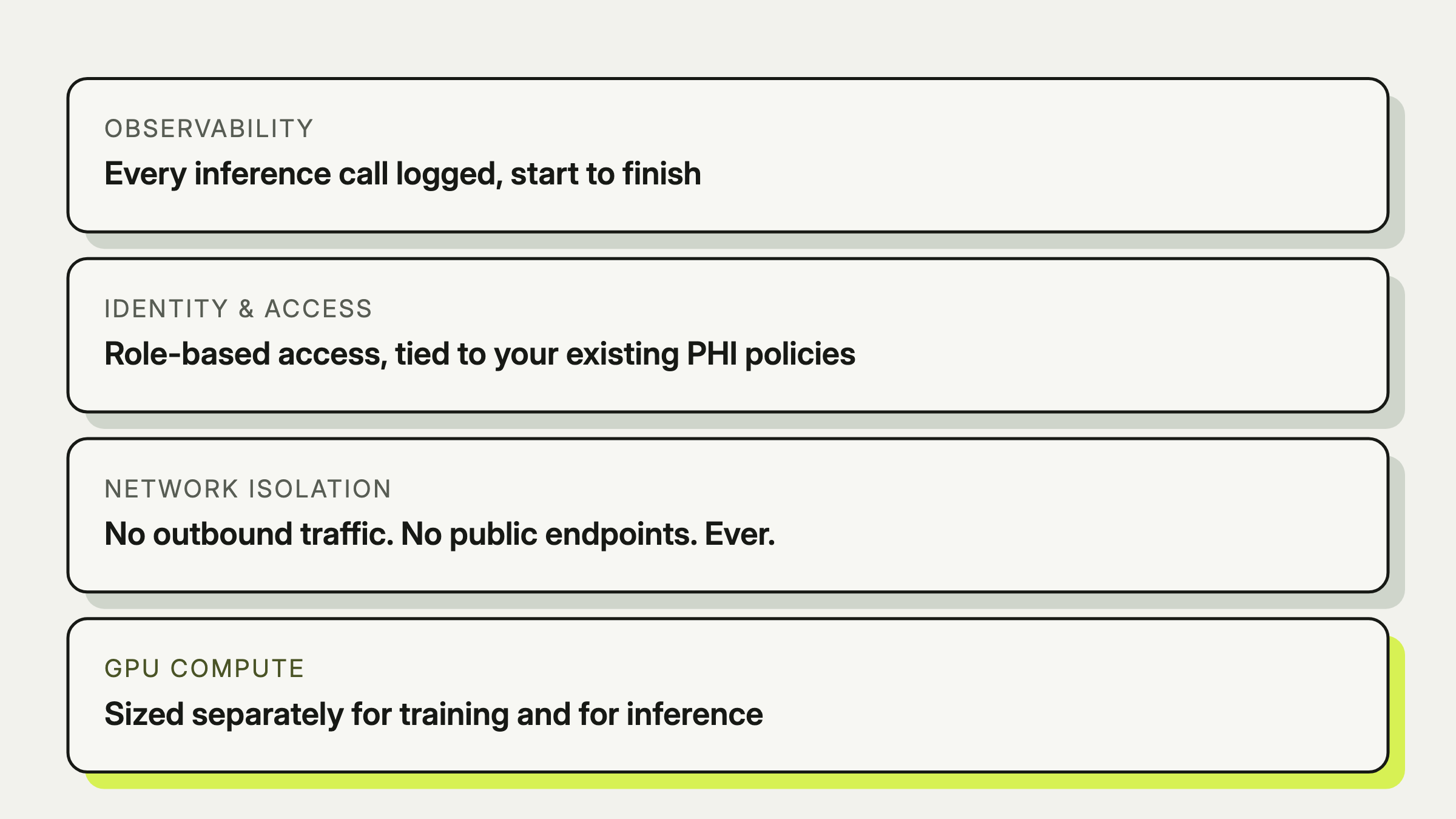
Before a model touches clinical data in a private environment, four infrastructure components need to be in place. Organizations that skip one typically discover it during compliance review, after the build has already started.
GPU Compute: Sizing for Training and Inference
Training a clinical SLM using PEFT/LoRA fine-tuning requires a minimum of one A100 40GB GPU. Full supervised fine-tuning or domain-adaptive pretraining requires two to four A100s or one H100 80GB. Inference at clinical volume, targeting sub-40ms latency and thousands of queries per day, requires dedicated GPU capacity separate from training.
| Model Size | Min. VRAM for Inference | Min. VRAM for PEFT Training |
|---|---|---|
| 3B parameters | 8GB (RTX 4090) | 12GB |
| 7B parameters | 16GB | 24GB (A100 40GB) |
| 13B parameters | 28GB | 40GB (A100 40GB) |
| 70B parameters | 140GB (2x H100) | 160GB+ |
Training compute and inference compute are separate requirements. Teams that provision GPU capacity for training frequently undersize what sustained inference at clinical volume requires.
Network Isolation: Preventing Data from Leaving Your Environment
The network configuration must enforce:
- Firewall rules blocking all outbound traffic from the model training and inference environment
- VPC configurations with no internet gateway for private cloud deployments
- Network monitoring alerts for any unexpected outbound connection attempts
Identity and Access Management: Tying AI Access to PHI Controls
Access to the model endpoint, training data, and model artifacts must be controlled at the role level, using the same RBAC policies governing PHI access elsewhere in your organization. Every user or system querying the model must be explicitly provisioned, with access reviews on a defined schedule.
Observability Stack: Logging Every Inference Call and Model Update
Every inference call must produce an auditable log: timestamp, input summary, output, model version, and user identity. Model updates must be version-controlled with reproducible checkpoints. This is what your compliance team reviews and what incident response procedures run against.
If your team is evaluating a private AI deployment and wants a specific infrastructure requirement map for your environment, book a 45-minute discovery call with HXAI. We've run private SLM deployments across health systems, payers, and HealthTech vendors and will give you a specific recommendation in that session.
Clinical Data Governance Before Training: What Has to Be in Place
Data governance is the stage that delays more private AI deployments than infrastructure. In my experience, teams discover they cannot answer basic questions about their training data after the build has already started. Four things to resolve before a single training run begins.
Legal Basis for Using Clinical Training Data
Does training on this data require patient consent, IRB approval, or a data use agreement? For de-identified data, has the de-identification been validated to HIPAA Safe Harbor or Expert Determination standard? Legal review of data provenance is non-negotiable. Budget two to four weeks of calendar time for review cycles.
PII Redaction at Scale
Clinical notes, claims records, and care coordination data contain PHI that must be redacted before training. Automated redaction with manual QA on a representative sample is the minimum standard. For a 50,000-record clinical dataset, expect two to four FTE-weeks for redaction pipeline setup and QA.
Source-to-Training Lineage Documentation
Every training record must trace back to its source system, data use agreement, and access log. Which system produced it? When? Under what agreement? This lineage is what a compliance audit starts with and what an incident response investigation requires.
Retention Policy During and After Training
How long is training data retained? Who can access it after the model is trained? When is it deleted? These answers must exist in writing before training begins. Healthcare organizations that have not defined a retention policy for AI training data are creating a compliance gap that surfaces during NIST AI RMF audits.
Get the data readiness checklist
SLM in a Box includes a data readiness checklist and governance process templates as part of every engagement, so this stage doesn't derail your timeline.
Thanks - we'll be in touch soon
Our team usually responds within one business day.
On-Premise vs Private Cloud vs Air-Gapped: Which Pattern Fits Which Healthcare Workflow
| Pattern | Use When | Infrastructure Required | Typical Healthcare Workflow |
|---|---|---|---|
| On-Premise | PHI movement must be impossible, not just unlikely | GPU servers in data center | Claims processing, prior auth, highest-sensitivity clinical workflows |
| Private Cloud | Existing cloud infrastructure, scalable volume | VPC with no public endpoints | Health systems and payers already on AWS, Azure, or GCP |
| Air-Gapped | No external connectivity acceptable | Isolated hardware, zero network access | Federal health systems, specific payer compliance environments |
One practical note from deployments I've run: organizations frequently default to private cloud when their compliance requirements call for on-premise. A VPC reduces data transit risk significantly. For the highest-sensitivity workflows including claims data, prior auth with full clinical notes, and behavioral health documentation, the CISO conversation typically ends at on-premise. The deployment pattern decision is worth resolving in the architecture session before the build starts.
What Your CISO Needs to Sign Off On Before a Clinical AI Goes Live
In every private AI deployment I've run, CISO sign-off covers the same five questions. Having clear answers before that conversation eliminates the primary source of deployment delay.
- Does data leave the environment at any point? Training data, inference inputs, and model outputs must stay inside the defined infrastructure boundary. The architecture must make this technically enforceable, not just policy-dependent.
- How is access to the model controlled? Role-based access controls tied to PHI access policies. Every user or system that can query the model must be explicitly provisioned. Access reviews on a defined schedule.
- What happens when the model is updated? Change control documentation covering what changed, when, and why. Reproducible checkpoints so the previous version can be restored if needed. Regression testing against acceptance criteria before any update goes live.
- How are inference logs retained and reviewed? Log retention policy, log access controls, and the review cadence. Who can see inference logs and for what purpose.
- What does the vendor hand over at contract end? Model artifacts, training data documentation, evaluation harness, governance documentation, and operational runbooks, all owned by your organization permanently, with no ongoing dependency on the vendor's infrastructure.
How HXAI Deploys Private Clinical AI: SLM in a Box
SLM in a Box is HXAI's managed delivery program for private clinical AI. We deploy production-ready clinical SLMs entirely inside your infrastructure, on-premise, private cloud, or air-gapped, with PHI never transiting HXAI's systems at any point.
HXAI's Six-Stage SLM Delivery Framework
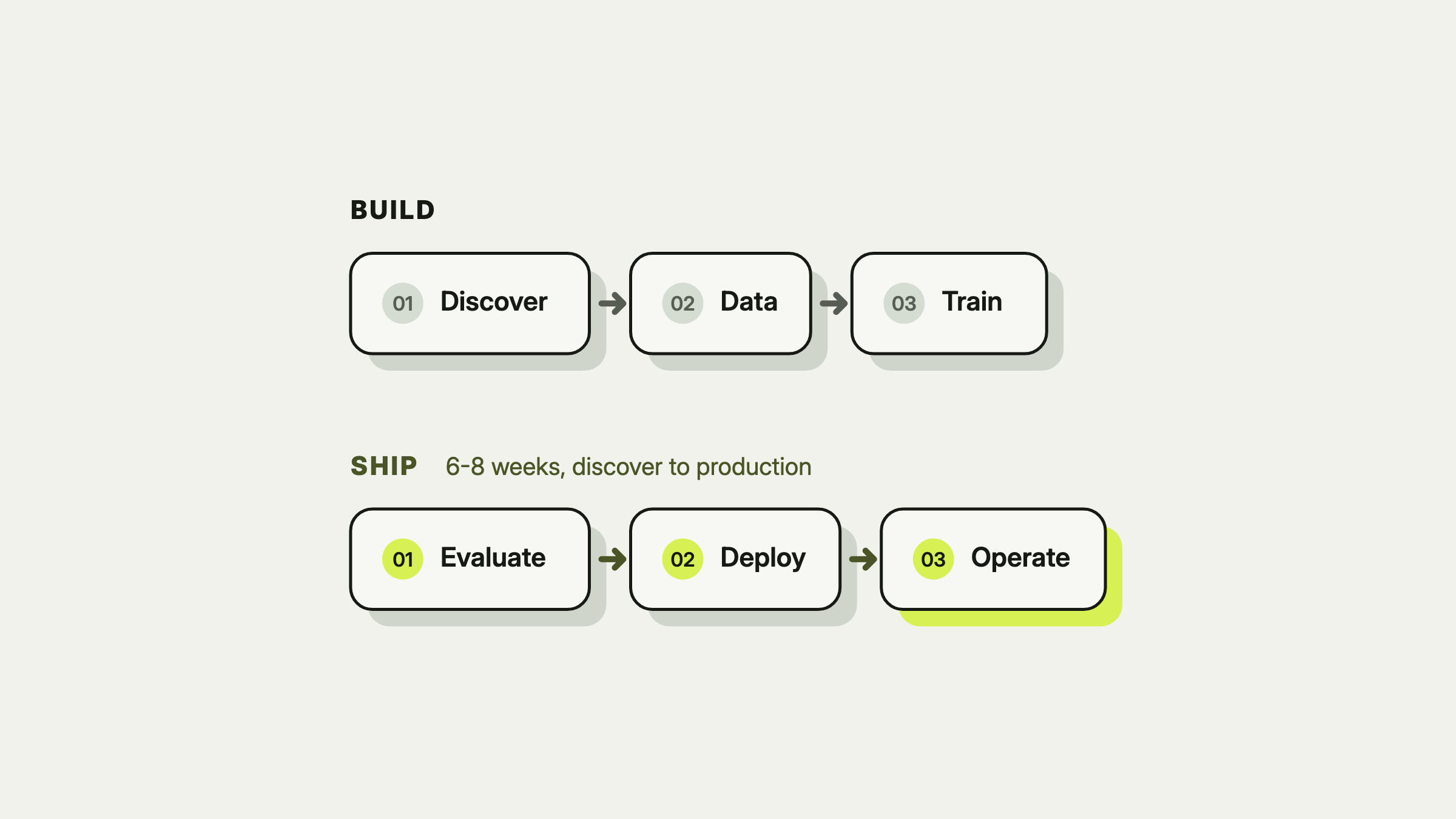
Every SLM in a Box engagement runs through six stages we've developed and refined across 17 healthcare verticals.
- Discover: Use case definition, KPI setting, data access review, risk checks, and architecture recommendation. We confirm the workflow fits the private SLM model and define what success looks like before any build begins.
- Data: Ingestion, cleaning, PII redaction, labeling, and lineage documentation. All data readiness work happens inside your environment.
- Train: Fine-tuning inside your infrastructure using PEFT/LoRA or SFT depending on the use case. Experiment tracking and reproducible checkpoints throughout.
- Evaluate: Custom regression test suite, safety checks, and accuracy validation against your defined acceptance criteria. The model does not move to deployment until it passes the evaluation harness.
- Deploy: Private endpoint setup, access controls, authentication, and observability stack. The model goes live inside your environment with full logging from day one.
- Operate: Monitoring, drift detection, feedback loops, and retraining cadence documentation. We hand off with everything your team needs to run the model independently.
What You Receive at Handoff
At the end of the engagement, your team receives:
- Fine-tuned model artifacts permanently owned by your organization
- Custom evaluation harness built for your workflow and acceptance criteria
- Governance documentation: model cards, audit trails, access logs, change control procedures aligned to NIST AI RMF
- Operational runbooks your team can run independently
No ongoing license. No infrastructure dependency on HXAI. The model runs on your infrastructure, under your controls, indefinitely. Six to eight weeks from use case selection to production.
Get an infrastructure requirement map for your environment
Send us your target clinical workflow. We'll map the GPU, network, and governance requirements specific to your infrastructure and give you a deployment recommendation, live.
Thanks - we'll be in touch soon
Our team usually responds within one business day.
Conclusion
Private AI in healthcare is becoming a compliance requirement for a growing set of clinical workflows, not a premium option. The new HIPAA Security Rule update, NIST AI RMF governance requirements, Joint Commission RUAIH guidance, and expanding state-level AI legislation mean organizations running clinical AI on hosted APIs are carrying regulatory exposure that will only increase. The infrastructure requirements are real but manageable: GPU compute with the right VRAM sizing, network isolation, IAM, and an observability stack. Data governance before training is where deployments either get this right or pay for it later.
If your organization is evaluating private AI for a specific clinical workflow, the right starting point is a scoped architecture conversation. For a detailed breakdown of what a private clinical AI deployment costs, see What Does It Cost to Deploy a Private Clinical Language Model? Book a 45-minute discovery call with HXAI and we will map your specific requirements in that session.
Frequently asked questions
HIPAA-compliant AI means the vendor has signed a BAA and follows HIPAA data handling requirements. Private AI means the model runs inside your infrastructure and data never leaves your environment. A vendor can be HIPAA-compliant while still processing your clinical data on shared external infrastructure. Private AI eliminates that exposure entirely.
PEFT/LoRA fine-tuning on a 7B model requires one A100 40GB GPU with 40GB VRAM. Full SFT requires two to four A100s or one H100 80GB. Inference at clinical volume requires dedicated GPU capacity separate from training. A 7B model running inference needs a minimum of 16GB VRAM. The right specification depends on model size, training approach, and query volume.
A first production deployment on a single, well-scoped clinical workflow takes six to eight weeks through a managed build program. The timeline extends when data readiness is lower than expected or compliance review surfaces data governance questions not resolved before training begins.
The updated HIPAA Security Rule (HHS OCR January 2025), NIST AI RMF governance requirements, Joint Commission RUAIH guidance, and state-level AI legislation across at least thirteen states collectively pressure healthcare organizations toward private deployments for high-stakes clinical workflows.
Sovereign AI refers to AI systems where the health system runs its own model on its own infrastructure, so PHI never leaves the organization's perimeter under any condition. It is a synonym for private AI with an emphasis on data sovereignty and organizational ownership. The model, training data, inference logs, and governance documentation all belong to the organization.
No. The HXAI delivery team works inside your infrastructure under your access controls throughout the engagement. Training runs inside your environment. Inference runs on a private endpoint. PHI does not transit HXAI's systems at any point.
- HHS Office for Civil Rights. HIPAA Security Rule to Strengthen the Cybersecurity of Electronic Protected Health Information. Federal Register, January 2025.
- NIST. Artificial Intelligence Risk Management Framework (AI RMF 1.0). 2023.
- NIST. AI Risk Management Framework: Generative AI Profile (NIST AI 600-1). July 2024.
- The Joint Commission. Requirements for Using Artificial Intelligence in Healthcare (RUAIH). 2025.
- Healthcare.digital. Engineering Sovereign AI in Healthcare: Architecture, Compliance and National Strategies. June 2026.
- AWS. Running and Optimizing Small Language Models On-Premises and at the Edge. 2025.
- John Snow Labs. Medical Small Language Models: Benchmarking JSL-MedS vs GPT-4o. 2025.
