Agentic AI in healthcare refers to autonomous AI systems that can perceive clinical and operational data, reason through multi-step problems, take actions across systems, and adapt based on feedback, entirely without a human initiating each step.
Across 25 years working with payers, providers, and life sciences organizations, I have watched many technology categories arrive with significant promise. Agentic AI is the first one that changes the structure of how healthcare work gets done.
A Microsoft and Health Management Academy study published in the New England Journal of Medicine found that 43% of health systems are piloting agentic AI, but only 3% have it running in live workflows. Understanding why that gap exists, and what the 3% are doing differently, is what this guide covers.
Quick answer: Agentic AI in healthcare is an AI system that perceives clinical and operational data, plans a sequence of steps, acts across systems autonomously, and learns from outcomes. It differs from generative AI (which responds to prompts) and RPA (which follows fixed rules) in that it handles multi-step workflows end to end without human initiation at each step. Deployed use cases include ambient clinical documentation, claims denial management, care gap closure, member risk stratification, and fraud detection.
What Is Agentic AI in Healthcare?
Agentic AI is an AI system that can set a goal, plan the steps to achieve it, execute those steps across multiple tools and systems, and revise its approach based on outcomes.
In healthcare, that means an agent can receive a clinical trigger and handle the downstream workflow without a human directing it at every turn.
The Four Core Capabilities
- Perception: Reading and interpreting inputs from EHRs, claims systems, lab data, scheduling systems, payer portals, and unstructured clinical notes.
- Reasoning: Planning a sequence of steps to achieve a defined goal, including branching logic when conditions change.
- Action: Executing across systems: drafting an appeal letter, generating a structured note, routing a referral, flagging a claim before submission.
- Learning: Updating behavior based on feedback, outcomes, and corrections from clinical staff or compliance review.
Agentic AI vs Generative AI vs RPA
These three are frequently conflated, and the confusion leads to wrong architecture decisions.
| Generative AI | RPA | Agentic AI | |
|---|---|---|---|
| How it works | Responds to prompts, produces content | Follows fixed rules and scripts | Plans and executes autonomously across variable conditions |
| Input | Human prompt | Structured trigger, defined path | Clinical or operational data, any format |
| What happens when conditions change | Requires a new prompt | Breaks or requires reprogramming | Adapts its plan |
| Healthcare example | Summarize a clinical note on demand | Submit a claim form via scripted portal navigation | Detect a claim likely to be denied, flag it before submission, draft the appeal if it is denied |
Many organizations are calling RPA workflows agentic AI. Many are calling generative AI assistants agents. Neither is accurate.
Further reading: SLM vs RAG vs Fine-Tuned LLM: Choosing the Right Clinical AI Architecture
How Agentic AI Works: Single Agents, Multi-Agent Systems, and Why the Distinction Matters
Single Agents
A single agent operates within one workflow boundary. For bounded clinical tasks like summarizing a diagnostic report, structuring a radiology finding, or reconciling a medication list, a single agent with the right data access and a well-defined output space is sufficient.
Multi-Agent Systems
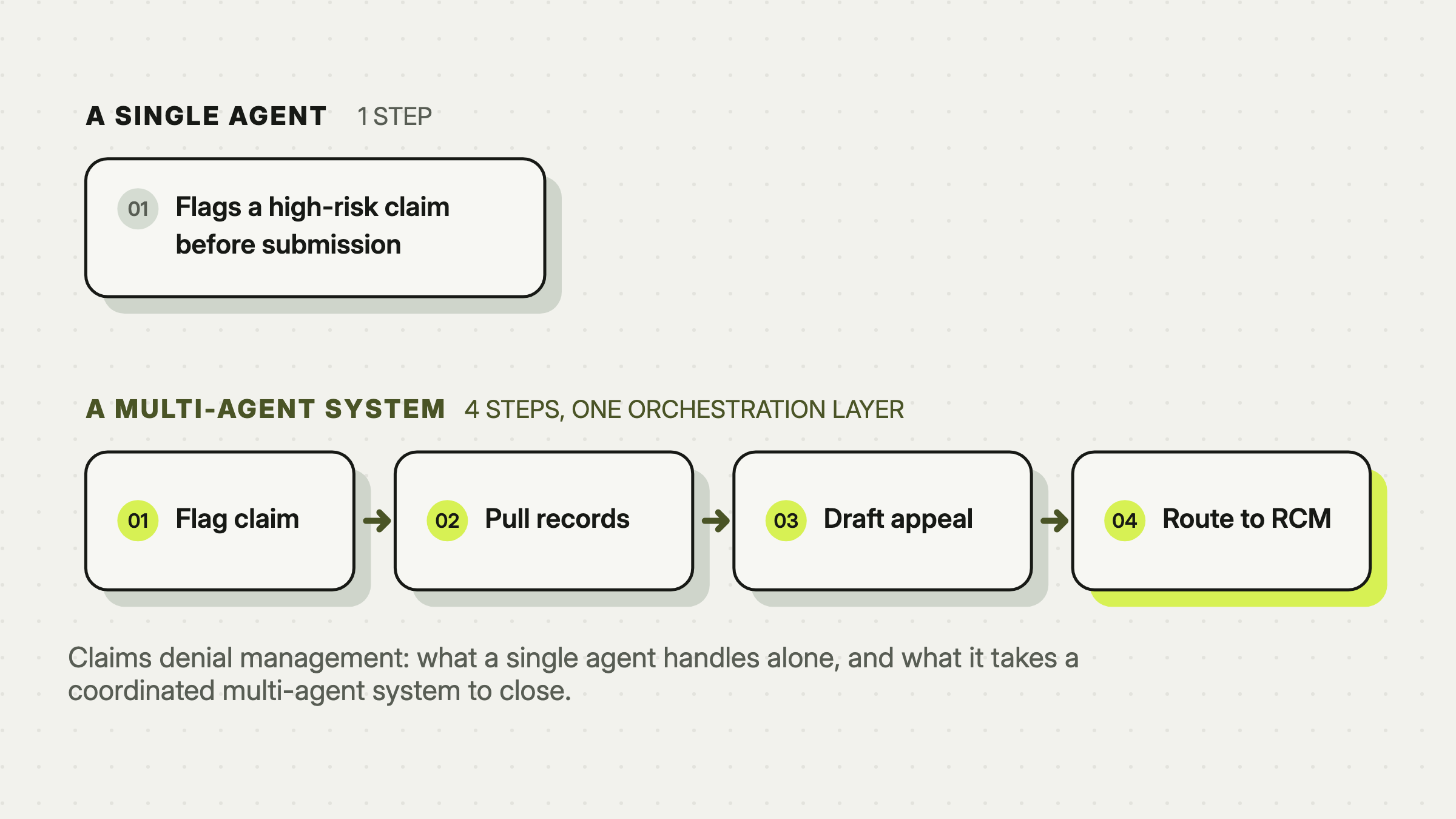
A multi-agent system orchestrates several agents, each responsible for a specific task, handing work to the next agent when its part is complete.
When walking a CIO through why the single vs. multi-agent distinction matters, claims denial management is always the workflow that makes it click. A single agent can flag a claim likely to be denied before submission. But handling the full denial cycle (flagging, analyzing the denial reason, pulling clinical documentation, drafting the appeal with payer-specific language, and routing it for RCM review) requires multiple agents coordinating in sequence. Each agent owns one step. The orchestration layer manages the handoffs.
Where Multi-Agent Systems Break Down
Individual agents perform well. The breakdown happens at the seams, when one agent needs to hand structured work to the next.
Multi-agent systems require an orchestration layer that manages agent sequencing, data handoffs, error handling, and escalation to human review. In healthcare, the orchestration layer also carries compliance responsibility: every agent action must be logged, every data handoff must maintain PHI containment, and every output that influences a clinical decision must be attributable and auditable.
What Agentic Workflows Look Like Across the Healthcare Stack
Agentic AI applies differently across healthcare. The deployments that have reached production share a common architecture: a defined trigger, a sequence of agents each owning one step, human review at the right points, and an audit trail throughout. Here is what that looks like across the five operational layers where agents are in live use.
Clinical Documentation and Coding
A physician conducts a patient encounter. An ambient documentation agent captures the audio or transcript, processes it in real time, and generates a structured clinical note (SOAP format, progress note, or discharge summary), ready for physician review within minutes of the encounter ending.
A second agent reads the completed note, maps the clinical content to CPT and ICD-10 codes, flags any undercoding or missing codes, and presents a coding recommendation. A third agent monitors the incoming lab and diagnostic stream, surfaces abnormal values, and flags clinically significant findings as results arrive.
Each agent operates independently and in parallel. The documentation agent does not wait for the coding agent. The lab agent does not wait for either.
Where humans stay in the loop: The physician reviews, edits, and signs the note. A coding specialist reviews the flagged codes before claim submission. Lab findings are surfaced for clinical review, the agent does not trigger orders.
What drives the outcomes: Ambient AI documentation has reduced physician charting time by 40 to 45% at Mass General Brigham. AI-assisted coding has driven 25% reductions in denial rates tied to coding errors.
HXAI's Ambient Clinical Documentation Agent, Coding & Charge Capture Agent, and Lab & Diagnostic Report Summarizer Agent cover this workflow.
Revenue Cycle and Claims
Before a claim is submitted, a denial prediction agent reads the claim data alongside the clinical documentation and scores the claim against payer-specific denial criteria. High-risk claims are flagged and routed to an RCM reviewer before they go out, not after they come back denied.
When a claim is denied, an appeals drafting agent picks it up. It reads the denial reason code, retrieves the relevant clinical documentation from the EHR, and drafts a payer-specific appeal letter. The appeal is structured for the specific payer's clinical criteria, not a generic template.
Running in parallel, an underpayment detection agent audits adjudicated claims against contracted rates. It identifies where reimbursement fell short and surfaces recovery opportunities the billing team would otherwise miss.
This is a three-agent system where each agent triggers independently on the right event. The claims cycle does not stop and wait. Each piece runs when its trigger fires.
Where humans stay in the loop: RCM staff review high-risk flagged claims before submission. Appeals are reviewed and approved before filing. Underpayment flags are reviewed before recovery is initiated.
What drives the outcomes: Avoidable claim denials run at 86 to 90% across the industry. HFMA data shows AI-driven automation in this layer saves 2,841 staff hours annually and produces direct cost savings of $644,000 per deployment.
HXAI's Claims Denial Prediction Agent, Appeals Drafting Agent, and Underpayment Detection Agent cover this workflow.
Payer Operations
A member risk stratification agent runs on a defined cadence, scoring health plan members against admission and utilization risk using claims history, clinical data, and social determinants. High-risk member lists are surfaced to care management before a hospitalization, not after.
A fraud detection agent monitors the incoming claims stream continuously, identifies anomalous billing patterns across providers, and routes findings to the SIU team for investigation. It does not make a determination: it flags for human review.
A care gap closure agent identifies members due for preventive screenings or chronic disease follow-up, generates outreach triggers, and tracks closure rates against quality measures like HEDIS and Stars. The care coordinator does not manually pull each member. The agent surfaces the list and the reason.
Where humans stay in the loop: Population health teams review high-risk lists and prioritize outreach. SIU investigators review every flagged billing pattern before any action. Care management approves outreach campaigns.
What drives the outcomes: The share of payer organizations investing in AI for business transformation jumped from 15% in 2024 to 52% in 2025, according to Gartner. For Medicare Advantage plans, AI-driven care gap closure and HCC capture are becoming core to Stars ratings performance.
HXAI's Member Risk Stratification Agent, Fraud, Waste & Abuse Detection Agent, and Care Gap Closure Agent cover this workflow.
Clinical Research and Trials
When a new clinical trial opens, a protocol digitization agent processes the protocol PDF and converts it into structured, queryable eligibility criteria. The result is a machine-readable definition of who qualifies, rather than a PDF a coordinator has to read manually every time a new patient is screened.
A trial matching agent runs continuously as patient records update. It reads both structured and unstructured chart data, matches against active trial criteria, and surfaces patients who qualify. The coordinator reviews matches and initiates contact. The agent does not contact patients.
For oncology and specialty workflows, a treatment pathway agent converts clinical guideline documents into deterministic treatment recommendation logic. When a physician submits patient pathology and biomarker data, the agent matches against the structured guideline representation and returns an explainable recommendation with the specific source citation. It retrieves from structured logic rather than generating from training memory. That distinction matters for clinical accountability.
Where humans stay in the loop: Principal investigators review every trial match before patient contact. Oncologists review pathway recommendations before any treatment decision. Every recommendation includes the specific guideline and matching criteria.
HXAI's Protocol Digitization Agent, Trial Matching Agent, and Treatment Pathway Agent cover this workflow.
Care Coordination and Post-Acute
At discharge, a medication reconciliation agent reads the patient's medication list from the inpatient EHR, compares it against the outpatient medication history, flags interactions, duplications, and omissions, and presents a reconciled list for the discharging physician to review.
A care gap closure agent tracks the discharged patient's follow-up care status against the care plan, identifies gaps as they open, and routes them to the appropriate care team member (outpatient physician, home health coordinator, or case manager) without a coordinator manually monitoring every case.
In post-acute settings, agents handle prior authorization requests for skilled nursing and home health services, pulling clinical documentation from the acute episode and matching it to payer criteria. This is the workflow that has historically run on faxed paper. Agents replace the fax, the manual data entry, and the back-and-forth with payer portals.
Where humans stay in the loop: Physicians review the reconciled medication list before discharge. Care managers review routed care gaps and decide on action. Prior auth decisions are reviewed by clinical staff before submission.
HXAI's Medication Reconciliation Agent and Care Gap Closure Agent cover parts of this workflow. The full post-acute prior auth workflow runs on Agent Hero.
Your first healthcare agent is on us
Tell us your workflow. HXAI scopes, builds, and hands it off production-ready in 8 weeks.
Thanks - we'll be in touch soon
Our team usually responds within one business day.
Where Humans Stay in the Loop: A Workflow-by-Workflow Map
Every agentic AI vendor says "human in the loop." What that means in practice varies enormously by workflow, and the difference matters for clinical accountability, regulatory compliance, and operational planning.
| Workflow | What the Agent Handles | Human Review Point | Who Reviews |
|---|---|---|---|
| Ambient clinical documentation | Generates structured note from encounter | Reviews, edits, signs | Physician or NP |
| Medical coding | Suggests CPT/ICD-10 codes, flags undercoding | Reviews and approves codes | Coding specialist |
| Claims denial prediction | Flags high-risk claims before submission | Reviews flagged claims, decides to hold or submit | RCM team |
| Appeals drafting | Drafts payer-specific appeal letter | Reviews and approves appeal | RCM team |
| Care gap closure | Identifies members, generates outreach trigger | Approves outreach campaign | Population health team |
| Member risk stratification | Scores members for admission/utilization risk | Reviews high-risk lists | Care management |
| Fraud and waste detection | Flags anomalous billing patterns | Investigates flagged patterns | SIU and compliance |
| Medication reconciliation | Reconciles lists across care transitions, flags interactions | Reviews flagged interactions | Pharmacist or physician |
| Trial matching | Matches patients to active trials | Reviews matches, approves contact | Principal investigator |
| HIPAA access audit | Monitors EHR access logs for inappropriate PHI access | Investigates flagged access events | Privacy officer |
Across every live deployment: agents handle data retrieval, matching, drafting, and flagging. Humans handle final approval on anything that initiates a clinical action, influences a coverage decision, or enters the official medical record.
What Healthcare Organizations Need Before an Agent Goes Live
Healthcare AI projects stall between pilot and production because the deployment infrastructure was never built, not because the AI failed.
Four things need to be in place before an agent can operate reliably in a live workflow.
FHIR R4 API Access to Your Clinical and Operational Systems
An agent cannot act on data it cannot read. FHIR R4 interoperability is the baseline for an agent that needs to retrieve patient records, clinical documentation, scheduling data, or claims history from an EHR.
Healthcare's data environment creates specific challenges:
- Epic FHIR sandbox access requires specific configuration and approval
- HL7 feeds from older systems vary significantly in quality and completeness
- Scanned documents require OCR and parsing before an agent can read them
Data readiness is infrastructure work, not AI work. It consistently takes longer than teams anticipate and is the most common reason a pilot that worked in demo breaks in production.
Structured Data Pipelines With Monitoring
Agents degrade silently when data quality drops. In one health system deployment, an agent performed well through the entire pilot phase and then degraded in production for three weeks before anyone noticed. The cause was an EHR configuration change that altered how clinical notes were structured, and there was no monitoring in place to catch it.
Production agentic AI needs pipeline monitoring that catches upstream changes before they reach the agent, rather than being discovered by a physician noticing that output quality has dropped.
Identity and Access Management for Agent Endpoints
An agent that accesses the EHR, the claims system, the payer portal, and the scheduling system requires access governance with the same rigor as human access. Every agent endpoint requires:
- Role-scoped access tied to the specific workflow
- Audit logging of every API call
- Credential rotation on a defined schedule
- Access reviews aligned with your existing IAM governance cycle
Organizations with mature IAM for human users still need deliberate architecture work to extend that to agent endpoints. Agent identities are a separate model from human identities and require explicit design.
An Audit Trail That Captures Every Agent Decision
NIST AI RMF, Joint Commission RUAIH, and an expanding set of state AI legislation require healthcare organizations to explain and audit AI-assisted decisions. For agentic AI, a proper audit trail captures the intermediate reasoning steps:
- What data the agent retrieved
- What criteria it applied
- What alternatives it considered
- Why it produced the output it did
Building this requires instrumentation at the orchestration layer, capturing reasoning steps alongside inference outputs.
Further reading: How to Deploy Private AI in Healthcare: On-Premise, Private Cloud, and Air-Gapped
The Regulatory Layer Specific to Agentic AI in Healthcare
Standard healthcare AI compliance content covers HIPAA, NIST AI RMF, and FDA SaMD classification. Agentic AI introduces four specific regulatory questions that none of those frameworks fully answer yet.
HIPAA Accountability When an Agent Acts Autonomously
When an agent acts autonomously and PHI is exposed through a data handoff between two agents or an API call to a payer system, accountability is not clear in the existing HIPAA framework.
The covered entity remains liable. The question of what constitutes a breach when an agent accesses PHI as part of a legitimate workflow, where data transits multiple systems, is an area where healthcare legal teams are building interpretations in the absence of specific HHS guidance. Every multi-agent deployment requires a specific legal review of the agent data flow before go-live, separate from the standard BAA review.
ONC HTI-1 and Agent Access to Interoperability APIs
ONC's HTI-1 rule establishes requirements for health IT developers around standardized API access. Agents that access FHIR APIs to retrieve clinical data are operating in the scope of HTI-1. The compliance question is whether the agent's API access constitutes information blocking if it is not available to all users of the system in the same way.
Joint Commission RUAIH and Demonstrating AI Oversight
The Joint Commission's RUAIH requirements mandate that health systems demonstrate oversight, monitoring, and governance of AI tools used in clinical decisions.
For an autonomous agent that initiates workflows without human prompting, demonstrating oversight requires documenting:
- How the agent is monitored
- What triggers human review
- How performance is tracked over time
- What the incident response procedure is when the agent produces an unexpected output
Who Is Responsible When an Agent Gets It Wrong
When a claims denial prediction agent fails to flag a high-risk claim, the claim is denied, and a patient's care is delayed. Who is responsible? The health system bears clinical accountability. Vendor liability depends on the contract. That answer will evolve as regulations catch up to deployment.
The organizations building agentic AI governance frameworks now, with clear accountability mapping for each agent action that influences a clinical or coverage decision, are building the compliance posture that will be required within two to three years.
Why 43% Are Piloting Agentic AI and Only 3% Have Deployed It
43% of health systems are piloting agentic AI, but only 3% have it running in live workflows. The deployment infrastructure around it is a major reason why, but the breakdown also comes from four overlapping operational problems that compound on each other.
The Data Is Not Structured Enough for Agents to Act On
Agents require structured, accessible, consistently formatted data to operate reliably. The average health system has clinical data distributed across multiple EHRs with different FHIR configurations, legacy systems with HL7 feeds of variable quality, scanned documents that have never been digitized, and payer data that arrives via fax or portal with no API access.
Building an agent on top of this produces a system that works in demo conditions and breaks in production when the data does not match what the agent was trained on.
PHI Exposure Happens at the Agent Handoff Points
In a single-agent system, PHI exposure is manageable: one system, one endpoint, one access log. In a multi-agent system, PHI crosses system boundaries every time one agent hands work to the next.
Each handoff is a potential exposure point. Organizations that have not built the orchestration layer to maintain PHI containment at every handoff are running multi-agent systems that are non-compliant as soon as they enter production.
Governance Documentation Is Missing When Auditors Arrive
NIST AI RMF audit readiness for an agentic system requires model cards, audit trails, access logs, change control procedures, and incident response documentation.
Health systems that pilot agents by spinning up an API integration and calling it a deployment have none of this. When the review arrives from the Joint Commission, from a state regulator, or from legal after an adverse event, there is nothing to show.
Clinical Staff Stop Using the Agent Because They Do Not Trust It
This is what ends healthcare AI deployments more than any technical problem, and no vendor will tell you that upfront.
An agent produces a diagnostic report summary that is accurate 94% of the time. Clinical staff review every output and correct it on instinct rather than on evidence, because they have no visibility into how the agent reasoned to its conclusion. Over time the workflow reverts: the agent produces, humans redo, and the efficiency gain disappears.
The fix is explainability: a visible reasoning trace that clinical staff can read and evaluate. And a change management process that builds trust through demonstrated accuracy over time.
How HXAI Deploys Agentic AI for Healthcare Organizations: Agent Hero
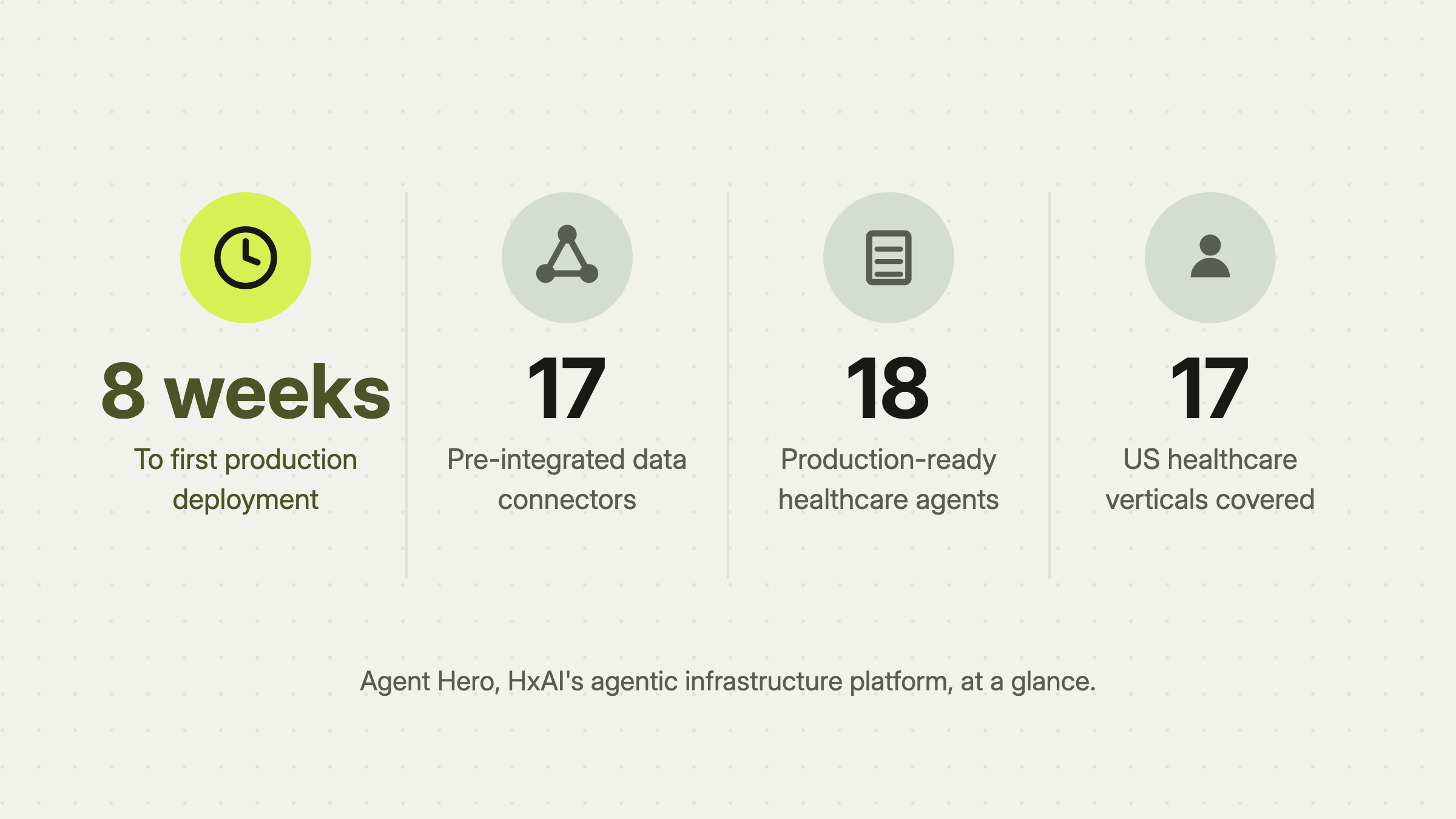
Agent Hero is HXAI's HIPAA-compliant agentic infrastructure platform, purpose-built for US healthcare workflows with 17 pre-integrated components that address the four infrastructure requirements and four deployment risks this guide covers.
What Agent Hero Covers
- Orchestration inside your infrastructure: Agent Hero deploys inside your environment, on-premise, private cloud, or hybrid. PHI never leaves your infrastructure. Every agent handoff is logged, and every data transit maintains PHI containment at the boundary.
- Pre-integrated healthcare data connectors: FHIR R4, HL7 v2, EHR APIs (Epic, Cerner, Athena), payer portal connectors, and claims system integrations are pre-built. The 17 pre-integrated components compress the infrastructure build from months to weeks.
- Compliance-ready audit trails: Every agent action produces an audit log in the format required for NIST AI RMF review, Joint Commission RUAIH documentation, and HIPAA access accounting.
- Explainable agent reasoning: Agent Hero surfaces the reasoning trace alongside the output: what data the agent read, what criteria it applied, and what alternatives it considered. This is what resolves clinical staff trust and reduces the override rate that ends adoption.
What We Have Deployed
In one geriatric care engagement, agentic AI managed patient records, automated documentation, and reduced administrative workloads across the care team. Results: a 25% reduction in time spent on CMS quality reporting, a 5% increase in daily encounter volume, and a 25% decrease in denied claims.
In a second engagement, a multi-agent care coordination system handled post-discharge workflows across a large health system, reading clinical context, identifying care gaps, routing escalations, with no care manager manually reviewing every handoff. The platform reconciled records across 40+ provider networks underneath it.
HXAI has built and deployed agentic systems across health systems, payers, pharma companies, and HealthTech vendors spanning 17 US healthcare verticals. First deployment takes eight weeks from use case selection to production.
Ready to see which agents apply to your specific workflows? Browse HxAI's 18 production-ready healthcare agents.
Ready to see which agents apply to your workflows?
Browse HxAI's 18 production-ready healthcare agents, or book a strategy call and we'll map your workflows to the right agent architecture with a deployment recommendation in that session.
Thanks - we'll be in touch soon
Our team usually responds within one business day.
Conclusion
Agentic AI in healthcare requires concrete production decisions: which workflows are ready, what infrastructure they require, where humans need to stay in the loop, and what governance documentation your compliance team will need.
The organizations moving from pilot to production are the ones that resolved data readiness, PHI containment at agent handoffs, audit trail requirements, and clinical staff trust before they started the build. That is a harder and more specific set of problems than the category-level content on agentic AI acknowledges, which is precisely why the 43% vs 3% gap exists.
Book a strategy call with HxAI to map your workflows to the right agent architecture.
Frequently asked questions
Agentic AI in healthcare is an AI system that perceives clinical and operational data, plans a sequence of steps to accomplish a goal, takes actions across multiple systems autonomously, and adapts based on outcomes, entirely without a human initiating each step. It differs from generative AI, which responds to prompts, and RPA, which follows fixed scripts, in that it handles complete multi-step workflows end to end.
Generative AI responds to a prompt and produces content: a note summary, a draft message, a code suggestion. Agentic AI plans and executes across multi-step workflows autonomously. A generative AI tool produces a claims appeal when a human asks it to. An agentic system detects a denied claim, reads the denial reason, retrieves supporting clinical documentation, drafts a payer-specific appeal, and routes it for RCM review, all without a human initiating each step.
The workflows with the deepest production track record are ambient clinical documentation, medical coding support, claims denial prediction and appeals drafting, care gap closure, member risk stratification, fraud and waste detection, and medication reconciliation. Clinical research applications including protocol digitization and trial matching are in active production at pharma and life sciences organizations.
In a properly architected multi-agent deployment, every agent handoff maintains PHI within the defined infrastructure boundary, on-premise or in a private cloud with no data transiting external systems. Every data handoff is logged, every agent endpoint has role-scoped access, and the orchestration layer enforces containment at each boundary.
HIPAA compliance for agentic AI depends on the architecture. The covered entity remains liable for how agents access and transmit PHI, regardless of vendor BAA coverage. Private, on-premise, or private-cloud agentic deployments where PHI stays inside the organization's infrastructure are the architecturally compliant path for high-sensitivity clinical workflows.
A first production deployment on a single, well-scoped healthcare workflow takes eight weeks from use case selection to production through HXAI's Agent Hero program. The timeline extends when data readiness is lower than expected or the workflow boundary is not clearly defined before the build begins.
Agent Hero is HxAI's HIPAA-compliant agentic infrastructure platform for healthcare. It deploys inside your infrastructure with 17 pre-integrated healthcare data connectors, compliance-ready audit trails, and explainable agent reasoning. HxAI's agent library includes 18 production-ready healthcare agents across clinical documentation, revenue cycle, payer operations, clinical research, compliance, and portfolio management.
- Microsoft and The Health Management Academy. Assessing Healthcare's Agentic AI Readiness. New England Journal of Medicine, January 2026.
- Gartner. Predicts 2026: U.S. Healthcare Payers Bet Big on Agentic Workforce. December 2025.
- HFMA. Prior Authorization Is Draining Revenue - Why Automation Has Become a Strategic Imperative. May 2026.
- HFMA. Health systems start to fight back against AI-powered robots driving denial rates higher. December 2025.
- Mass General Brigham. Hybrid Ambient Documentation Decreases After-Hours Work. November 2025.
- The Joint Commission. Requirements for Using Artificial Intelligence in Healthcare (RUAIH). 2025.
- NIST. AI Risk Management Framework (AI RMF 1.0). 2023.
- HHS Office for Civil Rights. HIPAA Security Rule Update. Federal Register, January 2025.