SLM vs RAG vs Fine-Tuned LLM: Choosing the Right Clinical AI Architecture
Choosing between SLM, RAG, and a fine-tuned LLM for a clinical workflow comes down to four factors: what the task requires, whether PHI can leave your infrastructure, how many queries run per day, and whether the information the model needs changes faster than you can retrain.
I've run this decision across health systems, payers, pharma companies, and HealthTech vendors. The architecture question looks complicated on paper. In practice, it usually resolves quickly once you apply those four factors to a specific workflow.
Quick answer: SLMs are fine-tuned smaller models for high-volume, bounded, privacy-sensitive clinical workflows like prior authorization and medical coding. RAG grounds a model's outputs in external documents at inference time, making it right for workflows that depend on frequently changing information: drug formularies, payer policies, clinical guidelines. Fine-tuned LLMs adapt a large model on domain data and suit broad clinical tasks requiring strong reasoning alongside domain calibration. Healthcare organizations in production typically run all three with a routing policy that directs each workflow to the right architecture.
The Core Difference Between SLM, RAG, and a Fine-Tuned LLM
When I walk a clinical AI team through architecture options, I start with one question: what does the model need to change? The answer tells you which architecture you're dealing with.
Small Language Models (SLMs)
An SLM changes what the model is. It is a language model in the 100M to 10B parameter range, fine-tuned for a specific domain or task. Rather than a generalist, you end up with a specialist built for a defined output space, designed to run on-premise or in a private cloud. PHI never leaves your infrastructure.
For a full breakdown, read What Is a Small Language Model in Healthcare?
Retrieval-Augmented Generation (RAG)
RAG changes what the model sees. It adds a retrieval layer to an existing model. At inference time, the model pulls relevant documents from a knowledge base and uses that content to ground its response. The model's weights stay unchanged. The knowledge it draws on can be updated continuously without retraining.
Fine-Tuned LLMs
A fine-tuned LLM changes how the model behaves. It takes a large pretrained model (70B+ parameters) and adapts it on domain-specific data using supervised fine-tuning, RLHF, or PEFT. Outputs calibrate toward clinical accuracy, terminology becomes domain-appropriate, and hallucination rates on clinical tasks drop. The model stays large, which means substantial infrastructure requirements carry through.
| Architecture | What It Changes |
|---|---|
| SLM | What the model is |
| RAG | What the model sees |
| Fine-Tuned LLM | How the model behaves |
How Each Architecture Handles PHI and Compliance
In my experience, this is the question that actually determines architecture in healthcare, well before task performance enters the conversation.
| Architecture | PHI at Inference | Audit Trails | Infrastructure Requirement |
|---|---|---|---|
| Private SLM | Stays inside your infrastructure | Built in by design | On-prem or private cloud GPU |
| RAG with private generation | Stays inside | Depends on implementation | Vector DB + private generation layer |
| RAG with hosted API | Transits external API | Unavailable from vendor | Minimal |
| Fine-tuned LLM, private | Stays inside | Achievable with proper logging | High GPU capacity |
| Fine-tuned LLM, hosted | Transits external API | Unavailable from vendor | Minimal |
The compliance gap I see consistently in RAG deployments: a RAG system is only as private as its generation layer. Retrieval can run privately while generation still routes to a hosted API. That means PHI transits external infrastructure. This surfaces during compliance review, rarely during prototyping. It is why I flag it early in every architecture conversation.
For any workflow where PHI cannot leave your infrastructure, the architecture that delivers the best task performance at the lowest infrastructure cost is a private SLM. For a detailed cost breakdown of private clinical SLM deployment, see What Does It Cost to Deploy a Private Clinical Language Model?
Where RAG Wins in Healthcare
RAG is the right call when the information a model needs changes faster than you can retrain. I've seen this pattern consistently with payer workflows. A fine-tuned model from six months ago returns outdated prior auth criteria, and your team is submitting against the wrong policy.
A 2026 systematic review of 50 peer-reviewed studies found that RAG significantly reduces hallucination rates in clinical settings by dynamically accessing current knowledge rather than relying on training data that may be months out of date.
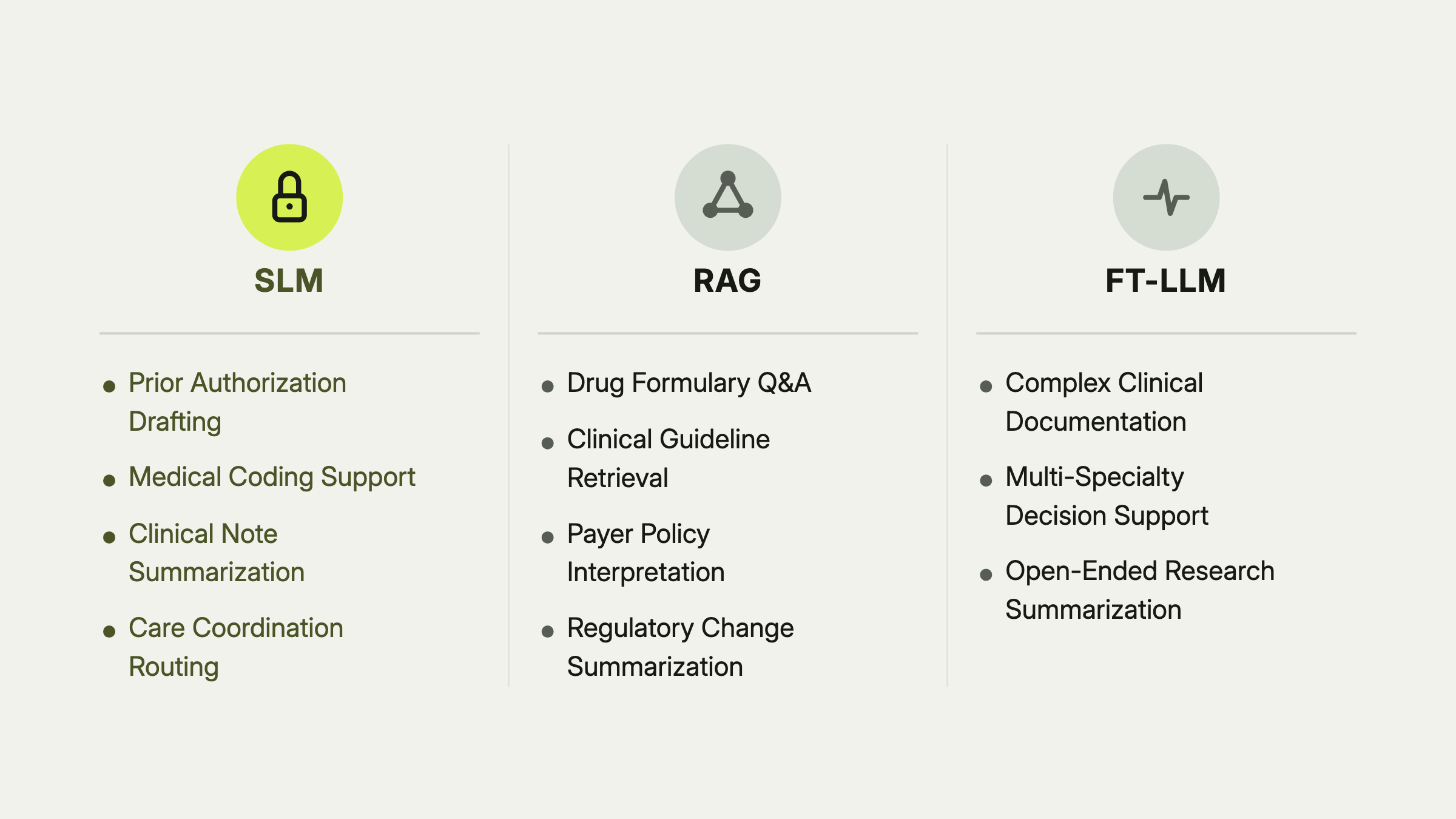
The workflows where RAG consistently wins:
Drug Formulary Q&A
Formularies change with payer cycles. A RAG system connected to a current formulary database reads from the source every time, rather than recalling what was true at training.
Clinical Guideline Retrieval
Guidelines from USPSTF, ACC, and AHA update on varying schedules. RAG grounded in a curated, current guidelines database produces responses traceable to the source document with a citation a clinician can verify.
Payer Policy Interpretation
Prior auth criteria vary by payer and update quarterly or more. A RAG system connected to current payer policy documents gives a prior auth team accurate, current criteria without requiring a retraining cycle each time a policy changes.
Regulatory Change Summarization
CMS rule updates, ONC guidance changes, and new accreditation requirements arrive on irregular schedules. RAG lets the system answer questions about current regulatory requirements by retrieving from the actual regulation text.
Where Fine-Tuned LLMs Win in Healthcare
Fine-tuned LLMs are the right architecture when the task surface is wide, open-ended reasoning is required, and a general-purpose model keeps producing clinically off outputs. Fine-tuning fixes that without removing the model's breadth.
A scoping review published in February 2026 found that hybrid fine-tuning plus RAG frameworks produce the strongest combination of domain reasoning and factual accuracy for complex clinical tasks.
The workflows where fine-tuned LLMs are the right call:
Complex Clinical Documentation
Generating a complete, accurate patient history from multiple note types, lab results, and imaging reports requires broad reasoning. A fine-tuned LLM calibrated on your organization's documentation style reduces the physician review burden substantially compared to a general model zero-shot on the same task.
Multi-Specialty Clinical Decision Support
Decision support tools serving physicians across specialties need both broad medical knowledge and domain calibration. Fine-tuning a large model on clinical literature and your organization's protocols delivers that combination.
Open-Ended Research Summarization
Synthesizing literature across a broad research question, identifying contradictions, or generating narrative evidence summaries requires long-context reasoning only large models provide reliably. Fine-tuning orients that reasoning toward clinical relevance.
The honest trade-off: a fine-tuned LLM on private infrastructure requires significantly more GPU capacity than an SLM deployment. For bounded workflows, a well-tuned SLM delivers the same clinical output at much lower ongoing cost. I only recommend fine-tuned LLMs where the task requires the breadth.
Where SLMs Win in Healthcare
SLMs win when three conditions are simultaneously true: the task is bounded, the data is sensitive, and the volume is high. In my experience, this describes a large share of the workflows that healthcare organizations are trying to automate right now.
Research from the Journal of Imaging Informatics in Medicine (March 2026) confirmed that a single fine-tuned SLM can match or exceed LLM performance across diverse clinical tasks, at lower resource requirements and with stronger privacy protection.
The workflows where SLMs consistently win:
Prior Authorization Drafting
Bounded task, PHI-heavy, high volume. HFMA data shows AI-driven prior auth automation reduces turnaround time by 80%, saves 2,841 staff hours annually, and produces direct cost savings of $644,000.
Medical Coding Support
ICD-10 and CPT coding from clinical notes is a bounded classification task with a well-defined output space. A fine-tuned SLM trained on your coding patterns reaches accuracy a general model requires extensive prompt engineering to approach, and it operates without claims data transiting an external API.
Clinical Note Summarization
Bounded output format. PHI cannot leave. Volume is high. One deployment I've seen reduced cost per document from $0.15 to $0.01 while processing over 10,000 records daily on standard server hardware.
Care Coordination Routing
Structured extraction and patient routing requires classification, not open-ended reasoning. An SLM handles it at the latency and cost profile that real-time clinical workflows require.
How to Match Your Clinical Workflow to the Right Architecture
Every architecture decision comes down to four characteristics of the workflow itself. Here is how I run the assessment.
| Workflow Characteristic | Points Toward |
|---|---|
| Bounded output space, measurable acceptance criteria | SLM |
| PHI in the prompt, cannot transit external API | SLM or private fine-tuned LLM |
| High query volume (thousands per day) | SLM (fixed infra beats per-token at scale) |
| Information changes faster than you can retrain | RAG layer |
| Wide task surface, open-ended reasoning required | Fine-tuned LLM |
| Complex multi-step clinical reasoning | Fine-tuned LLM with RAG |
How this maps to a real workflow: Prior authorization: bounded output (column 1) + PHI-heavy (column 2) + thousands of requests per month (column 3) + payer criteria change quarterly (column 4). The right architecture is a private SLM for extraction and drafting, with a RAG layer connected to current payer policy documents.
That is the pattern I run in every first engagement. The assessment takes 45 minutes. The architecture recommendation comes out of that session.
Get your architecture recommendation in 45 minutes
Send us one clinical workflow. We run it through the same four-factor assessment from this guide, live, and tell you whether it points to an SLM, RAG, or a fine-tuned LLM, and why.
Thanks - we'll be in touch soon
Our team usually responds within one business day.
What Production Healthcare AI Architecture Looks Like
Healthcare organizations with mature clinical AI deployments run a routing policy rather than a single architecture across all use cases. Here is what I see in production deployments that are actually working.
- A central fine-tuned LLM or LLM with RAG handles complex open-ended reasoning and lower-volume high-stakes decisions
- Multiple fine-tuned SLMs handle the high-volume, bounded, privacy-sensitive operational workflows
- A RAG layer sits between the models and the organization's reference knowledge stores, feeding current formulary, guideline, and payer policy information to whichever model handles the query
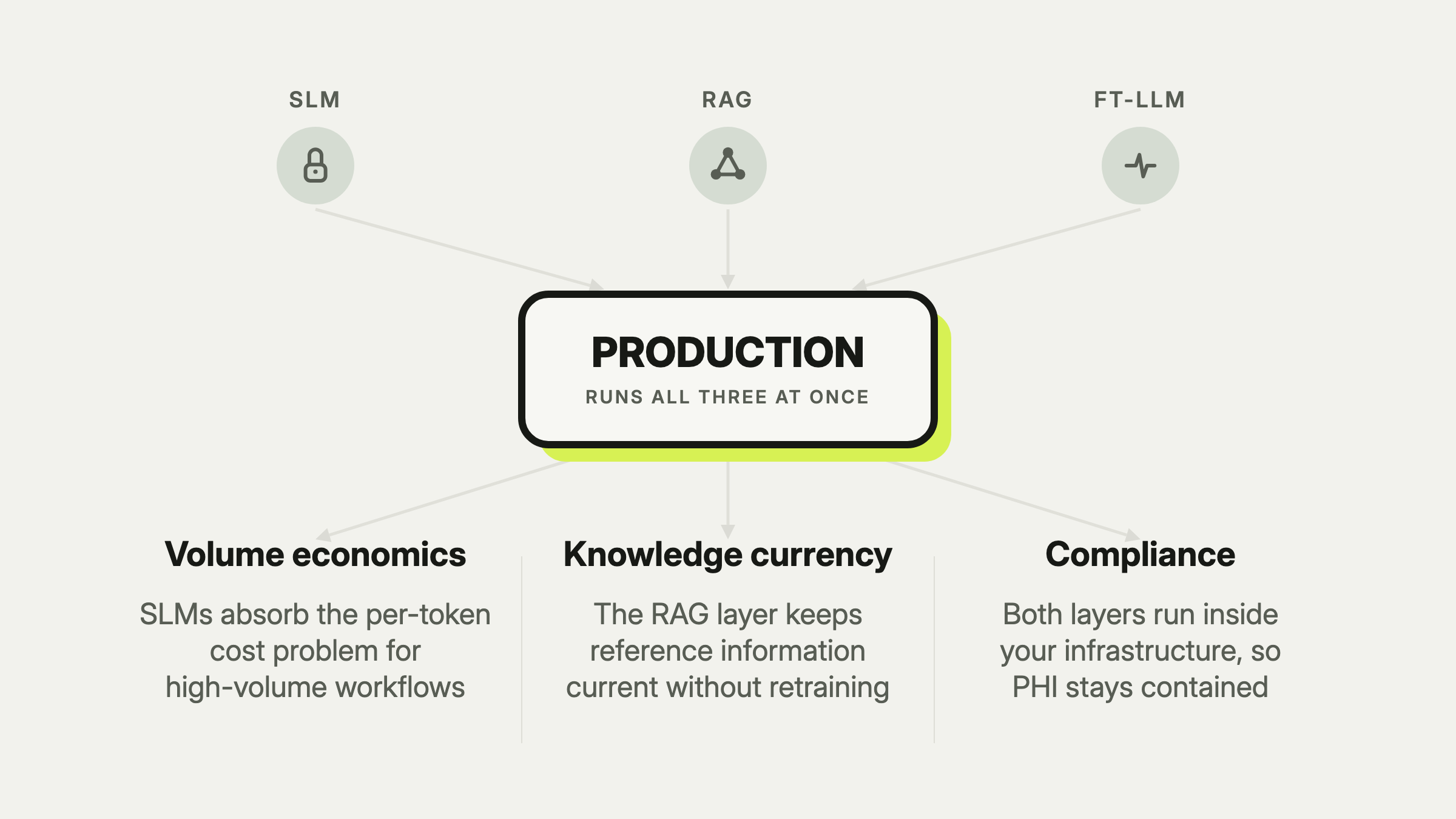
This delivers three things that matter operationally:
Volume economics: SLMs absorb the per-token cost problem for high-volume workflows. The larger model handles only what actually requires its capabilities.
Knowledge currency: The RAG layer keeps reference information current without full model retraining.
Compliance: Both the SLM inference layer and the RAG retrieval layer run inside the infrastructure, so PHI stays contained throughout. For GPU sizing, network isolation, and CISO sign-off requirements for private deployments, see How to Deploy Private AI in Healthcare: On-Premise, Private Cloud, and Air-Gapped.
A scoping review published in February 2026 confirmed that hybrid fine-tuning plus RAG architectures produce the strongest combination of factual accuracy and clinical reliability, validating the routing approach that production deployments have arrived at through operational experience.
I'd recommend starting with a single SLM use case, proving the production pattern, then expanding the architecture and adding the routing layer as your use case portfolio grows. Trying to build the full architecture upfront almost always slows you down.
How We Deploy Each Architecture at HxAI
At HxAI, we do both halves of this: we figure out the right architecture with you, and then we build it. That combination is harder to find than it sounds. Advisory firms will tell you which architecture to pick but stop there, and vendors will build what they already sell regardless of fit. For a comparison of HxAI against other private clinical LLM deployment providers, see 6 Companies That Deploy Private Language Models for Healthcare in 2026.
Here is how we cover the full spectrum:
SLM in a Box: When the Workflow Calls for a Private SLM
SLM in a Box is our managed delivery program for organizations that need a production-ready private language model for a specific bounded clinical workflow. We build it inside your infrastructure, under your access controls. PHI does not touch our systems at any point.
At handoff, you receive model artifacts you permanently own, a custom evaluation harness built for your workflow, governance documentation aligned to NIST AI RMF, and operational runbooks your team can run on without us. No ongoing license, no infrastructure dependency on HxAI continuing to be involved. Six to eight weeks from use case selection to production.
Agent Hero: When the Workflow Calls for RAG or Agentic Orchestration
Agent Hero is our HIPAA-compliant agentic infrastructure platform for RAG systems, multi-agent workflows, and complex clinical AI orchestration. It handles the architecture for workflows that require retrieval across live or frequently updated knowledge stores, including formularies, guidelines, and payer policies, while keeping retrieval and generation inside your infrastructure.
If the assessment points to RAG or a more complex orchestration layer, this is what we build on.
Not sure which architecture fits your workflow?
We run the workflow fit assessment in a 45-minute session and give you an architecture recommendation and scoped deployment plan before the call ends. No prep needed on your end.
Thanks - we'll be in touch soon
Our team usually responds within one business day.
Frequently asked questions
An SLM changes the model itself into a specialist for a specific task. RAG adds a retrieval layer to an existing model, changing what it can see at inference time without touching the model's weights. Use SLM when the task is bounded, data is sensitive, and volume is high. Use RAG when the workflow requires information that changes faster than you can retrain.
Yes, and it is a common production pattern. The SLM handles classification, extraction, and drafting. The RAG layer grounds outputs in current reference sources: formularies, guidelines, payer policies. Both run inside your infrastructure so PHI stays contained. Prior authorization is a good example of where this hybrid works well.
At high volume, a private SLM on fixed infrastructure is the lowest-cost option. Per-token pricing on hosted APIs scales linearly with query volume. A fixed-infrastructure SLM has a predictable cost envelope regardless of query count. I've seen per-document cost drop by over 90% when organizations move from a hosted API to an on-premise SLM at clinical volume.
SLMs limit the output space structurally and are evaluated against clinical acceptance criteria before any workflow runs on them. RAG reduces hallucination by grounding the model's response in retrieved source documents. A 2026 systematic review found RAG to be the superior hallucination mitigation strategy in clinical safety contexts. Fine-tuned LLMs produce lower hallucination rates than the base model zero-shot but still require an evaluation harness and ongoing monitoring in production.
RAG on a hosted LLM API prototypes fastest, as no model training is required. For workflows involving PHI that cannot leave your environment, a private deployment is required. A managed private SLM deployment through SLM in a Box takes six to eight weeks from use case selection to production handoff.
It depends on the workflow. For high-volume, bounded, privacy-sensitive operational workflows, a private SLM is the starting point. For workflows requiring access to frequently changing reference information, a RAG layer is added. We determine the right architecture in the discovery call by running the workflow fit assessment across all four criteria: task scope, data sensitivity, query volume, and knowledge freshness.
- MDPI Bioengineering. Integrating Fine-Tuning and Retrieval-Augmented Generation for Healthcare AI Systems: A Scoping Review. February 2026.
- Authorea. RAG vs. Fine-Tuning: A Systematic Review of Hallucination Mitigation in Medical LLMs. January 2026.
- Springer Nature. Adaptive, Privacy-Preserving Small Language Models for Multi-Task Clinical Assistance. Journal of Imaging Informatics in Medicine, March 2026.
- John Snow Labs. Medical Small Language Models: Benchmarking JSL-MedS vs GPT-4o. 2025.
- HFMA. Health systems start to fight back against AI-powered robots driving denial rates higher. December 2025.
- Belcak P, et al. Small Language Models are the Future of Agentic AI. NVIDIA / arXiv:2506.02153, September 2025.
- NIST. Artificial Intelligence Risk Management Framework (AI RMF 1.0). 2023.
