In 25 years of working across payer and provider organizations, I have watched denial management evolve from a billing backlog problem into a revenue integrity discipline. And in 2026, it has become an AI problem, on both sides of the transaction.
Payers are now using AI to review and deny claims faster than provider billing teams can manually respond.
The only effective response to AI-driven denial acceleration is AI-powered denial management on the provider side. This guide covers how that works, what it returns, and how to build a denial management program that recovers revenue instead of writing it off.
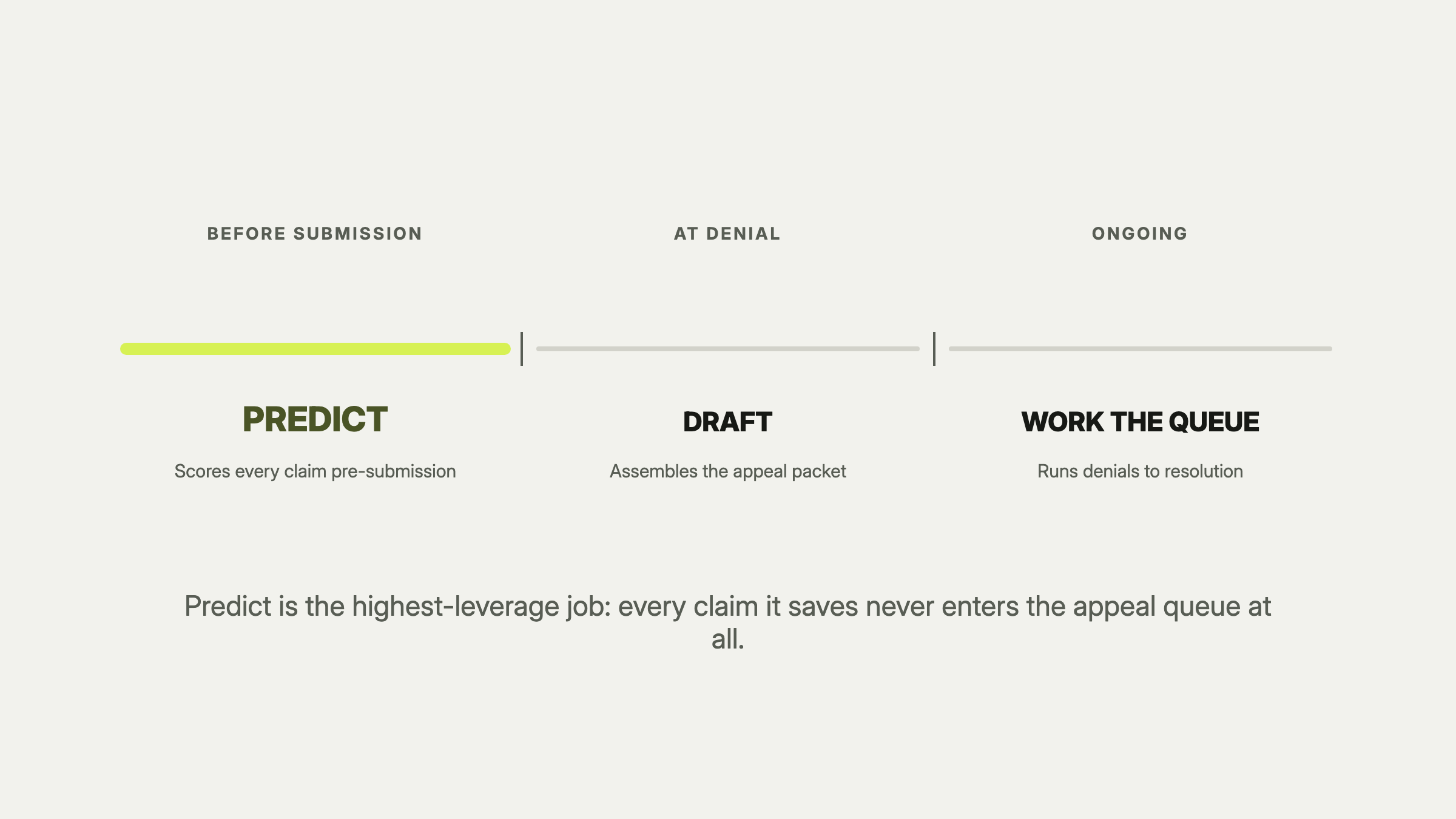
Quick answer: AI denial management in healthcare uses machine learning and agentic AI to prevent denials before submission, classify and prioritize denied claims automatically when they return, and generate payer-specific appeal packets without manual assembly. The three jobs it does (predict, draft, and work the queue) correspond to three different points in the denial lifecycle, each with a different ROI profile and implementation requirement.
In this guide, you'll learn:
- What AI denial management is and how it works
- Why denial rates keep rising in 2026
- The three jobs AI does in denial management
- The five denial categories AI handles differently
- How the denial lifecycle works with AI step by step
- What AI denial management returns
- How HXAI builds this in production
- How to get started
What Is AI Denial Management in Healthcare?
AI denial management is the use of machine learning, natural language processing, and agentic AI to predict, classify, appeal, and prevent insurance claim denials across the healthcare revenue cycle.
It operates differently from traditional denial management software. Legacy systems use rules engines: if the claim has this code combination, flag it. AI learns from historical claim and remittance data across thousands of payer decisions, surfaces the denial patterns that rules cannot anticipate, and takes action on those patterns: before submission, at the point of denial, and in aggregate to fix systemic root causes.
The key distinction is between denial recovery and denial prevention. Traditional denial management is reactive: claims deny, billers work the queue. AI-powered denial management is predictive: claims at high risk of denial are flagged and corrected before they leave the building. That shift from recovery to prevention is where the real economics of denial management change.
For a broader view of how AI fits into the full healthcare claims lifecycle, see AI in Healthcare Claims Processing: How It Works, What It Returns, and How to Get Started.
Why Denial Rates Keep Rising in 2026
The denial rate environment in 2026 is the hardest I've seen across my career. Three forces are compounding simultaneously.
Payers have accelerated AI-driven claim review. Commercial insurers and Medicare Advantage plans are deploying AI to automate claim reviews at scale, identifying more grounds for denial faster and with less human involvement than at any point in the past decade. The sophistication of payer AI has significantly outpaced the sophistication of provider billing operations.
Medical necessity documentation requirements have tightened sharply. The average amount denied for medical necessity and requests for information rose 70% from 2024 to 2025, according to MDaudit data. Payers are now reviewing clinical documentation with greater specificity than before, and claims that would have cleared two years ago are being returned for additional evidence.
Provider teams lack the capacity to respond. Reworking a denied claim costs between $25 and $181 depending on claim type, according to MGMA. At scale, across thousands of monthly denials, that rework burden exceeds what manual billing teams can absorb. 50 to 65% of denied claims are never reworked at all, meaning providers are writing off reimbursable revenue because they do not have the capacity to pursue it.
This is the environment AI denial management is designed for. Winning denials at scale requires speed, payer-specific knowledge, and throughput that manual operations cannot provide. AI denial management is built for exactly that.
Want to see what this looks like on your denial data?
HXAI will deploy your first denial management agent at no cost, built inside your environment against your real claims data.
Thanks - we'll be in touch soon
Our team usually responds within one business day.
The Three Jobs AI Does in Denial Management
AI in denial management does three distinct jobs, and they matter at different points in the revenue cycle. Understanding which job applies where determines where to start and what to expect.
Job 1: Predict: Prevent Denials Before Submission
The highest-ROI application of AI in denial management is prevention. Every claim that AI stops from being denied is a claim that never enters the rework queue, never ages in AR, and never costs $25 to $181 to resolve.
Predictive AI scores each claim before submission for denial probability, based on historical patterns across payer decisions, coding combinations, documentation completeness, and authorization status. Claims scoring above a risk threshold are routed for correction before they leave the building.
The specific issues AI surfaces at pre-submission:
- Missing or mismatched prior authorization
- Procedure-diagnosis code combinations the payer has denied historically
- Documentation gaps that will trigger a medical necessity review
- Eligibility issues that will cause a coverage denial
- Timely filing violations that will make the claim unappealable
Our Claims Denial Prediction Agent scores claims for denial risk before submission, flags the specific issue by category, and routes high-risk claims to the right correction path, including coding review, documentation request, or authorization follow-up, so they submit clean.
Job 2: Draft: Generate Appeals When Denials Occur
When denials do occur despite pre-submission screening, the bottleneck is appeal assembly. Reading the denial reason, pulling the clinical documentation, cross-referencing the payer's coverage criteria, and drafting a payer-specific appeal letter used to take a biller one to two hours per denial. Across a denial queue of hundreds, that is a throughput problem that cannot be solved with headcount.
AI reads the denial reason code, extracts the relevant clinical documentation from the patient record, identifies the specific payer policy at issue, and generates a complete appeal packet ready for human review and submission. What took one to two hours takes minutes. The human reviewer approves and submits rather than assembles from scratch.
Our Appeals Drafting Agent generates payer-specific appeal letters mapped to denial reason categories, with the relevant clinical documentation and policy citations attached. Appeal turnaround drops from days to hours.
Job 3: Work the Queue: Autonomous End-to-End Denial Resolution
The third job is the one that changes the economics of denial management at scale. Rather than surfacing a denial for a human to act on, AI agents take the denial and run it to resolution: diagnosing the root cause, correcting the claim or drafting the appeal, submitting via payer portal or clearinghouse, tracking the response, and escalating only the cases that require genuine clinical or contractual judgment.
This is the shift from AI as a tool within the workflow to AI as the operational driver of the workflow. Revenue cycle staff govern the system and handle complex exceptions, while AI handles the procedural, high-volume cases that consume the bulk of biller time today.
For a deeper look at how agentic AI orchestrates multi-step revenue cycle workflows, see Agentic AI in Healthcare: The Complete Guide.
The first agent is free
We build it, run it on your real claims data, and show you the numbers. Then you decide.
Thanks - we'll be in touch soon
Our team usually responds within one business day.
The Five Denial Categories AI Handles Differently
Not all denials are equal, and the AI approach varies by denial reason. Here are the five categories that account for the majority of denial volume, and what AI does in each.
1. Prior Authorization Denials
Why they happen: The service required prior authorization and it was not obtained, the authorization was obtained but not linked to the claim, or the authorization was obtained for different procedure codes than those billed.
How AI addresses them:
- Pre-submission: AI checks authorization status against the payer's current PA requirements before the claim submits, flags missing authorizations, and identifies authorization-to-claim code mismatches
- Post-denial: AI reads the denial reason, identifies whether the authorization gap is correctable, and either initiates a retroactive authorization request or drafts an appeal documenting why the service met medical necessity criteria independent of the authorization
- Root cause: AI surfaces the authorization workflows generating the highest denial volume by payer and service line, so the front-end process can be corrected
2. Medical Necessity Denials
Why they happen: The clinical documentation submitted with the claim does not satisfy the payer's medical necessity criteria for the service. This is the fastest-growing denial category, up 70% from 2024 to 2025.
How AI addresses them:
- Pre-submission: AI reviews the clinical documentation against the specific payer's medical necessity criteria before submission and flags gaps, including missing diagnoses, insufficient severity documentation, or treatment history that the payer will require
- Post-denial: AI identifies the specific criteria the payer cited, pulls the clinical evidence from the patient record that addresses those criteria, and drafts an appeal letter with the evidence organized according to the payer's appeals process
- Root cause: AI identifies the clinical documentation patterns correlated with medical necessity denials by physician and service line, enabling provider-level feedback to improve documentation quality upstream
3. Coding Error Denials
Why they happen: Wrong CPT code, incorrect or missing modifier, unbundling violations, procedure-diagnosis code combination mismatches, or codes outside the provider's specialty scope.
How AI addresses them:
- Pre-submission: AI audits every claim against current payer-specific coding rules, NCCI edits, and LCD/NCD requirements before submission and surfaces specific coding corrections
- Post-denial: AI reads the specific coding denial reason, identifies the correction, and routes the corrected claim for resubmission or generates an appeal if the original coding was defensible
- Root cause: AI tracks coding denial patterns by coder, physician, and code combination, surfacing the systematic coding errors that generate recurring denials
4. Eligibility and Coverage Denials
Why they happen: Patient coverage has changed or lapsed, coordination of benefits has not been resolved, or the service is not covered under the patient's specific benefit plan.
How AI addresses them:
- Pre-submission: Real-time eligibility verification before the appointment or procedure, with AI surfacing coverage issues: benefit sub-limits, COB situations, and plan exclusions, before the service is rendered
- Post-denial: AI classifies the specific eligibility denial reason and identifies whether it is correctable (wrong insurance on file, COB sequence error) or requires patient financial counseling
- Root cause: AI identifies the patient intake and registration workflows generating the highest eligibility denial volume, enabling process corrections at the front desk
5. Timely Filing Denials
Why they happen: The claim was not submitted within the payer's filing window, ranging from 90 days to one year depending on the payer and plan type.
How AI addresses them:
- Prevention: AI monitors claim submission timelines by payer and flags claims approaching filing deadlines that have not yet been submitted, prioritizing them for immediate submission
- Post-denial: AI identifies whether a timely filing exception applies, such as system downtime, eligibility issues that delayed submission, or documentation that establishes the claim was submitted on time and subsequently lost, and drafts the exception appeal
- Root cause: AI surfaces the billing workflow gaps causing timely filing failures, including claims held in billing review queues past the filing window
How the Denial Lifecycle Works with AI: A Step-by-Step Breakdown
Here is the full denial management lifecycle with AI embedded at each stage.
Step 1: Pre-submission screening
Before the claim submits, AI scores it for denial risk across all five categories: prior auth, medical necessity, coding, eligibility, and timely filing. High-risk claims route to the appropriate correction path, while low-risk claims submit directly.
Step 2: Remittance ingestion and denial classification
When remittance files return, AI reads CARC and RARC codes across every payer format, normalizes denial reasons into consistent categories, and classifies each denial by type. There is no manual remittance reading; every denial is categorized the moment it arrives.
Step 3: Prioritization by value and overturn probability
AI scores each denial by the combination of dollar value and overturn probability. For instance, a $50,000 medical necessity denial with a 70% historical overturn rate for that payer rises to the top of the queue, while a $200 timely filing denial with a 5% overturn rate goes to a lower priority or is written off automatically if below the cost-to-rework threshold.
Step 4: Appeal generation
For each denial that clears the priority threshold, AI generates the appeal packet: clinical documentation pulled from the EHR, payer policy citations, and a payer-specific appeal letter structured according to the payer's requirements. Human reviewers approve and submit.
Step 5: Follow-up and escalation
AI tracks appeal submission and response timelines by payer. Claims approaching response deadlines without resolution are escalated. Second-level appeal options are surfaced when initial appeals are overturned at the wrong rate.
Step 6: Root cause analysis and feedback
Across all denials processed, AI identifies the systemic patterns: which payers are denying which codes, which physicians have the highest medical necessity denial rates, which front-end processes are generating eligibility denials, and surfaces them as operational recommendations. This is where denial management shifts from recovery to prevention.
AI Denial Management ROI: Benchmarks from Production Deployments
These are the benchmarks from production denial management AI programs. The variation reflects starting state, claim mix, and deployment depth.
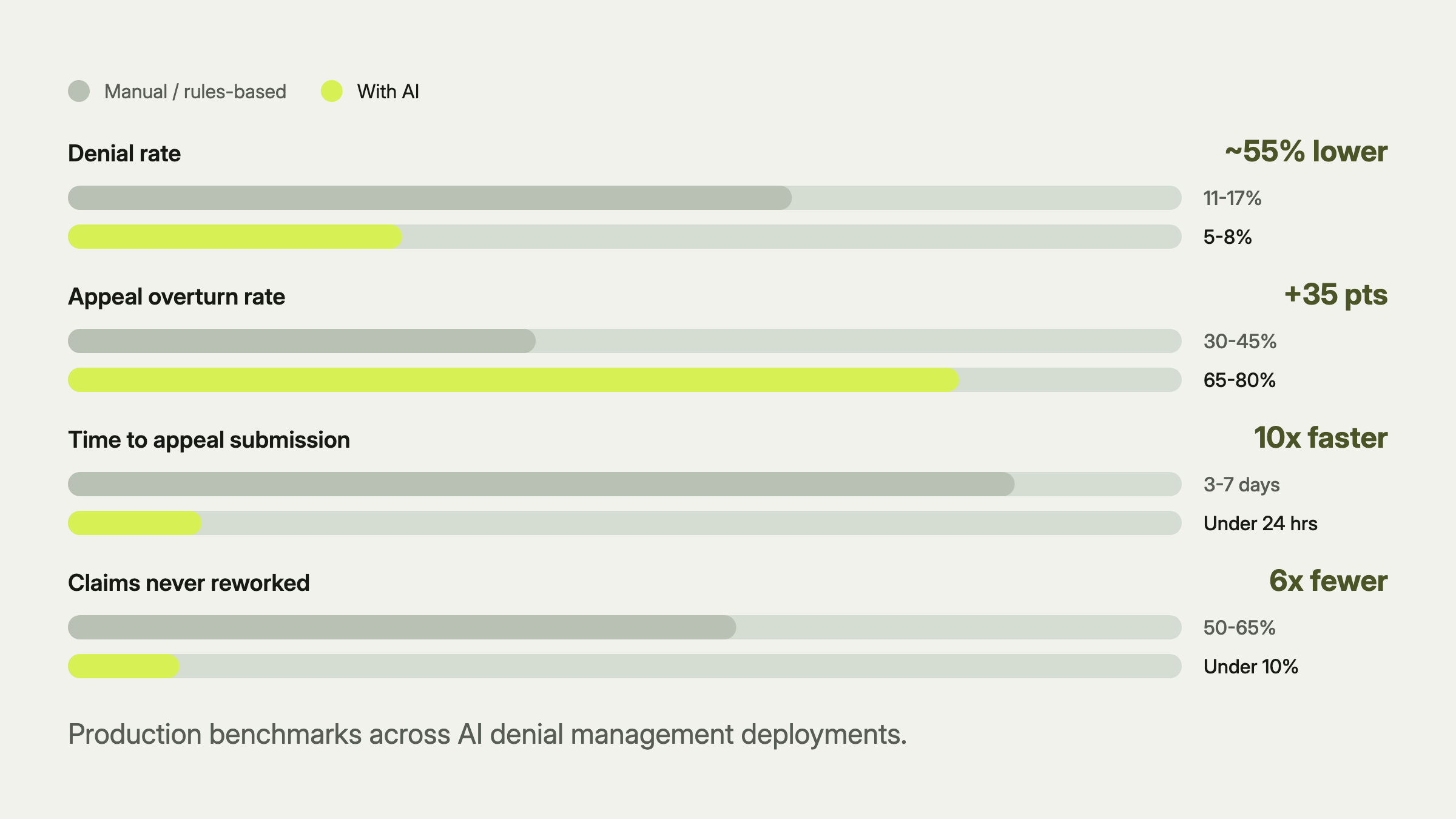
Here is what those numbers look like for a mid-size provider:
| Scenario | Figure |
|---|---|
| Annual billing volume | $50M |
| Denial rate (12%) | $6M in denied claims |
| Claims never reworked (50%) | $3M written off annually |
| Revenue recovered with AI (80% recovery rate) | $2.4M returned per year |
That $2.4M is revenue that was already earned and billed; it was simply being written off because the team did not have the capacity to pursue it. That figure does not include the additional savings from a lower per-claim rework cost.
Why Healthcare Organizations Work With HXAI for Denial Management
I want to be direct about what makes HXAI different here, because the denial management vendor market is crowded and the claims are often indistinguishable.
HXAI is a healthcare AI transformation partner with 400+ healthcare engineers and 16 years of production experience across all 17 US healthcare sub-verticals. Denial management is one of the highest-frequency workflows we have built and operated across providers, payers, post-acute operators, and HealthTech platforms.
What that experience looks like in practice:
We have built agentic RCM infrastructure that now processes millions of claims-related tasks monthly for some of the largest post-acute care networks in the US, solving the exact problems that generate denials at scale: unstructured documentation, faxed prior auth requests, and eligibility mismatches that rules-based systems could not handle. A GenAI document comprehension system we built for a healthcare provider RCM team cut information retrieval time by 50%, directly accelerating appeal assembly and overturn rates.
Across those engagements, we have seen denial programs succeed and fail. The failures trace to three things consistently: AI deployed before data and configuration issues were fixed, point solutions that cannot handle exception volume in production, and programs owned by IT rather than the revenue cycle leader accountable for the outcome.
What we build and how we engage:
We build on Agent Hero, our HIPAA-compliant agentic infrastructure, inside your environment. The denial prediction agent, the appeals drafting agent, the underpayment detection agent, and the root cause analysis layer all run on infrastructure you own at the end of the engagement. No platform fees. No licensing dependency. No vendor lock-in.
Every engagement starts with your real denial data: your denial rate by category, your payer mix, your pending reason codes, your current appeal overturn rates. We identify the highest-value starting point together. We build the first agent and show you results before we discuss anything beyond it.
The first agent is free. We build it, run it on your real claims data, and show you the numbers. Then you decide.
Get your first denial agent free →
How to Get Started: A Three-Phase Framework
| Phase | Timeline | What to Do | What You Get |
|---|---|---|---|
| Phase 1: Baseline | Week 1 | Pull four numbers from your billing system: denial rate by category, appeal submission rate, appeal overturn rate by denial reason and payer, and average days from denial to appeal submission | A clear picture of whether your problem is capacity (low appeal submission rate) or prevention (denials clustering in specific categories), which determines which AI job to deploy first |
| Phase 2: Deploy on one category and one payer | Weeks 2-8 | Choose the denial category with the highest dollar volume and clearest overturn path. Deploy the prediction and drafting agents on that category and payer combination. Measure first-pass yield, appeal turnaround, and overturn rate at weeks 2 and 4 | Production results on your real denial data, from one focused deployment, before expanding |
| Phase 3: Extend across categories and payers | Month 3 onwards | The FHIR integrations, HIPAA architecture, and model training from Phase 2 carry to every subsequent payer and denial category | Each additional deployment takes days rather than months because the infrastructure is already in place |
Frequently asked questions
- Experian Health, State of Claims 2025
- Adonis, 2026 RCM Industry Report
- MDaudit, Medical Necessity and Requests for Information Denial Data 2025
- MGMA, Claim Denial Cost Benchmarks 2026
- Aegis Health, Guide to Healthcare Claims Denial Management 2026
- HoneyHealth, 10 Best AI Denial Management Tools 2026
- Datarovers, AI Denial Management Software: How AI Transforms Healthcare Revenue Cycle
- HFMA, Prior Authorization AI Deployment Outcomes 2026