Every major US health insurer ended 2025 at or above the 85% MLR ceiling. UnitedHealth's medical care ratio hit 88.9%, a 340 basis-point deterioration year over year, with Aetna at 87.3% and Elevance at 86.4%. The margin compression story in health insurance is real, and it is not going away.
In that environment, the administrative cost ratio is the lever payer leaders can move. And the single metric that drives it is the auto-adjudication rate: the percentage of claims your system processes without a human reviewer opening the file.
I've spent 25 years on the operations side of payer organizations. The plans widening their margins in 2026 are the ones that stopped treating auto-adjudication rate as a systems KPI and started treating it as a financial strategy. This post is the operational guide to doing that.
Quick answer: Auto-adjudication rates above 85% are achievable for high-volume, lower-complexity claim types with AI in 2026. The gap between where health plans are today (30-40% for legacy systems, 60-70% for modern ones) and where leading plans are operating is primarily a configuration quality problem, a data completeness problem, and a medical policy encoding problem. Fix those three, and AI does the rest.
What Is Auto-Adjudication Rate and Why It Defines Your Administrative Cost Story
Auto-adjudication rate is the percentage of incoming claims your system processes and pays or denies without any human reviewer opening the file. Every claim requiring manual review costs a health plan roughly $20 in administrative handling. Every claim that auto-adjudicates costs a fraction of that.
Auto-adjudication is where administrative cost control happens. A plan processing 100,000 claims per month at 40% auto-adjudication is spending significantly more on administrative handling than one at 80%, and the gap compounds as claim volume grows.
The industry benchmark:
| Platform Type | Auto-Adjudication Rate | What's Limiting It |
|---|---|---|
| Legacy claims platforms | 30-40% | Rules engines handle standard patterns only; anything complex goes to manual review |
| Modern platforms without AI | 60-70% | AI used for routing and flagging, not adjudication decisions |
| AI-enabled operations | 80-90%+ on eligible claim types | AI embedded into adjudication logic; some platforms above 96% on specific categories |
39% of payers in HealthEdge's 2026 survey list increasing auto-adjudication rates as their top investment priority. With MCRs where they are, the administrative cost ratio is one of the few levers finance leaders can pull.
Where Health Plans Stand in 2026
Legacy systems (30-40%): These plans run claims adjudication platforms designed for a different era of claim complexity. Standard claim types process automatically, but anything outside the rules engine's scope, whether a missing field, a non-standard procedure combination, or a medical necessity question, goes to a reviewer. Administrative costs per claim are high, processing cycles run long, and the pended claims inventory grows with volume.
Modern platforms without AI (60-70%): These plans have modernized their claims platform but use AI primarily as a routing and flagging tool. AI identifies which claims need review. A human still does the review. The auto-adjudication rate improves but the ceiling is limited because AI is making routing decisions, not adjudication decisions.
AI-enabled operations (80-90%+ on eligible claim types): AI is embedded into the adjudication logic itself, routine determinations happen automatically, and complex cases go to reviewers with AI-generated context already assembled. These plans are at or approaching the 85%+ benchmark on high-volume claim types, with some platforms above 96% on specific categories.
Moving from the second tier to the third requires addressing three operational issues that determine your auto-adjudication ceiling: configuration quality, data completeness, and medical policy encoding.
What Drives Auto-Adjudication Rate
Before deploying any AI model, three things determine your auto-adjudication ceiling: configuration quality, data completeness, and medical policy encoding. AI helps with all three, but the biggest gains come from addressing them systematically rather than deploying AI and hoping the rate improves.
Configuration Quality
Benefit plan configurations drive a significant share of claims that cannot auto-adjudicate. When a plan's configuration has gaps, inconsistencies across benefit year changes, or sub-benefit rules that are not fully coded, claims that should clear automatically get pended for human review.
How AI helps:
- Analyzes pended claim patterns to surface the specific configuration rules generating unnecessary manual intervention
- Identifies which benefit plan rules are producing pend volume vs. which are working as intended
- Prioritizes the configuration fixes with the highest auto-adjudication rate impact
Data Completeness
A claim arriving with missing fields, inconsistent provider data, or unresolved eligibility exceptions cannot auto-adjudicate regardless of how sophisticated the adjudication engine is.
How AI helps:
- Reads unstructured claim documentation and resolves data gaps in real time through payer data connections
- Flags providers whose submissions consistently arrive with missing or inconsistent data, enabling targeted provider outreach
- Identifies eligibility exceptions at intake rather than at adjudication, so they are resolved before they generate pends
Medical Policy Encoding
Health plan medical policies determine coverage for specific procedures, diagnoses, and care settings. When those policies exist as PDF documents rather than encoded decision logic, every claim triggering a medical necessity question requires a reviewer to interpret the policy text.
How AI helps:
- Converts medical policy documents into structured decision logic the adjudication engine applies consistently
- Handles routine medical necessity determinations automatically when clinical criteria clearly apply
- Routes borderline cases to reviewers with the relevant policy language and clinical documentation already assembled
Want to see what this does to your auto-adjudication rate?
HXAI will deploy your first claims agent at no cost. Choose the workflow where your auto-adjudication rate has the largest gap: prior auth, coding validation, medical policy determination, or payment integrity, and we will build it inside your environment and show you the results before you commit to anything else.
Thanks - we'll be in touch soon
Our team usually responds within one business day.
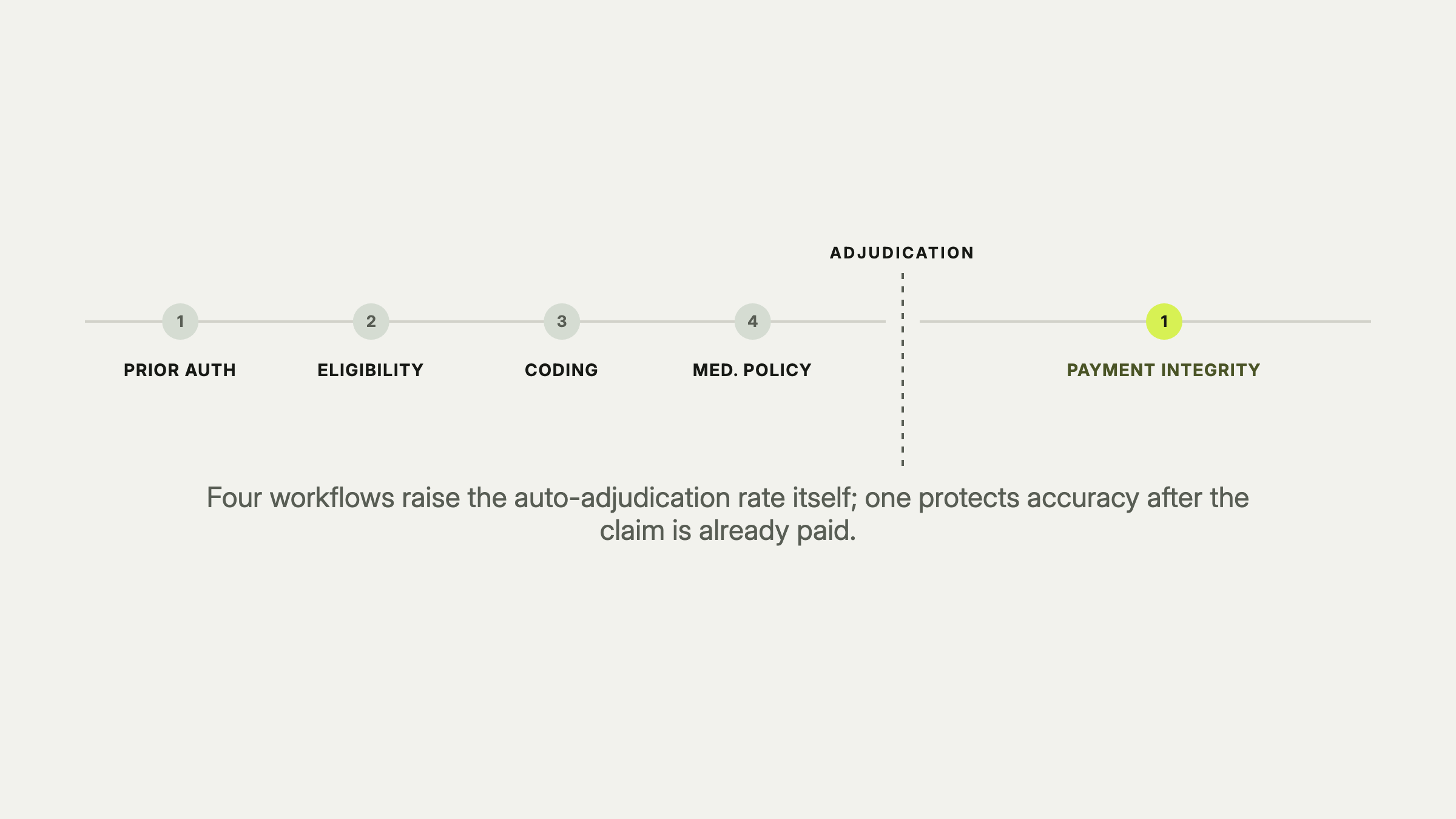
The Five Workflows Where AI Moves the Auto-Adjudication Needle
These are the five specific claims workflows where AI improves auto-adjudication rate for health plans, and what each looks like in production.
1. Prior Authorization Pre-Adjudication
The problem: When a claim arrives without a linked prior authorization, the adjudication system pends it for manual review. PA was not obtained, was not linked to the claim, or was obtained under different procedure codes. That pend is avoidable.
How AI fixes it:
- Receives the PA request via FHIR API when the provider submits
- Validates the request against current payer clinical criteria
- Routes clearly approvable requests for instant determination
- Attaches the authorization record in a format the downstream claims system reads automatically
- The claim arrives with authorization already linked and adjudicates without a reviewer
Why it matters for MA plans: PA accuracy directly affects Star Ratings. Plans with high PA appeal overturn rates face CMS scrutiny and risk to their quality bonus, up to $17M annually for a 100,000-member plan.
2. Eligibility and Benefits Verification
The problem: Eligibility failures cause a significant share of pended claims. Coverage details have changed, coordination of benefits is unresolved, or benefit sub-limits are approaching. The adjudication system cannot process the claim cleanly.
How AI fixes it:
- Checks eligibility against real-time payer data before the claim enters the adjudication queue
- Identifies active coordination of benefits situations requiring resolution
- Flags benefit sub-limit situations before adjudication
- Routes clean-eligibility claims directly to adjudication; routes problem claims to the right resolution path with the specific issue identified
Result: Claims arriving with clean eligibility data auto-adjudicate. Eligibility problems are resolved before they become pended claims.
3. Medical Coding Validation
The problem: Procedure codes inconsistent with diagnosis codes, missing modifiers, codes outside the provider's scope, and NCCI edit failures all send claims to manual review. On the payer side, these arrive as undifferentiated pended inventory with no indication of what specifically failed.
How AI fixes it:
- Reads the submitted claim and identifies specific coding issues
- Routes claims with coding problems to the relevant queue with the specific error identified, not just flagged for general review
- Tracks coding error patterns by provider, enabling provider-specific feedback that reduces the error rate at the source
- Over time, coding validation catches provider-level systematic errors before they enter the adjudication queue
Our Claims Denial Prediction Agent identifies claims at high denial risk before adjudication and surfaces the specific issue, whether a configuration gap, missing documentation, or policy question, so it can be resolved before the claim pends.
4. Medical Policy and Coverage Determination
The problem: Health plan medical policies determine coverage for specific procedures, diagnoses, and settings of care. When those policies exist as PDFs rather than encoded decision logic, every claim triggering a medical necessity question requires a reviewer to interpret the policy text. This is the single workflow with the highest impact on auto-adjudication rate for health plans with complex benefit structures.
How AI fixes it:
- Converts medical policy documents into structured decision logic the adjudication engine applies consistently
- Routine medical necessity determinations, where the clinical criteria clearly apply, happen automatically
- Claims involving genuinely complex clinical questions route to reviewers with context already assembled: relevant policy language, clinical documentation from the claim, and a recommended determination
- The reviewer confirms rather than researches
Result: The reviewer capacity that was consumed by routine policy interpretation moves to genuinely complex cases that require clinical judgment.
5. Payment Integrity and 835 Reconciliation
The problem: Auto-adjudication rate is measured at the point of determination, but post-payment accuracy matters for the full administrative cost picture. Claims paying incorrectly generate downstream rework: underpayment recovery, overpayment recoupment, and provider disputes that consume operational capacity.
How AI fixes it:
- Reconciles 835 remittance data against the original claim and contracted rates automatically
- Flags underpayments and overpayments before they generate provider disputes
- Identifies systematic underpayment patterns across provider types, not just individual claim exceptions
- Surfaces payment accuracy issues in the same operational cycle rather than weeks later in manual reconciliation
Our Underpayment Detection Agent catches systematic underpayment patterns across providers and surfaces them for recovery before they compound.
The first agent is free
Choose the workflow where your auto-adjudication rate has the largest gap, and we will build it, run it against your real claims data, and show you the impact before you commit to a full program.
Thanks - we'll be in touch soon
Our team usually responds within one business day.
The Compliance Architecture That Makes AI-Assisted Adjudication Defensible
Arizona, Nebraska, Texas, and California have enacted legislation prohibiting AI from being the sole basis for denying a prior authorization or medical necessity determination. Every adverse determination requires a qualified human reviewer in the decision loop, with that review documented.
The architecture that works:
- AI auto-adjudicates approvals and clearly covered services. Adverse determinations require human review.
- Borderline cases go to reviewers with AI-generated context: relevant policy language, clinical documentation, and a recommended determination. The reviewer decides.
- Audit trails capture every AI action, every routing decision, and every human review step with clinical basis documented.
- Disclosure mechanisms are in place for members and providers where state laws require it.
For Medicare Advantage plans: CMS requires that MA plans apply clinical criteria no more restrictive than original Medicare, and that AI tools be applied consistently without discriminatory effect. Plans deploying AI in MA adjudication need to validate that their models are not producing systematically different outcomes across demographic groups or clinical presentations.
Building this governance architecture on day one, rather than adding it after the system is in production, is the difference between a program that scales and one that stalls when the first CMS audit arrives.
For a deeper look at how agentic AI orchestrates multi-step clinical workflows within this governance model, see Agentic AI in Healthcare: The Complete Guide.
How to Frame This for Your CFO
Auto-adjudication rate improvement translates to specific budget line impact.
| Scenario | At 50,000 Claims/Month | At 200,000 Claims/Month |
|---|---|---|
| Rate moves from 40% to 60% | 10,000 fewer manual reviews/month | 40,000 fewer manual reviews/month |
| Savings at $20/manual review | $200,000/month ($2.4M/year) | $800,000/month ($9.6M/year) |
| Rate moves from 60% to 80% | Additional 10,000 fewer reviews | Additional 40,000 fewer reviews |
| Combined impact | $400,000/month ($4.8M/year) | $1.6M/month ($19.2M/year) |
These numbers are conservative. They use the $20 per manual review figure and do not include denial rate reduction, payment accuracy improvement, or the provider abrasion reduction that comes from faster processing and fewer pended claims.
The framing that lands with payer CFOs in 2026: "Moving our auto-adjudication rate from 45% to 75% on our current claim volume eliminates X million dollars in annual administrative handling cost, reduces our administrative cost ratio by Y basis points, and does not require headcount reduction. It means our existing team handles three times the volume."
Given where MCRs are across the industry, that is a conversation payer CFOs are ready to have.
How to Get Started: The Auto-Adjudication Improvement Framework
Health plans that successfully improve auto-adjudication rates with AI follow a consistent four-phase sequence. The plans that stall skip Phase 1 and go straight to vendor evaluation.
Phase 1: Diagnose (Weeks 1-2)
Pull three numbers from your claims system before speaking to any vendor:
- Auto-adjudication rate by claim type: Professional, facility, pharmacy, and behavioral health claims have different auto-adjudication profiles and different root causes. The claim category with the largest gap from the 85% benchmark is your starting point.
- Top five pending reason codes: These tell you whether your problem is configuration, data completeness, medical policy encoding, or eligibility. The fix for each is different, and identifying the right one before deployment saves months.
- Provider clean claim rate by provider: Providers submitting claims with systematic coding errors, missing authorizations, or incomplete data are a direct drag on your auto-adjudication rate. Knowing which providers are the source tells you where provider-facing feedback will have the most impact.
Phase 2: Prioritize (Week 3)
Match your highest-volume pending reason codes to the corresponding workflow from the five listed above. The workflow where your pend volume is highest and your underlying data quality is cleanest is the right first deployment. That combination gives you the fastest measurable auto-adjudication rate improvement.
Phase 3: Deploy the First Agent (Weeks 4-12)
Deploy one agent on the prioritized workflow. Connect it to your claims system via FHIR. Build the HIPAA architecture and agent monitoring stack. Go live with staged rollout: a subset of claim volume first, measure for two to three weeks, then expand. The governance model for adverse determinations should be defined and tested before go-live, not after.
Phase 4: Extend Across Workflows (Month 3 Onwards)
The FHIR integrations, HIPAA architecture, and agent monitoring stack built for the first deployment carry to every subsequent one. The second and third workflows deploy in weeks rather than months because the infrastructure is already there. Each new agent extends the same foundation rather than starting from scratch.

How HXAI Improves Auto-Adjudication Rates for Health Plans
HXAI builds the agentic claims infrastructure that connects directly to your existing claims system, payer data sources, and provider-facing systems via FHIR, inside your environment, under your HIPAA architecture.
Here is what that looks like in practice across the five workflows:
Prior authorization: Our PA agent receives authorization requests via FHIR API, validates them against your current clinical criteria and payer medical policies, routes approvable requests for instant determination, and attaches the authorization record in the format your claims adjudication system reads automatically. When the claim arrives, the auth is already linked.
Eligibility and benefits verification: Our eligibility agent checks patient coverage against real-time payer data at the point of claim intake, identifies active coordination of benefits situations, and flags benefit sub-limit issues before the claim enters the adjudication queue.
Medical coding validation: Our Claims Denial Prediction Agent reads submitted claims, identifies the specific coding issues that would have caused a pend or denial, routes those claims to the right resolution queue with the issue named, and tracks error patterns by provider to surface systematic problems at the source.
Medical policy and coverage determination: We convert your medical policy documents into structured decision logic your adjudication engine applies consistently, handling routine medical necessity determinations automatically and routing complex cases with full context assembled for your clinical reviewers.
Payment integrity: Our Underpayment Detection Agent reconciles 835 remittance data against original claims and contracted rates, flags systematic underpayment patterns across providers, and surfaces recovery opportunities before they compound in downstream disputes.
Every deployment runs inside your environment, connected to your claims system via FHIR, under your own HIPAA architecture. You own the infrastructure at the end of the engagement with no platform fees and no vendor dependency.
The first agent is free. Choose the workflow where your auto-adjudication rate has the largest gap, and we will build it, run it against your real claims data, and show you the impact before you commit to a full program.
Frequently asked questions
- HealthEdge, 2026 Payer Survey Results
- ThinkLytics, Healthcare Payer Loss-Ratio AI: How AI Is Transforming MLR Management in 2026
- Viaante, Healthcare Payer Trends in 2026: Battling Margin Pressure, Mastering AI
- Mirra Healthcare, The Strategic Guide to Claims Adjudication Software for Health Plans
- GetPerspective, Health Insurance AI in 2026: Member Engagement, Claims, and the Compliance Reality
- KFF, Regulation of AI in Prior Authorization and Claims Review, 2026
- HealthAxis, Maximizing Claims Processing Efficiency with AI, 2026