What Does It Cost to Deploy a Private Clinical Language Model?
Deploying a private clinical language model has three cost drivers: compute for training and inference, people to run the deployment lifecycle, and data readiness, the stage that consistently delays more healthcare AI deployments than the other two combined. For the infrastructure and governance requirements that drive these costs, see How to Deploy Private AI in Healthcare: On-Premise, Private Cloud, and Air-Gapped.
This guide breaks down what each driver covers, where the numbers land for a first production deployment, and how the managed build model compares to building in-house. If you are new to clinical SLMs, start with What Is a Small Language Model in Healthcare? before reading this cost breakdown.
Quick answer: A first production private clinical SLM via managed build costs $80,000–$200,000. Three cost buckets: compute (GPU training and inference), people (eight to eighteen FTE-weeks across four roles), and data readiness. Ongoing: $500–$2,000/month inference on private cloud, monitoring, and annual retraining.
The Three Cost Drivers of Private Clinical AI Deployment
Before looking at specific numbers, understand the structure. A private clinical SLM deployment has three cost drivers that behave differently from each other and run in parallel, not in sequence.
| Cost Driver | Nature | What Organizations Consistently Underestimate |
|---|---|---|
| Compute | Infrastructure spend: GPU training and inference | Inference compute at clinical volume, not just training |
| People | Specialist labor across four roles | Total FTE-weeks across all stages, not just ML engineering |
| Data readiness | PII redaction, labeling, legal review, lineage | How far this exceeds initial estimates when data quality is poor |
Unlike a typical software project where costs stack in phases, all three run simultaneously. Data readiness starts the same week as infrastructure provisioning. The ML engineer needs clean data before training begins, and the MLOps engineer needs the deployment environment ready before training finishes. The budget for all three needs to be assigned on day one.
Compute Costs: GPU Infrastructure for Training and Inference Healthcare AI
Compute is the cost teams model first and the one they consistently undersize for production.
Training Compute: Cost by Approach
| Training Approach | GPU Requirement | Cloud Cost Range | When to Use |
|---|---|---|---|
| PEFT / LoRA | 1–2x A100 40GB | $150–$2,500 total | First production deployment, bounded clinical task, fastest iteration |
| Supervised Fine-Tuning (SFT) | 2–4x A100 or 1x H100 | $1,000–$8,000 total | Labeled task examples available, higher accuracy target |
| Domain-Adaptive Pretraining (DAPT) | 4+ x A100 or 2+ x H100 | $5,000–$25,000+ total | Largest domain adaptation requirement, typically combined with SFT |
Cloud GPU reference pricing (on-demand, 2026):
- A100 40GB: $1.48–$1.85 per GPU-hour
- H100 80GB: $3.93–$4.92 per GPU-hour
For a first production deployment, PEFT/LoRA is the standard approach: the lowest compute cost, fastest iteration cycle, and sufficient accuracy for bounded clinical tasks. A typical PEFT training run on a 7B parameter model takes five to fifteen iterations to reach production-quality accuracy, landing at $150–$2,500 in total training compute.
Training compute is not the expensive part of a private clinical SLM deployment.
The right training approach depends on the architecture you've chosen. If you're still working through that decision, read SLM vs RAG vs Fine-Tuned LLM: Choosing the Right Clinical AI Architecture.
Inference Compute: Where Volume Economics Matter
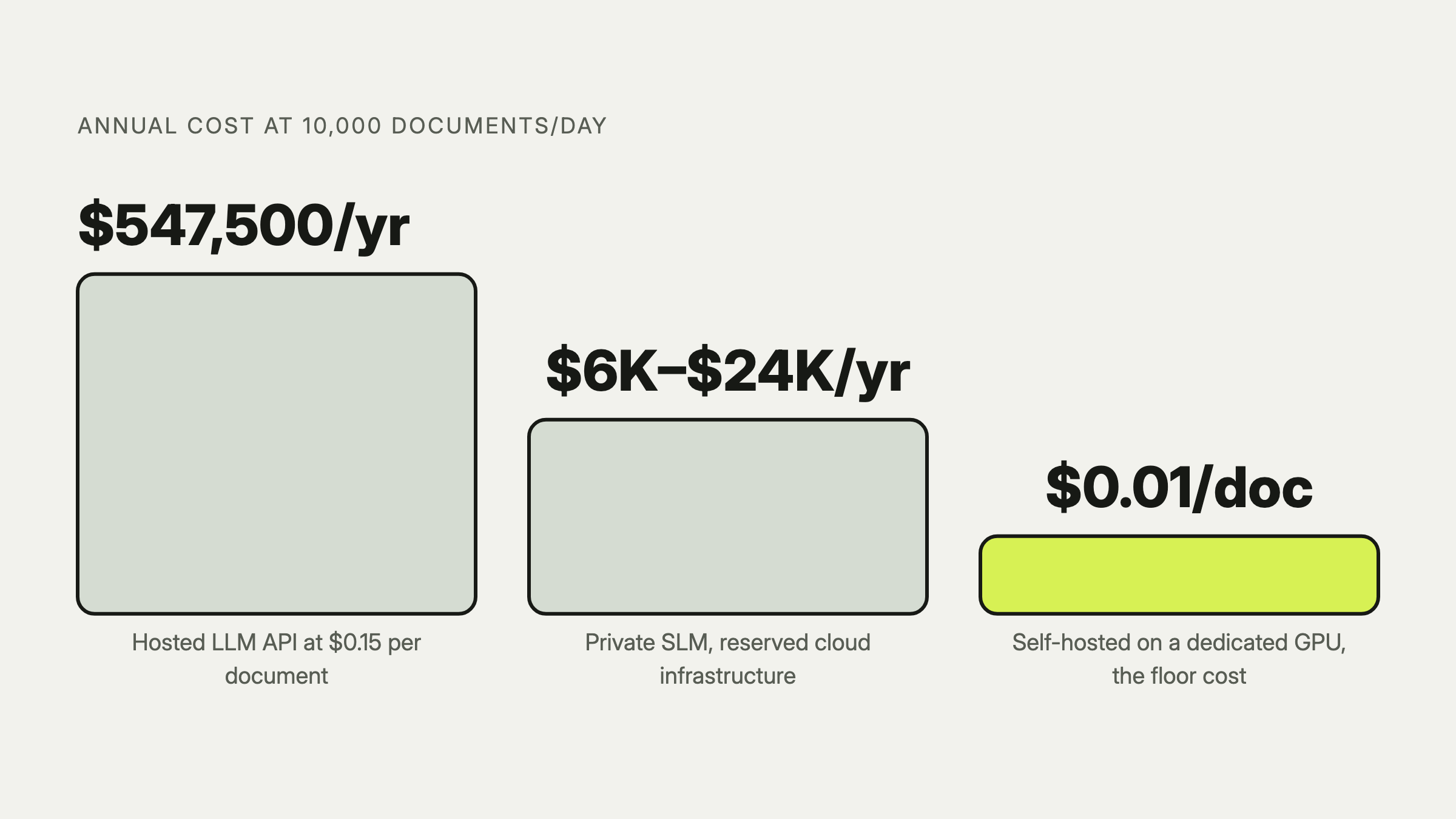
Inference is where the cost compounds at scale. At 10,000 clinical documents per day:
- A hosted LLM API at $0.15 per document costs $547,500 per year
- A private SLM endpoint on AWS or GCP serving 10,000 daily queries runs $500–$2,000 per month ($6,000–$24,000 per year)
- A self-hosted 7B SLM on an H100 runs approximately $0.013 per 1,000 tokens, roughly $0.01 per document at typical clinical note length
Above 50,000 queries per month, private deployment reaches cost parity with cloud APIs in three to six months. Beyond that, the economics compound consistently in favor of the private model. That math is what drives healthcare organizations to make the move.
If you want to see what the cost model looks like for your specific workflow and volume, book a 45-minute discovery call with HXAI. We will give you a deployment cost estimate and infrastructure recommendation before the call ends.
See what's bundled into the fixed pilot fee
All four specialist roles as one delivery team, data readiness tooling, and the NIST AI RMF governance package, all included at no extra cost.
Thanks - we'll be in touch soon
Our team usually responds within one business day.
People Costs: The Four Roles and How Long Each Deployment Stage Takes
People costs are the largest single expense in a private clinical SLM deployment and the one teams consistently underestimate. Four specialist roles are required across the full lifecycle.
| Role | Core Responsibility |
|---|---|
| Solution Architect | Use case scoping, architecture design, KPI definition, client coordination |
| ML Engineer | Model selection, fine-tuning, experiment tracking, evaluation |
| Data Engineer | Data ingestion, PII redaction, labeling, lineage documentation |
| MLOps / Platform | Private endpoint setup, access controls, observability, monitoring |
Total FTE-weeks by training approach:
| Training Approach | Total FTE-Weeks (All Roles) | Typical Calendar Timeline |
|---|---|---|
| PEFT / LoRA | 8–18 FTE-weeks | 6–8 weeks |
| SFT | 12–24 FTE-weeks | 8–12 weeks |
| DAPT + SFT | 16–30 FTE-weeks | 10–16 weeks |
At senior healthcare AI specialist rates of $18,000–$28,000 per FTE-week, a PEFT engagement with 12 FTE-weeks of total labor costs $216,000–$336,000 in people alone when built entirely in-house with hired specialists. That is the comparison number against which a managed build program should be evaluated.
Data Readiness: The Healthcare AI Cost That Delays More Deployments Than Compute
I've run enough of these to say with confidence: data readiness is where timelines and budgets break. Teams underestimate it by the widest margin of any cost in the deployment.
The four data readiness work items:
PII Redaction at Clinical Data Scale
Clinical notes, claims records, and care coordination data contain PHI that must be redacted before training. Automated redaction with manual QA on a representative sample is the minimum standard. For a 50,000-record clinical dataset, budget two to four FTE-weeks for redaction pipeline setup and QA.
Clinical Data Labeling
SFT models require labeled examples of the target clinical task. A prior auth SFT model needs labeled pairs of clinical criteria and authorization decisions. Clinical labeling requires domain expertise, not just annotation staff. Budget one to three FTE-weeks of clinical subject matter expert time for a first production dataset.
Legal Review of Clinical Training Data
What data can legally be used for training? Does it require IRB approval, a data use agreement, or patient consent? Legal review of data provenance is non-negotiable. Budget one to two FTE-weeks of legal and compliance time and two to four weeks of calendar time for review cycles.
Source-to-Training Lineage Documentation
Every training record must trace back to its source system, data use agreement, and access log. Building lineage documentation for a 50,000-record dataset takes one to two FTE-weeks of data engineering time.
Total data readiness cost: four to eight FTE-weeks across all four work items, plus legal calendar time. At specialist rates, this is $72,000–$224,000 in labor for data preparation. Organizations that start a deployment without resolving data readiness first typically hit a two-to-six-week delay in week four or five, after infrastructure has been provisioned and training pipelines are ready to run.
Ongoing Operating Costs After a Clinical SLM Goes Live
Production deployment opens a second cost envelope that the pilot budget does not cover.
Inference infrastructure:
- Private cloud (reserved GPU instance): $500–$2,000 per month for a 7B model at 10,000 daily queries
- On-premise GPU server: $30,000–$120,000 capital expense plus power, cooling, and maintenance
Monitoring and observability: Latency tracking, accuracy drift monitoring, and feedback loop management require tooling and part-time MLOps support. Budget $5,000–$15,000 per year in tooling and 0.25–0.5 FTE of MLOps time for a single use case.
Retraining cycles: Clinical SLMs require retraining when the underlying data distribution shifts: payer criteria change, documentation standards evolve, coding guidelines update. Plan for one to two retraining cycles per year per use case. Each PEFT retraining cycle runs two to five FTE-weeks of ML and data engineering work.
Build In-House vs Managed Build: 12-Month Cost Comparison
| Cost Item | Build In-House | Managed Build (SLM in a Box) |
|---|---|---|
| Pilot engagement: people | $200,000–$400,000 | Fixed pilot fee, delivery team included |
| Compute: training | $500–$5,000 | Included |
| Data readiness | $75,000–$225,000 | Included |
| Governance documentation | $20,000–$50,000 | NIST AI RMF package included |
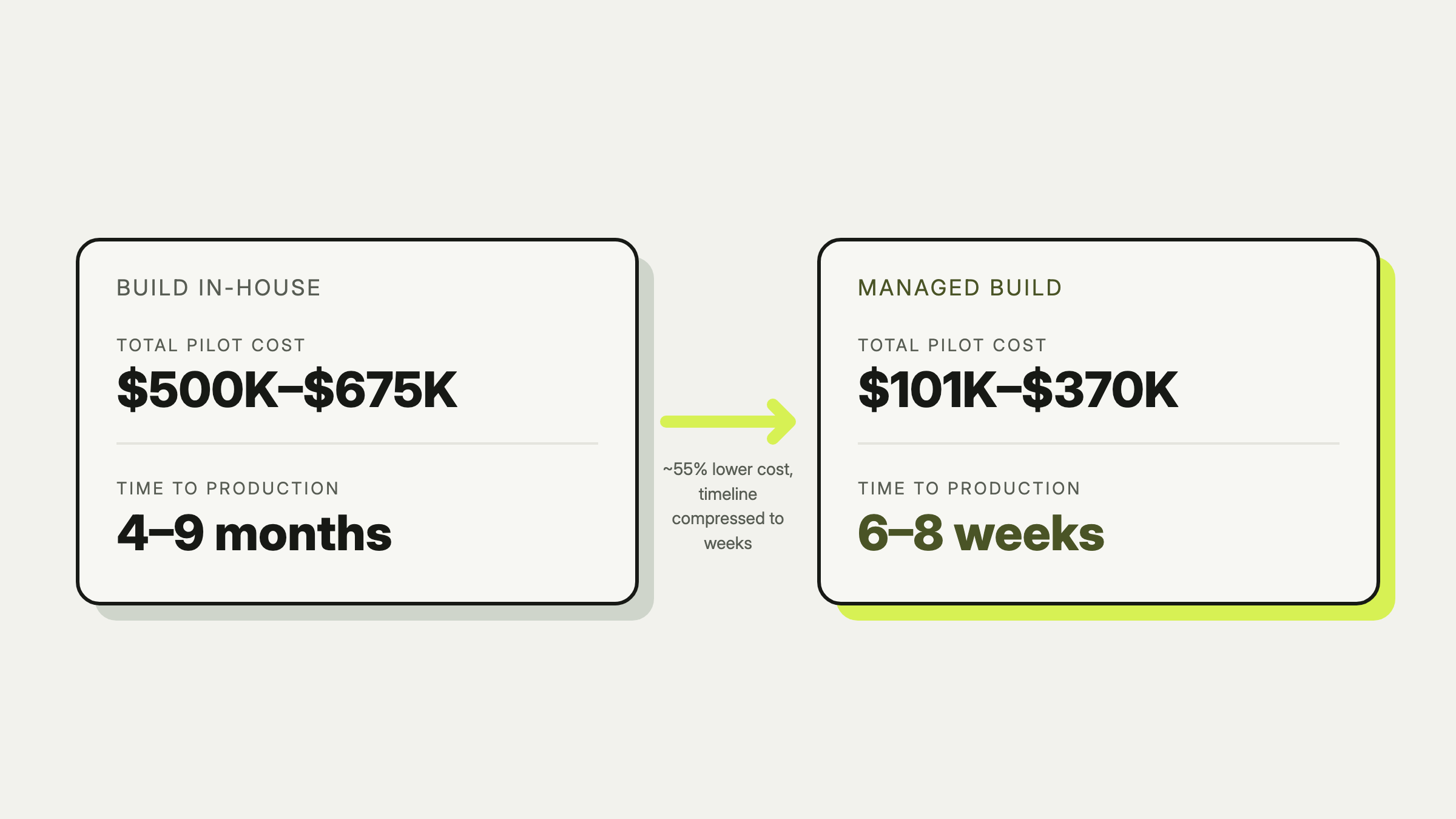
| Timeline to production | 4–9 months | 6–8 weeks |
| Inference (private cloud, Year 1) | $6,000–$24,000 | Customer-owned, no markup |
| Monitoring tooling and MLOps | $15,000–$40,000 | Customer-owned post-handoff |
| Model ownership | Full | Full: artifacts transfer at handoff |
The managed build model compresses the pilot timeline from months to weeks and removes the need to source and coordinate four specialist roles in-house. For a first production deployment, the managed build path consistently reaches production faster and at lower total cost. For organizations deploying multiple use cases at scale, a hybrid co-build model where HXAI works alongside your engineering team with knowledge transfer built in creates internal capability over time.
What a Realistic Healthcare AI Deployment Budget Looks Like
A first production private clinical SLM on a single bounded workflow, PEFT/SFT approach, managed build:
| Item | Low | Mid | High |
|---|---|---|---|
| Pilot engagement (managed build) | $80,000 | $130,000 | $200,000 |
| On-prem inference server (if required) | $30,000 | $65,000 | $120,000 |
| Private cloud inference, Year 1 | $6,000 | $12,000 | $24,000 |
| Monitoring and retraining, Year 1 | $15,000 | $25,000 | $50,000 |
| Total Year 1 (on-prem) | $125,000 | $220,000 | $370,000 |
| Total Year 1 (private cloud) | $101,000 | $167,000 | $274,000 |
What moves the number higher: larger model (13B+), DAPT training approach, poor data quality requiring significant rework, air-gapped deployment with specialized hardware, or multi-system EHR integration requirements.
What brings it lower: PEFT/LoRA on a 3B–7B model, clean labeled training data already available, private cloud deployment on existing cloud infrastructure, and a single well-scoped use case with defined acceptance criteria from day one.
The ROI comparison: HFMA reports physicians average 39 prior authorization requests a week, consuming at least 13 hours of staff time (HFMA, May 2026), a direct, recoverable cost that scales with physician headcount. Automating that workflow alone is one of the fastest, easiest-to-quantify payback cases for a first managed-build engagement.
How SLM in a Box Changes the Cost Equation for Healthcare Organizations
SLM in a Box by HXAI is a managed delivery program covering the full deployment lifecycle at a fixed pilot scope. The delivery team (solution architect, ML engineer, data engineer, MLOps) is included. Data readiness tooling and process templates are included. The NIST AI RMF governance documentation package is included.
The economics work because HXAI has platformized the delivery process across 17 healthcare verticals. What takes a new team four to nine months to build from scratch, we deliver in six to eight weeks because the tooling, templates, and clinical domain experience are already in place.
At handoff, your organization permanently owns:
- Fine-tuned model artifacts
- Custom evaluation harness built for your workflow
- Governance documentation package aligned to NIST AI RMF
- Operational runbooks your team can run independently
No ongoing license. No infrastructure dependency on HXAI after handoff. The model runs on your infrastructure, under your access controls, indefinitely.
If you want a specific cost estimate for your use case, model size, and deployment environment, book a 45-minute pilot discovery call. We scope the pilot in that session and give you a fixed engagement price in that session.
Get a fixed-price cost estimate for your deployment
Send us your target clinical workflow and volume. We'll map compute, people, and data-readiness costs specific to your environment and give you a fixed engagement price, live.
Thanks - we'll be in touch soon
Our team usually responds within one business day.
Conclusion
The cost of a private clinical language model deployment is predictable when you understand the three-bucket structure. Compute is smaller than teams expect. People and data readiness are larger, and data readiness is the one that consistently derails timelines when teams don't resolve it before the build starts. The managed build model compresses both cost and timeline by eliminating the need to source and manage four specialist roles from scratch. At clinical volume, the economics are clear: a 93% reduction in per-document inference cost against a hosted API, a fast and easily-quantified payback on prior auth alone, where HFMA reports physicians already lose 13 hours of staff time a week to the manual process (HFMA, May 2026), and a model your organization owns permanently with no ongoing licensing dependency. To compare managed build providers and understand your options, see 6 Companies That Deploy Private Language Models for Healthcare in 2026. The right starting point for a first deployment is a scoped discovery on a single well-defined clinical workflow. Book a 45-minute call with HXAI and we will scope it, price it, and give you a fixed engagement price in that session.
Frequently asked questions
A first production private clinical SLM using a managed build approach typically costs $80,000-$200,000 for the pilot engagement. Total Year 1 cost including inference infrastructure and monitoring runs $101,000-$274,000 for private cloud deployment and $125,000-$370,000 for on-premise.
People costs are consistently the largest single expense, specifically the specialist labor across four roles required across the full deployment lifecycle. Data readiness is the second-largest and the one that surprises teams the furthest. Compute is the smallest of the three buckets.
At clinical volume, private SLM is dramatically cheaper. A hosted API at $0.15 per document costs $547,500 per year at 10,000 documents daily. A private SLM on reserved cloud infrastructure runs $6,000-$24,000 per year at the same volume, a 96-99% reduction. Above 50,000 queries per month, private deployment reaches cost parity with cloud APIs in three to six months.
Payback timelines vary by workflow and volume. Prior authorization is typically the fastest: HFMA reports physicians already average 13 hours of staff time a week on the manual process, a cost that is immediate and easy to quantify against a fixed pilot fee. For note summarization and medical coding, payback typically runs three to nine months depending on volume and current staffing costs.
Yes, significantly. A 3B parameter model requires less compute and less expensive inference hardware than a 13B model. For bounded clinical workflows including prior auth, coding, and note summarization, a well-tuned 3B model delivers production-quality accuracy. Choosing the right model size for the workflow is one of the highest-impact cost decisions in the deployment.
SLM in a Box engagements are structured as fixed-scope, fixed-price pilot packages. The specific price depends on use case complexity, model size, deployment pattern, and data readiness. We scope and price the pilot in the discovery call. Multi-use-case rollouts are structured as production subscription engagements with volume incentives.
- HFMA. Prior Authorization Is Draining Revenue — Why Automation Has Become a Strategic Imperative. Healthcare Financial Management Association, May 2026.
- HFMA. Health systems start to fight back against AI-powered robots driving denial rates higher. Healthcare Financial Management Association, December 2025.
- Intuz. Top 10 Small Language Models in 2026. 2026.
- PremAI. Self-Hosted LLM Guide: Setup, Tools and Cost Comparison (2026). 2026.
- Petronella Technology Group. Private LLM Deployment: Enterprise Self-Hosted AI (2026). July 2026.
- Taction Software. On-Premise LLMs for Healthcare: Llama 3, Mistral, Phi-3. 2026.
- John Snow Labs. Medical Small Language Models: Benchmarking JSL-MedS vs GPT-4o. 2025.
- NIST. Artificial Intelligence Risk Management Framework (AI RMF 1.0). 2023.
